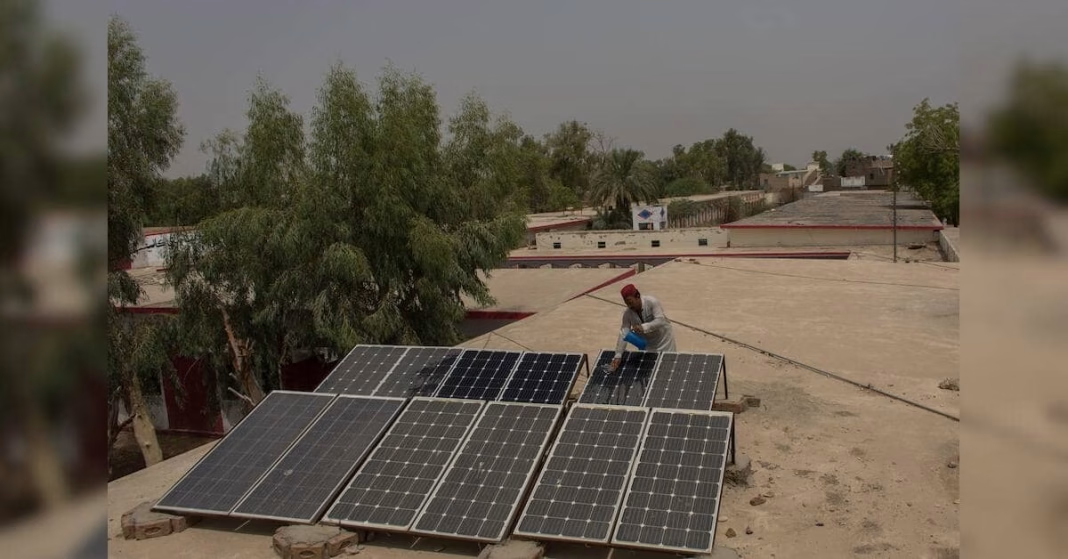

The rapid expansion of rooftop solar installations in Uttar Pradesh, which are nearing the one-million mark, is powering the state’s Micro, Small and Medium Enterprises (MSMEs) sector.
With Uttar Pradesh leading the country in rooftop solar installations, the state’s solar economic value chain is estimated to be worth nearly ₹18,000 crore.
The state has nearly 8,700 vendors and around 100,000 people employed across the solar business ecosystem, which encompasses solar modules, inverters, batteries, mounting structures, electrical equipment, installation, logistics, warehousing, distribution and maintenance.
According to officials, the rooftop solar value chain generates annual business opportunities worth ₹16,000 crore to ₹18,000 crore in the state.
Uttar Pradesh New & Renewable Energy Development Agency (UPNEDA) Director Ravinder Kumar said more than 953,200 rooftop solar plants had been installed in the state as of November 5.
Uttar Pradesh secured the top position with 75,031 installations in October 2026, surpassing Gujarat and Maharashtra in cumulative rooftop solar installations.
This reflects public confidence in solar energy, government policies and the efforts of UPNEDA, UP Power Corporation Limited (UPPCL), electricity distribution companies, banking institutions and solar vendors, Kumar said.
The Centre and the Uttar Pradesh government have together disbursed subsidies worth ₹8,455 crore, including ₹6,255 crore from the Centre and ₹2,200 crore from the Yogi Adityanath government.
The state’s installed rooftop solar capacity of 3,167 megawatts (Mw) is generating 14.2 million units of clean electricity every day.
Assuming an electricity value of ₹6.50 per unit, this translates into an economic value of about ₹9.26 crore per day, or nearly ₹3,380 crore annually.
This reduces dependence on conventional electricity and delivers financial benefits to consumers, apart from environmental gains through clean energy generation.
Since solar power is generated on rooftops, it also eliminates the need to develop solar parks across large tracts of land.
Based on Uttar Pradesh’s installed rooftop solar capacity of 3,167 Mw, an equivalent capacity developed through ground-mounted solar plants would require approximately 12,670 acres of land.
Rooftop installations have thus helped avoid the need for extensive land use, reducing pressure on agricultural land and natural resources.
Besides, clean electricity generated through rooftop solar reduces carbon emissions associated with conventional grid electricity.
The existing installed capacity is estimated to help avoid approximately 3.5 million tonnes of carbon dioxide emissions annually.