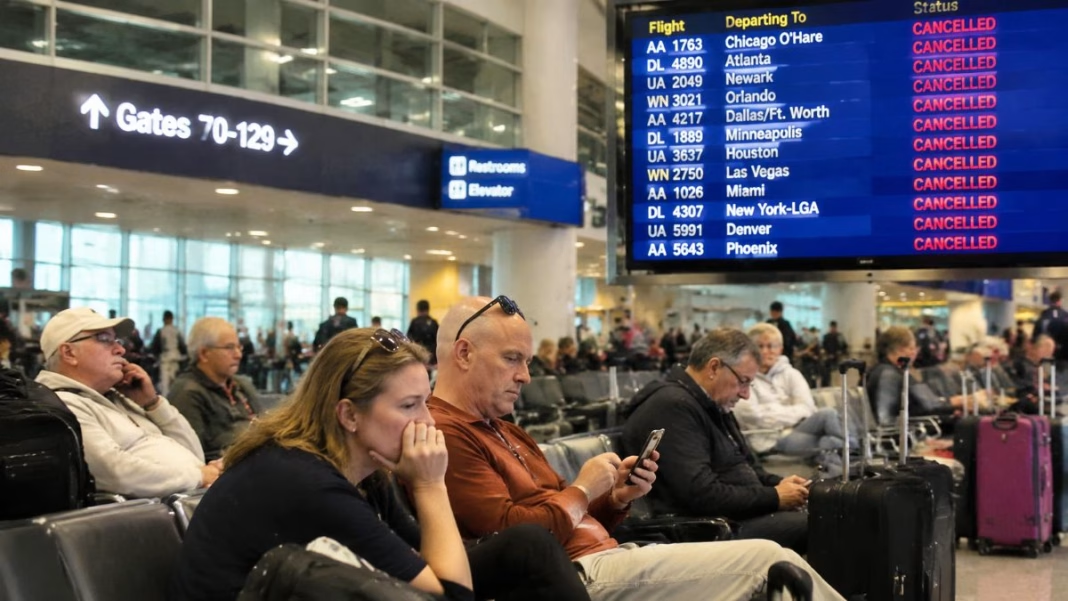


United States air travel disruption entered its third day on Sunday, 15 November 2026, as airlines struggled to restore normal schedules following a nationwide Federal Aviation Administration (FAA) communications failure. More than 5,200 flights were affected on Sunday, including over 1,600 cancellations and nearly 3,600 delays. The crisis has disrupted domestic journeys, international connections and holiday travel plans across the country. Although the FAA restored its air traffic control network on Friday evening, the recovery has proved more complicated than initially expected. Airlines are now working to reposition aircraft, reorganise crews and clear passenger backlogs ahead of the Thanksgiving travel season.
US Air Travel Disruption Enters Third Day as Thousands of Flights Remain Affected
The aviation crisis continued across the United States on Sunday despite the FAA restoring normal air traffic operations following Friday’s emergency ground stop. FlightAware figures reported by Reuters and the Egyptian Gazette indicated that more than 5,200 flights were affected on Sunday, comprising over 1,600 cancellations and approximately 3,600 delays. These figures represented a developing operational snapshot rather than a final total for the entire incident.
Advertisement
Advertisement
Saturday had also brought extensive disruption, with more than 6,400 cancellations and over 8,000 delays reported across the country. The continuing problems demonstrated how a nationwide departure restriction can create operational consequences long after the original technical failure has been isolated. Airlines must restore aircraft rotations, arrange replacement crews and accommodate passengers whose journeys have been interrupted. Consequently, the return of normal air traffic control operations does not automatically restore every airline timetable.
JetBlue, American Airlines and Major US Carriers Face Heavy Cancellation Pressure
Airlines experienced different levels of disruption during Sunday’s recovery. JetBlue recorded the highest reported cancellation proportion, cancelling approximately 27% of its scheduled services. American Airlines followed with around 13%, while Southwest Airlines, United Airlines and Delta Air Lines reported cancellation rates ranging from approximately 3% to 5%.
Advertisement
Advertisement
The differences reflect individual airline operating conditions, aircraft availability and network exposure rather than an identical impact across every carrier. Airlines operating extensive connecting networks face particular difficulties because aircraft delayed at one airport may be scheduled to operate several subsequent services elsewhere. Crew availability and working-hour restrictions can further complicate the recovery. Passengers travelling through major connecting hubs may therefore continue experiencing missed connections and revised departure times even when their original airports are operating normally.
FAA Confirms Technical Instability Across 17 Air Traffic Control Centres
The emergency began at approximately 3.30 pm Eastern Time on Friday, 13 November, when technical instability affected the FAA’s telecommunications infrastructure. The agency introduced a nationwide ground stop as a precaution because inconsistent information was affecting communications and radar feeds used by air traffic controllers. The disruption spread across 17 of the country’s 22 Air Route Traffic Control Centres and subsequently affected several Terminal Radar Approach Control facilities.
Advertisement
Advertisement
The FAA’s 15 November investigation update explained that excessive data activity had reached approximately 1,000 connection attempts every four to five seconds. This created instability across the legacy telecommunications network and affected the reliability of information needed to coordinate aircraft movements. The restriction prevented new departures while controllers continued managing aircraft already airborne. Federal officials confirmed that approximately 3,500 aircraft landed safely and that every passenger reached their destination safely. The agency also clarified that the incident did not involve a complete loss of communications because certain radio frequencies and radar feeds remained operational.
Router Replacement Investigation Exposes Problems With Ageing US Aviation Technology
The technical investigation has focused on maintenance work involving L3Harris, the FAA’s telecommunications network service provider. Officials identified two potential locations associated with abnormal data activity: a radar facility in Amarillo, Texas, and a radio communications facility in El Dorado, Arkansas. The contractor had been replacing ageing infrastructure at the Arkansas facility, including installing a new router, when the network experienced instability.
Advertisement
Advertisement
The FAA and L3Harris are examining the equipment and installation process to establish the precise technical cause. The agency confirmed that the problematic router locations were isolated and that the broadcasting function was disabled on approximately 60 similar routers as a precaution. Officials also stated that they had no indication of a cyberattack or deliberate external interference. The investigation has highlighted the difficulties of maintaining ageing telecommunications systems while introducing modern infrastructure into an aviation network that must operate continuously.
US Government Faces Growing Pressure to Accelerate Air Traffic Control Modernisation
The nationwide disruption has intensified pressure on federal authorities to modernise America’s air traffic control infrastructure. Congress approved approximately $12.5 billion in 2025 for aviation technology improvements, including communications equipment, radar systems and other operational upgrades. However, Transportation Secretary Sean Duffy has argued that the allocation represents only an initial investment and does not cover every requirement for a comprehensive modernisation programme.
In his 15 November briefing, the Department of Transportation explained that the existing funding had been allocated to specific projects, including replacing telecommunications lines, upgrading radio systems and installing electronic flight technology. Duffy also highlighted the need for additional investment in network architecture and software used to manage aircraft movements. The department reported that routers connected with the incident were undergoing technical diagnostics with engineers at L3Harris facilities. Further funding decisions remain subject to federal budget and congressional processes.
New York, Chicago, Los Angeles and Other Major Airports Face Recovery Challenges
The disruption has affected the wider American aviation network because major airports depend on coordinated aircraft movements and connecting services. New York, Chicago, Los Angeles, Dallas, Atlanta, Miami and Washington are important domestic and international gateways, making operational recovery particularly challenging when aircraft and crews are displaced.
Advertisement
Advertisement
Airlines must restore aircraft rotations, arrange replacement crews and accommodate passengers whose original flights were cancelled. International services may also experience knock-on effects when aircraft arriving from Europe, Asia or the Pacific are unavailable for subsequent departures. The FAA lifted the nationwide ground stop on Friday evening, but its 15 November update acknowledged that recovery would be gradual. The agency urged passengers to remain patient while airlines worked through disrupted schedules and restored their services.
International Travellers Face Missed Connections and Thanksgiving Booking Uncertainty
The crisis extends beyond domestic passengers because the United States serves as a major connecting hub for international aviation. Travellers flying between Europe and the Americas, or between Asia and North America, frequently rely on American airports for onward connections. Passengers arriving at New York, Los Angeles, Chicago or Miami may miss domestic services even when their original international flights operate successfully.
The disruption can also affect hotel reservations, airport transfers, cruise departures and pre-booked sightseeing activities. Canadian, British and Caribbean travellers should pay particular attention to connecting itineraries because numerous international routes depend on American aircraft movements and airport operations. The timing is especially important as the United States approaches Thanksgiving, when domestic passenger demand traditionally increases. If recovery takes longer than expected, airlines could face additional pressure from higher seasonal demand and limited spare capacity.
US Department of Transportation Refund Rules Protect Eligible Passengers
Passengers affected by cancellations and significant schedule changes may qualify for refunds under US Department of Transportation regulations. Travellers are generally entitled to a refund when an airline cancels a flight and they decide not to accept alternative transportation, travel credits or other compensation. Refund eligibility also applies to certain significant schedule changes when passengers decline the revised journey.
Federal rules generally recognise an arrival delay of at least three hours for domestic itineraries or six hours for international itineraries as a significant change. Eligible refunds must be issued automatically using the original payment method. The Department of Transportation specifies a deadline of seven business days for credit card purchases and 20 calendar days for other payment methods. Passengers should retain airline notifications, booking confirmations and receipts for additional expenses while reviewing the conditions of their travel insurance.
US Aviation Recovery Highlights the Urgent Need for Reliable Air Traffic Control Systems
The third day of disruption has demonstrated how a technical problem within an air traffic control network can create consequences far beyond the original incident. Although the FAA restored its telecommunications network and resumed departures on Friday evening, airlines continued dealing with thousands of disrupted services throughout the weekend. The investigation into the router failure will be important in determining whether equipment replacement procedures, contractor oversight or outdated technology contributed to the incident.
Advertisement
Advertisement
For the aviation industry, the challenge extends beyond resolving one technical failure. Authorities must strengthen network resilience, improve backup arrangements and ensure that future maintenance activities do not compromise critical operations. The outcome could influence infrastructure investment and operational safeguards for years. For travellers, the immediate priority remains monitoring airline updates and allowing flexibility while carriers restore schedules and clear outstanding passenger backlogs.
Conclusion: United States Travel Recovery Faces a Crucial Test After FAA Outage
The United States’ third consecutive day of aviation disruption has exposed the far-reaching consequences of a failure within critical air traffic control infrastructure. More than 5,200 flights were affected on Sunday, adding to thousands of cancellations and delays recorded over the weekend. Although the FAA has stabilised its network, airlines still face the demanding task of restoring aircraft, crews and passenger itineraries. The expected recovery offers hope, but the investigation has renewed serious questions about ageing technology and infrastructure investment. For travellers, reliable flight information and flexible arrangements remain essential as American aviation works towards a more stable operation.