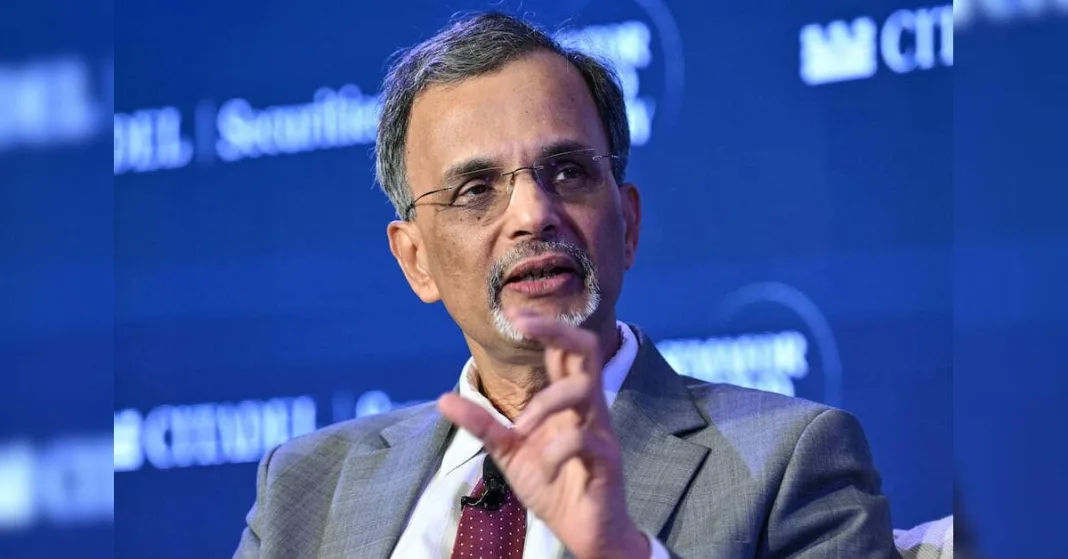

Monetary policy tools such as interest rate adjustments will become relatively less effective across the world in tackling inflation as supply shocks take over the global economy, Chief Economic Adviser (CEA) V Anantha Nageswaran said on Friday, adding that fiscal and other public policy measures need to do the heavy lifting.
“Raising interest rates will not solve the supply-induced problems. If anything, it may even be counterproductive,” he said, pointing to a world of supply-induced inflation.
Speaking at the 9th Annual Food Systems Dialogue, Nageswaran said that in such a supply-constrained world, inflation targeting will remain a framework, but countries will “take creative liberties with it” — and may abandon it if it becomes a real constraint.
Nageswaran’s comments come a day after India’s retail inflation breached the Reserve Bank of India’s tolerance limit of 6 per cent in October for the first time in two years. The RBI’s Monetary Policy Committee is widely expected to raise interest rates by another 25 basis points at its December 2-4 meeting.
Economists agreed that rate hikes alone cannot fix supply shocks.
Madan Sabnavis, chief economist at Bank of Baroda, said higher rates cannot raise the supply of food or bring down the price of oil. But he added that when crude oil is the problem, no policy at all can bring prices down.
“If crude oil is creating problems, no policy can bring down prices. None, including public policy, unless the government is taking a heavy subsidy,” Sabnavis said, adding that the government’s fiscal constraints rule this out.
However, Madhavankutty G, chief economist at Canara Bank, said monetary policy remains relevant as it anchors expectations, while agreeing that supply-side factors play an outsized role at present. “Monetary policy is largely ineffective in controlling supply side inflation like the crude price surge due to geo politics. But demand-pull inflation, seen in rising costs of health, personal care and education, and in money supply growing 12–13 per cent a year, cannot be ignored,” he added.
The pandemic, Nageswaran said, has ended an era, and the world is moving from globalisation and integration to segmentation and fragmentation. “Supply shocks will dominate the world in the next 25–30 years,” the CEA said.
The CEA added that while demand will be growing slowly, supply shocks will occur throughout the world — mostly by design — as countries weaponise supply chains and choke points.
Urging a reimagining of development, Nageswaran called for a comeback of agriculture as an engine of growth. “In the post-COVID world, agriculture has to come back as a driver of growth,” he said.
Nageswaran said the familiar ladder from farms to factories to services is under strain. While manufacturing faces the China challenge, with China treating manufacturing as a strategic goal and bringing the entire power of the state to bear on it, services face AI, which threatens the entry-level jobs that form the first step of a career, and immigration curbs abroad.
Agriculture, by contrast, is “mostly in your control”, he said. The CEA added that this was not a case against manufacturing and that all three must be pursued together.
Also speaking at the dialogue, Saurabh Garg, secretary, Ministry of Statistics and Programme Implementation (MoSPI), said that reliable data is the foundation of resilient, inclusive and sustainable food systems, and the focus must shift from measuring farm output alone to understanding the entire food system — from farm-level productivity and farmers’ livelihoods to consumption, nutrition, prices, employment and environmental sustainability.
India’s agricultural data ecosystem is rich and expanding, Garg said, but the next step is to make it usable, moving from data availability to data intelligence. That means machine-readable, interoperable, AI-ready data built on common standards, which would enable AI-enabled analysis, stronger research and better policy targeting.