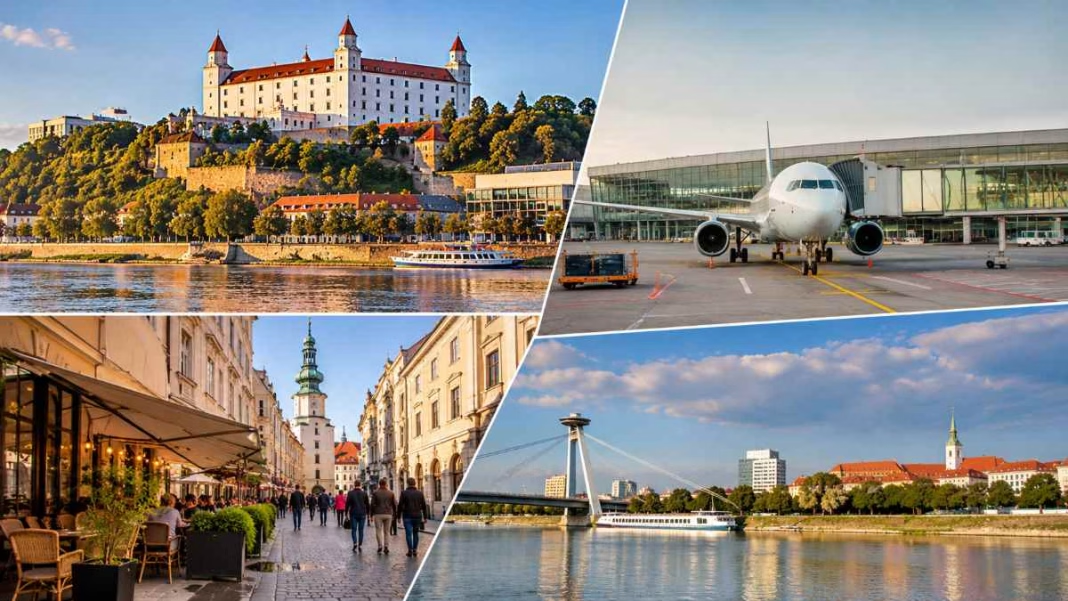


Slovakia is gaining greater prominence as a Central European destination, with Bratislava emerging as a key player within the country’s international tourism and business travel markets. Capitalising on the city’s historic buildings, cultural sites, along the river and with increasing access through aviation services, visitors have access to the broader region. Rising through recent developments at M. R. Štefánik Airport and Slovakia’s established conference infrastructure, Bratislava is becoming a target destination for the international leisure traveller and corporate visitor. As per the published annual statistics by the airport, Bratislava serviced 2,438,215 passengers in 2025 – 25% up in comparison with 2024, which remains the airport’s highest annual passenger count.
Bratislava Airport Records Strong Passenger Growth
M. R. Štefánik Airport is Slovakia’s principal international aviation gateway and an important entry point for visitors exploring the capital and surrounding regions.
Advertisement
Advertisement
The airport recorded 29,002 aircraft movements during 2025, while air cargo volumes reached 18,929 tonnes, representing an increase of approximately 70% compared with the previous year.
Airline network expansion contributed to the passenger growth, with additional scheduled routes introduced during 2025. The airport’s 2026 network development has included further destinations operated by airlines such as Wizz Air.
For international visitors, Bratislava Airport provides access to the city centre through taxis, public transport and private transfers. Its location also makes it convenient for travellers visiting nearby destinations in western Slovakia, Austria and Hungary.
Although autonomous ground-handling technology is becoming increasingly relevant to airport operations, no independently verified announcement confirms the claimed full activation of a new autonomous logistics module at Bratislava Airport.
Advertisement
Advertisement
Bratislava Develops Its Business and MICE Tourism Sector
Meetings, incentives, conferences and exhibitions (MICE) form an established part of Bratislava’s tourism offering.
The Bratislava Convention Bureau, operated by the Bratislava Tourist Board, supports conference organisers and business-event planners through venue information, professional contacts, accommodation recommendations and event-planning assistance.
Advertisement
Advertisement
The city’s compact historic centre, international transport connections and hotel infrastructure provide a suitable setting for corporate gatherings and professional meetings.
Venues across the capital include convention hotels, exhibition spaces, historic buildings and modern conference facilities.
Bratislava’s location along the Danube also allows organisers to incorporate riverfront dining, cultural visits and guided city experiences into business itineraries.
The reported 59% increase in corporate event spending per delegate has not been independently established through published industry statistics. It should therefore not be treated as a confirmed measure of Bratislava’s MICE performance.
Advertisement
Advertisement
Hotel Accommodation and Cultural Experiences
Bratislava offers accommodation across several categories, including international hotel brands, boutique properties, business hotels and independent establishments.
The historic centre is particularly popular with visitors interested in architecture, restaurants, shopping and cultural attractions. Hotels around the business districts and transport hubs also cater to conference delegates and corporate travellers.
According to Slovakia’s Statistical Office, accommodation providers across the country generated approximately €709 million in turnover during 2025, excluding VAT. This represented a 15.7% year-on-year increase.
Bratislava Region was among the country’s leading accommodation markets, reflecting the capital’s importance to international tourism.
However, the specific claim of a 5.8% increase in premium hotel room revenue linked to autumn automotive and logistics exhibitions could not be independently verified.
Digital Nomad Travel and Slovakia’s Residence Framework
Slovakia has established temporary residence arrangements for foreign nationals intending to work, conduct business, study or undertake other qualifying activities.
Advertisement
Advertisement
The country’s immigration framework includes residence categories for employment, business, research and development, and other specific purposes.
However, Slovakia does not currently have a separately established digital nomad visa category with an officially confirmed universal 24-hour approval system.
International remote workers must determine which existing residence category applies to their circumstances and whether their employment arrangements meet the relevant legal requirements.
Applications generally require supporting documentation and are assessed by the competent immigration authorities. Processing periods depend on the application category and individual circumstances.
For visitors considering longer stays in Bratislava, checking the latest requirements through Slovakia’s immigration authorities before travelling remains important.
Electronic Document Management for Business Travellers
Digital document management is increasingly relevant to international business travel, particularly for companies managing accommodation, transport and conference expenditure.
Advertisement
Advertisement
Slovakia already permits accounting documentation and invoices to be stored electronically, provided applicable legal requirements are satisfied.
The Slovak Financial Administration specifies that electronic invoices must maintain authenticity of origin, integrity of content and readability throughout the required retention period.
Businesses can use appropriate electronic systems to manage their records, provided these systems meet the applicable accounting and tax requirements.
However, no verified announcement confirms a newly introduced corporate travel receipt archiving mandate or a separate nationwide electronic travel-expense application launched specifically for corporate commuters.
Exploring Bratislava Beyond Business Travel
Bratislava offers visitors a range of cultural and recreational attractions within a relatively compact urban area.
Bratislava Castle overlooks the Danube and provides views across the city and neighbouring countries. Its historic centre features St Martin’s Cathedral, Michael’s Gate, traditional squares and pedestrian streets.
Advertisement
Advertisement
The Blue Church is another recognised architectural attraction, while the Slovak National Gallery and Slovak National Museum offer opportunities to explore the country’s artistic and historical heritage.
Visitors can also explore the Danube waterfront, enjoy river cruises or take excursions to Devín Castle, situated at the confluence of the Danube and Morava rivers.
The city’s restaurants and cafés provide opportunities to experience Slovak cuisine, including traditional dishes and regional specialities.
Conclusion
Slovak tourism still relies on increasing airport connectivity, conference capabilities and a varied hotel infrastructure. Bratislava, the country’s capital, registered the best-ever passenger numbers in 2025, demonstrating Bratislava’s rising importance as a gateway to the world. Its attractions, Danube location and business scene present visitors with additional motivation to see the capital city, as in addition to sightseeing opportunities, it offers international tourists attractions and professional events, as well as excellent links to other places in neighbouring Central Europe.