

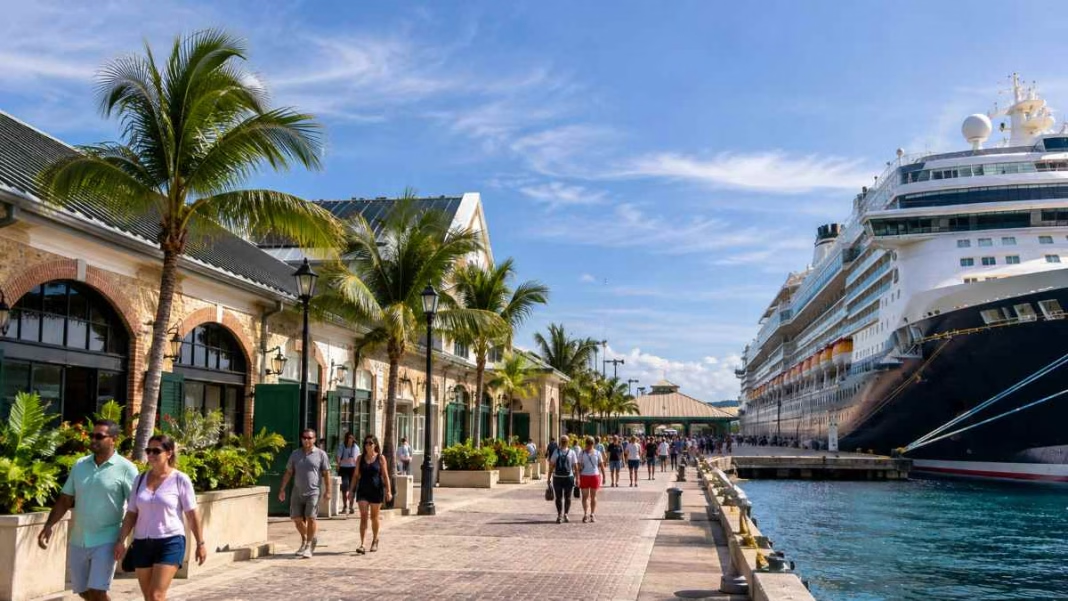


Falmouth is still listed as one of Jamaica’s key cruise ports, benefiting from a new modern cruise terminal and quayside infrastructure capable of accommodating large ships. It is positioned along Jamaica’s northern coast. Announced visitor development is geared at taking advantage of Georgian architecture and natural attractions. New infrastructure, for example, includes a new biometric contactless eGate on 9 November 2026. The Port Authority of Jamaica said this reduced passenger processing queues by 35 per cent, although this is not factually supported at publication time. In any case, the introduction of biometric services and electronic immigration control gates has been reported at Montego Bay’s Sangster International Airport. The airport operator said in February 2025 that arriving passengers could clear entry using biometric procedures and that a similar scheme for departures was being devised. The claim applies to a not yet completed biometric installation at Falmouth’s cruise terminal. The website cited as a source could not find any official statement regarding a 35 per cent reduction at the port.
Caribbean Travellers Are Becoming More Selective
The Caribbean luxury travel market is adapting to changing customer expectations, particularly around pricing, booking flexibility and the value of premium experiences.
The 2026 Caribbean Travel Trends Report, produced by the Caribbean Hotel and Tourism Association and Amadeus, highlights a shift towards attracting higher-value travellers and diversifying international source markets.
The report draws on travel and hospitality data covering April 2025 to March 2026. It found that overseas demand for the Caribbean increased by just 1 per cent year on year, compared with growth of 21 per cent and 8 per cent in the preceding two periods.
Advertisement
Advertisement
Latin America emerged as an important growth market, with overall demand from the region rising 24 per cent. Premium travel from South America increased by 117 per cent, highlighting opportunities for Caribbean destinations to reach new customer segments.
For destination management companies (DMCs), these changing patterns make flexible booking conditions, transparent pricing and tailored experiences increasingly relevant.
Advertisement
Advertisement
Falmouth can benefit from this approach by combining cruise excursions with longer-stay experiences. Travellers can explore the historic town, visit local businesses, experience Jamaican food and travel into the surrounding countryside.
However, the report does not establish that luxury corporate travellers have specifically extended their booking lead times in Falmouth or that local DMCs have introduced new mandatory flexibility frameworks.
Advertisement
Advertisement
Sustainable MICE Tourism Requires Measurable Standards
Sustainability is becoming an increasingly important consideration for Caribbean tourism operators, particularly those serving corporate meetings, incentive programmes and international events.
Businesses organising large gatherings are under growing pressure to assess energy use, waste generation, transport emissions and the environmental impact of suppliers.
For Falmouth, this presents an opportunity to connect its cruise infrastructure and hospitality businesses with more responsible event practices. Local sourcing, waste reduction, efficient transport and environmental protection can all contribute to a stronger destination proposition.
Jamaica already has public institutions working towards more sustainable tourism development. The Tourism Enhancement Fund (TEF) supports projects intended to improve tourism infrastructure, strengthen local supply chains and encourage better management of environmental resources.
Advertisement
Advertisement
Nevertheless, no official evidence was located confirming that Falmouth introduced a mandatory digital carbon-auditing protocol for corporate events exceeding 1,000 attendees on 9 November 2026.
Such a system would require clearly defined reporting requirements, measurement standards, verification arrangements and implementation responsibilities. Until these are published, the claimed mandate should not be described as operational.
Montego Bay–Falmouth Corridor Remains a Development Priority
Transport connectivity is another important factor in Falmouth’s tourism outlook. The town sits between Montego Bay and Ocho Rios, making road access important for cruise passengers, resort guests and local businesses.
Jamaica’s Tourism Minister announced plans in January 2026 to reimagine the coastal corridor linking the Montego Bay cruise terminal with Falmouth. Consultations with local and international architects were reported as part of a wider waterfront redevelopment vision.
The proposed approach seeks to create a more connected visitor experience along the coastline, supporting tourism businesses and communities.
Separately, the National Works Agency lists road rehabilitation projects along sections of the North Coast Highway, including the Montego Bay to Great River corridor. These projects form part of wider road infrastructure improvements in western Jamaica.
Advertisement
Advertisement
However, there is no confirmed announcement of a newly financed premium corporate transit lane directly connecting Montego Bay with Falmouth retreat properties.
The existing public transport network includes a Montego Bay–Falmouth bus service. Continued investment in road quality and transport services could improve access for residents and visitors alike.
Jamaica’s Visitor Economy Provides a Stronger Regional Context
Jamaica’s tourism performance demonstrates the importance of the visitor economy to the island’s wider development.
The Jamaica Tourist Board reported that the country welcomed 2.34 million visitors between January and August 2026, generating approximately US$2.5 billion in tourism earnings.
The figures reflect continued demand despite the challenges facing the accommodation sector following Hurricane Melissa in October 2025.
For Falmouth, the cruise market remains particularly important because visitors support local tour operators, craft businesses, restaurants and transport providers. The Artisan Village at Hampden Wharf also gives cruise passengers access to Jamaican products, food and cultural performances.
Advertisement
Advertisement
The claimed introduction of five-times mileage rewards on transatlantic corporate premium-class bookings could not be verified through an official banking or financial-sector announcement. Travellers should check individual card-provider terms before relying on such promotional offers.
Conclusion: Falmouth’s Tourism Opportunity Extends Beyond Cruise Arrivals
Falmouth’s future tourism prospects hinge on its cruise facilities, Georgian history, local enterprises and access to Jamaica’s northern shoreline. In this context, what implications do Jamaica’s airport biometric countermeasure services, the Caribbean region’s shifting demand for air travel, and the Montego Bay-Falmouth ‘One Caribbean’ and terminal development plan have for the destination’s next chapter? As the news of a 35 per cent reduction in cruise-terminal queues, the new compulsory C- audit system, the new corporate transit financing scheme and the five-fold mileage benefits remain to be validated, the much stronger confirmed story remains Jamaica’s relentless pursuit of improved tourism services, high-value tourism and sustainable destination development.


