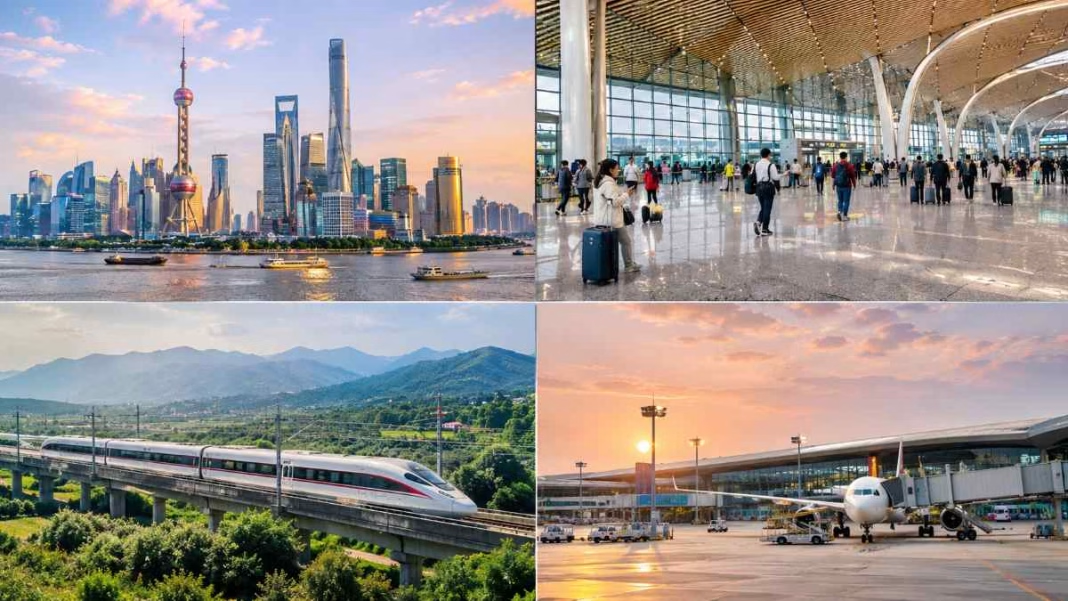


China continues to increase its the options available for international travel through visa-free access schemes and improved immigration procedures, all factors which should be weighed by overseas tourists, business travellers and visitors taking multi-destination journeys around China. The country’s National Immigration Administration states that for a single-trip visit, unilateral visa-free entry schemes are in place with 50 nations, with individuals holding ordinary passports being permitted to visit for tourism, business, family visits, exchanges and transit for up to 30 days. This policy is valid until the end of 2026 for the nations covered by the arrangement, which are subject to individual restrictions. Check whether a nationality is eligible before the trip, as these exemptions are not universal. Also, China has a 240-hour visa-free transit scheme which is open to potential visitors from 57 nations travelling through 65 designated ports of entry, allowing eligible visitors to sightsee in locations eligible as part of their international transit, under the set terms and conditions. These benefits allow for more international travel itineraries to include Chinese holiday experiences.
Shanghai Introduces Wi-Fi 7 at a Major International Exhibition Venue
Shanghai has strengthened its digital visitor infrastructure through a venue-wide Wi-Fi 7 upgrade at the National Exhibition and Convention Centre (NECC) in Hongqiao International Central Business District.
Advertisement
Advertisement
Completed on October 22, 2026, the upgrade provides wireless connectivity across exhibition halls, entrance lobbies, conference areas and public spaces.
The system is designed to support nearly 100,000 simultaneous users, providing faster connectivity, reduced latency and more reliable access to online services.
The development is particularly relevant to international visitors attending exhibitions, conferences and business events. Improved connectivity can support digital registration, navigation, online information access and communication throughout large exhibition facilities.
The venue also hosts the annual China International Import Expo (CIIE), making its upgraded infrastructure relevant to international business tourism.
Advertisement
Advertisement
However, the Wi-Fi 7 development applies to the exhibition and convention centre. There is no verified evidence that China has activated continuous Wi-Fi 7 corporate workspace facilities across its premium bullet train networks as claimed.
Beijing Daxing Airport Advances Autonomous Baggage Operations
China is also introducing intelligent systems into airport operations, with Beijing Daxing International Airport developing automated baggage-handling capabilities.
In January 2026, the airport’s baggage intelligent handling project entered its trial-operation phase. The pilot system was installed in the terminal’s baggage sorting area and designed to automate the loading of baggage into transport vehicles.
The technology combines radio-frequency identification (RFID), artificial intelligence and robotic handling equipment to identify luggage and organise its placement.
The system can recognise baggage characteristics and vehicle storage conditions before determining suitable loading arrangements. Its application is intended to improve operational efficiency, optimise available space and reduce the possibility of baggage damage.
In September 2026, Daxing Airport also introduced 19 proposed robotic application scenarios covering airport safety, terminal services, infrastructure management and baggage assistance.
Advertisement
Advertisement
These developments are part of China’s wider smart-airport expansion, although they should not be confused with a confirmed full-scale autonomous baggage network at Beijing Capital International Airport (PEK).
For international tourists, improvements in baggage handling and terminal services could contribute to smoother airport experiences as these technologies progress towards wider operational deployment.
Beijing Hosts Caspian Week Forum and International Business Delegations
Beijing also featured in the international business-events calendar through the Caspian Week Forum Beijing, held on November 3, 2026, with business-to-business meetings scheduled for November 4.
The programme covered energy, critical minerals, transport and logistics, bringing together representatives connected with the wider Caspian region.
The event demonstrates Beijing’s role as a destination for international business meetings and professional exchanges. Such gatherings can contribute to demand for accommodation, conference facilities, local transportation and hospitality services.
However, the event was identified as Caspian Week Forum Beijing, not a newly finalised Caspian Energy Forum venue project. Its November programme had already taken place by November 9.
China’s Travel Infrastructure Supports Multiple Tourism Segments
The China update also points to a range of other aspects of international tourism which may be of interest or importance, such as ease of access for immigrants; the country’s worldwide web of digital links; airport automation; and commercial and business-events facilities. For leisure travellers, visa exemptions will make certain trips easy and will also enable more complex multi-destination journeys. Updated connectivity to Shanghai’s exhibition centres means greater capacity for international business visitors, and signs of automation at Beijing Daxing International Airport point to a variety of innovations in baggage and terminal handling. All these facets of the new infrastructure offer an insight into China as a destination for international tourists, corporate visitors and individuals.