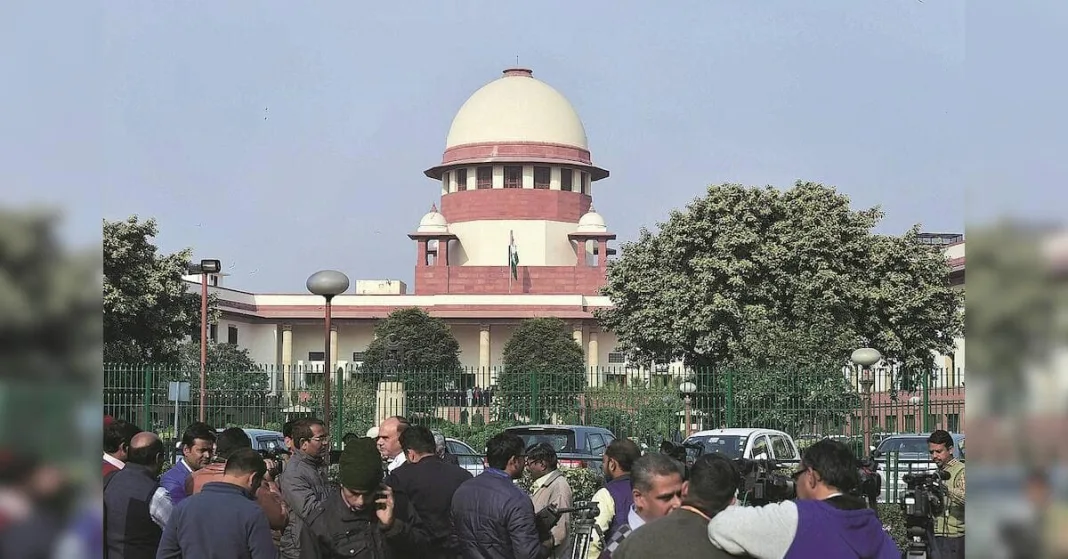

The Supreme Court on Monday warned the Centre that “nobody will trust” it if it continued to frustrate the enforcement of arbitral awards, dismissing the government’s challenge to the enforcement of two awards in favour of Vedanta Limited and Ravva Oil (Singapore) Pte Limited. The dispute has now dragged on for more than two decades.
A Bench of Justice J B Pardiwala and Justice Manmohan took exception to the Centre’s decision to continue contesting enforcement after years of litigation, asking why it would not allow the companies to realise the amounts awarded to them. “What are these arguments? You are frustrating an arbitral award like this? At the stage of enforcement of it?” the Bench asked.
The judges also questioned the government’s position on arbitration, underscoring the contradiction between its resistance to enforcement and its efforts to promote India as an arbitration-friendly jurisdiction.
“And we talk about all of this arbitration and seat, and this and that,” the court observed, before adding: “Nobody will trust you.”
The dispute originates in a production sharing contract signed in October 1994 between the Centre and a consortium of companies to develop the Ravva oil and gas field in the Krishna-Godavari basin. What began as a disagreement over contractual payments evolved into arbitration proceedings in Malaysia, challenges before foreign courts and prolonged
enforcement litigation in India.
The first partial arbitral award was delivered in October 2004, followed by a final award in October 2016. The arbitral tribunal held that that no further amounts were due from the companies under the ONGC carry dispute, rejecting the Centre’s demand for $99 million.
The Delhi High Court rejected the Centre’s challenge to enforcement on July 1, 2026, prompting its appeal to the Supreme Court. The apex court found no grounds to interfere with the High Court’s decision.
“We are of the view that no error, not to speak of any error of law, could be said to have been committed by the High Court in passing the impugned judgment and order,” the Bench said, while dismissing the appeal.
The dispute has now spanned 32 years since the original contract was signed and approximately 22 years since arbitration was formally invoked on August 16, 2004. The first award itself is more than 22 years old, while the final award was delivered a decade ago.
How the dispute unfolded
The consortium entered into a production sharing contract with the Centre on October 28, 1994, for developing the Ravva oil and gas field. Differences subsequently arose over the interpretation of contractual provisions governing the calculation of the government’s share of profit petroleum, including the treatment of payments made towards ONGC’s carry obligations.
The dispute was referred to arbitration in Kuala Lumpur in August 2004. On October 12 that year, the tribunal delivered a partial award, deciding certain contractual issues while leaving the quantification of amounts payable to a later stage.
The Centre challenged the award before Malaysian courts. The Malaysian High Court set it aside on January 12, 2009, but the Court of Appeal restored it on September 15 that year. The Malaysian Federal Court upheld the award on October 11, 2011.
Nearly three years later, on July 10, 2014, the Centre issued a showcause notice seeking to recover approximately $99 million from the companies — $64 million from Vedanta’s predecessor, Cairn Energy India, and $35 million from Ravva Oil. It claimed the amounts were due under the production sharing contract.
The companies subsequently returned to arbitration to resolve the outstanding question of quantification. A reconstituted tribunal delivered the final award on October 26, 2016, ruling in their favour. The award was subsequently upheld by Malaysian courts, including the Malaysian Federal Court on February 28, 2019.
The Centre then resisted enforcement in India, raising objections relating to limitation, public policy and the tribunal’s jurisdiction. Among other arguments, it contended that the tribunal had become functus officio — having exhausted its authority — after delivering the partial award in 2004.
On July 1, 2026, Delhi High Court Justice Jasmeet Singh rejected the objections. The High Court held that the enforcement proceedings were within the limitation period and that the tribunal retained jurisdiction to determine the amounts payable. It also directed that bank guarantees furnished in connection with the dispute be released within eight weeks.
Government’s arbitration record under scrutiny
The Supreme Court’s remarks come amid growing scrutiny of the government’s role in arbitration-related litigation. The government has itself acknowledged the extent of litigation following arbitration proceedings. In a written reply to the Lok Sabha on July 22, 2024, the Ministry of Finance said a sample study of the National Highways Authority of India (NHAI) and NTPC found that more than 60 per cent of arbitral awards were challenged in courts.
The ministry said its guidelines on arbitration and mediation in domestic public procurement contracts reflected its “unsatisfactory experience” with arbitration in high-value contracts involving the government, government entities and public sector enterprises.
It also clarified that it did not maintain comprehensive data on arbitration and litigation expenditure in the form sought in the parliamentary question, while acknowledging that the government incurred costs on both arbitration and subsequent litigation.
A separate study published in Arbitration International in June 2026 examined 2,020 petitions challenging arbitral awards under Section 34 of the Arbitration and Conciliation Act, 1996, filed before the Delhi High Court between 2021 and 2024. Government entities featured in 1,258 cases, accounting for 62.28 per cent of the dataset.
The study found that government entities were petitioners challenging awards in 825 cases, or 40.84 per cent of the total. By comparison, they defended awards as respondents in 412 cases, or 20.39 per cent.
Government entities therefore challenged awards approximately twice as often as they defended them in the dataset. Indian Railways and its subsidiaries accounted for 178 cases, followed by NHAI with 116.
The study does not cover execution proceedings or establish that government entities account for a corresponding proportion of enforcement delays. It nevertheless illustrates the extent of government participation in litigation challenging arbitral awards.
The findings come as the Centre seeks to position India as a global arbitration hub.
In June 2025, Union Minister of State (Independent Charge) for Law and Justice Arjun Ram Meghwal told the National Conference on Institutional Arbitration organised by the Department of Legal Affairs that “India will become the arbitration hub”.
Organised in collaboration with the India International Arbitration Centre (IIAC) and ONGC, the conference sought to promote institutional arbitration as the preferred mechanism for commercial dispute resolution, particularly among public sector enterprises.
In a Lok Sabha reply in February 2026, the Law Ministry said the government had undertaken legislative amendments in 2015, 2019 and 2020 to facilitate timely arbitration, minimise judicial intervention and ensure faster enforcement of arbitral awards.
It also acknowledged, however, that the Arbitration Council of India, envisaged under the 2019 amendments, had yet to be constituted.
SC flags persistent enforcement delays
The Supreme Court has repeatedly highlighted the difficulties parties face in securing the benefits of arbitral awards, even after successfully navigating arbitration and subsequent court challenges.
On May 29, in Madhya Pradesh Road Development Corporation Limited versus Jabalpur Corridor Private Limited, Justice J K Maheshwari and Justice Atul S Chandurkar observed that both the government and the courts had contributed to undermining arbitration in India.
“Arbitration in India has not failed; however, courts sometimes have failed arbitration in India. Even the government’s role cannot be ignored,” the court said, warning that excessive judicial intervention could undermine India’s credibility and its ease of doing business. It also stressed that judges must recognise the importance of certainty, uniformity and finality.
More recently, on October 28, a Bench of Justice Vikram Nath, Justice Sandeep Mehta and Justice Aparesh Kumar Singh highlighted the problem of award-holders being forced into prolonged execution proceedings in Royal Construction Company Private Limited versus National Projects Construction Corporation.
The dispute involved an international arbitral award dated August 10, 2002, with enforcement litigation continuing more than 24 years later. “The promise of arbitration remains unfulfilled if a party, having traversed the arbitral process, is compelled to embark upon another protracted course of litigation to secure the benefit of the award,” the court observed.
It asked the Law Commission to examine the framework governing enforcement and execution of arbitral awards and recommend measures to ensure timely recovery.