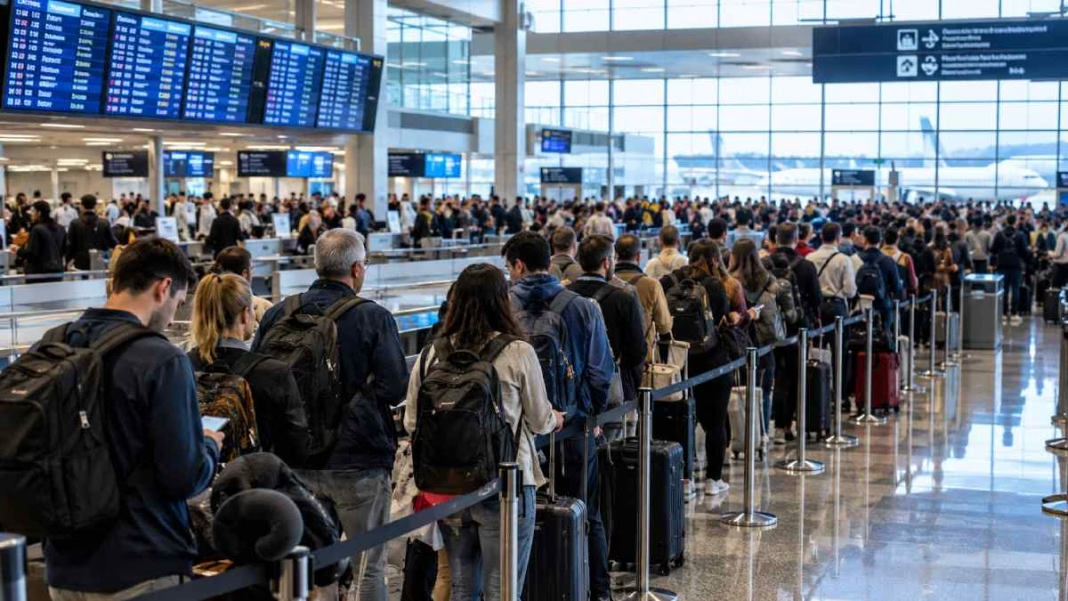


A unique challenge of operations has been laid out for the international commercial aviation industry due to the implementation of a wide-ranging public health mandate by U.S. federal authorities. Through the imposition of the condition that international arrivals are contingent on the confirmation of foreign gateway entry, border obligations have essentially been shifted from the sovereign to the private commercial airline. There have been numerous issues arising from friction, delay, and regulatory conflict for international air carrier operations, global booking systems, and transit routes. This brief explores the legal framework, digital challenges, operational constraints, mobility exposures, and macroeconomic impacts resulting from unilateral biosecurity mandates in the global digital environment.
Epidemiological Origins and the Controlled Free Pratique Mandate
The global civil aviation network is operated on interconnected logistical precision, where international hub operations can be disrupted by a procedural intervention introduced by a single sovereign state. In late October 2026, an emergency order mandating a universal passenger disclosure and attestation for all flights entering or transiting the United States was issued by the U.S. Centers for Disease Control and Prevention (CDC), operating under the Department of Health and Human Services (HHS). Rooted in historic statutory quarantine powers, international air carriers are required by this blanket directive to confirm that an official declaration has been executed by every individual boarding an aircraft bound for a U.S. destination, confirming that physical presence in the Democratic Republic of the Congo (DRC) has not occurred during the preceding 21 days.
Rather than these measures being enforced through standard port-of-entry primary inspections upon domestic arrival, the legal grant of “controlled free pratique” has been conditioned by the CDC on airline compliance at foreign points of embarkation. Controlled free pratique is recognized as the legal clearance required for a foreign conveyance to land, disembark passengers, and discharge cargo at a domestic port of entry.
By this clearance being made contingent upon foreign gate compliance, frontline border enforcement duties have effectively been delegated by the U.S. government to commercial airline personnel, station managers, and subcontracted ground handling staff across the globe.
Advertisement
Advertisement
Statutory Foundations Under Title 42 and Public Health Authorities
The statutory framework governing this directive is derived from Sections 361, 365, 368, and 369 of the Public Health Service Act, codified under Title 42 of the United States Code. Broad powers are provided by these statutes to the federal executive branch to apprehend, examine, and exclude conveyances and individuals so that the introduction and transmission of communicable diseases from foreign jurisdictions may be prevented.
The order was implemented by the CDC through administrative regulations set out in Title 42 of the Code of Federal Regulations, Part 71, specifically Section 71.20 regarding public health prevention measures, Section 71.31(b) regarding the conditioning of controlled free pratique, and Section 71.32(b) concerning the detention and inspection of conveyances.
Advertisement
Advertisement
Under Section 71.31(b), clearance may be withheld by federal quarantine officers from any inbound aircraft whose operator fails to demonstrate compliance with mandated disease surveillance protocols. Extraterritorial leverage is thereby afforded to the CDC over foreign carriers operating across Europe, Asia, the Middle East, and the Americas.
Outbreak Dynamics in Central Africa
The operational justification for this global mandate was provided by an escalating epidemic of the Bundibugyo Ebola virus species centered in the eastern provinces of the Democratic Republic of the Congo. It was indicated by public health surveillance reports issued by regional health ministries and international epidemiological agencies that extensive cumulative cases and confirmed fatalities had been recorded. The epicenter of viral transmission has remained concentrated within the conflict-affected provinces of Ituri and North Kivu, where containment protocols have been severely impaired by ongoing civil instability, damaged civil infrastructure, and displaced populations.
Advertisement
Advertisement
It was assessed by federal public health authorities that a vast majority of newly confirmed cases within Ituri province could not be epidemiologically linked to established contact-tracing chains. It was concluded by U.S. health officials that international transmission risks could not be sufficiently mitigated through traditional contact tracing and localized outbound screening at African departure terminals.
Because porous regional land borders could be crossed by infected individuals into transit hubs in Kenya, Uganda, and Rwanda prior to onward connections to Europe and the Middle East, it was determined by federal authorities that universal, extraterritorial screening had become necessary.
Controlled Free Pratique and the Incubation Parameter
The operational rules established by the CDC order are hinged upon a mandatory lookback window of twenty-one days, reflecting the established maximum biological incubation period of the Ebola virus. The chronological parameter was defined by the agency’s technical instructions using calendar days: the calendar day on which Congolese territory is physically departed is designated as Day 0, while the first full calendar day spent outside the country is designated as Day 1. Boarding an aircraft destined for the United States is legally prohibited until Day 22 has been reached.
| Regulatory Parameter | Statutory Authority | Operational Requirement | Non-Compliance Sanctions |
| Controlled Free Pratique | 42 C.F.R. § 71.31(b); 42 U.S.C. § 264 | Completion of attestations must be confirmed by carriers prior to departure from any foreign station. | Revocation of landing/disembarkation clearance; grounding of aircraft at U.S. gates. |
| Universal Scope | CDC Order Attachment A; 42 C.F.R. § 71.20 | An attestation must be executed by every passenger, deadheading crew member, and flight crew member. | Mandatory denial of boarding at overseas points of origin. |
| 21-Day Lookback Window | CDC Technical Instructions; 42 C.F.R. § 71.32 | Boarding is prohibited for any individual present in the DRC within the past 21 calendar days. | Denial of boarding until Day 22; mandatory referral to health authorities. |
| 42-Day Document Retention | CDC Order Section 1(C); 42 C.F.R. § 71.32(b) | Digital or paper attestations must be securely archived by carriers for at least 42 days post-flight. | Corporate criminal citations; potential legal exposure under EU GDPR Article 9. |
| Passenger False Statements | 18 U.S.C. § 1001; 18 U.S.C. § 3571 | Criminal liability is established for willfully providing false or fraudulent travel declarations. | Statutory federal fines, visa revocation, and terms of imprisonment up to five years. |
| Carrier Non-Compliance | 42 U.S.C. §§ 270, 271; 18 U.S.C. §§ 3559, 3571 | Misdemeanor liability is established for airlines boarding passengers without verified attestations. | Federal criminal corporate fines imposed per violation. |
Strict corporate liability is established by the order. Criminal misdemeanor charges are faced under Title 42, in conjunction with statutory federal sentencing provisions, by any commercial passenger airline or private charter operator by which an uncertified passenger is boarded. Substantial institutional fines per violation are risked by commercial air carriers under these provisions.
Advertisement
Advertisement
Foreign air carriers are forced by this legal structure to operate as de facto U.S. public health inspectors, whereby the burden of administrative enforcement is shifted entirely onto private aviation enterprises.
Engineering the Universal Ebola Attestation Across Global PSS and GDS Platforms
An unprecedented challenge was created for global airline information technology infrastructures by the sudden implementation of the universal Ebola attestation. Less than two weeks was granted to commercial passenger carriers between the formal publication of the CDC directive in late October 2026 and the midnight enforcement deadline in early November 2026. Within this brief development window, passenger-facing digital interfaces, native mobile applications, and airport station workflows had to be overhauled by airline engineering teams, Passenger Service System (PSS) providers, and Global Distribution Systems (GDS).
The Software Development Sprint for Global Airlines
Digital passenger check-in workflows are typically modified over months of development, quality assurance testing, and international compliance verification. Enterprise IT release cycles across the industry were disrupted when a regulatory gate was forced into commercial software within a two-week timeframe.
Conditional logic capable of identifying whether U.S. sovereign airspace would be entered or transited by any flight segment within a passenger’s itinerary had to be constructed by engineering teams. If an arrival or connection within the United States was detected, the transaction had to be intercepted by the digital check-in engine, seat assignments and boarding pass issuances had to be prevented, and a mandatory attestation screen had to be displayed.
This digital interception requirement was applied across every customer touchpoint, including web check-in portals, native mobile applications, and self-service airport check-in kiosks. Either an electronic signature or an authenticated digital checkbox confirming non-presence in the DRC had to be captured by systems, linked to the Passenger Name Record (PNR), and converted into an issued digital verification token.
If this data handshake failed to be completed by an interface, the boarding pass barcode was configured to be suppressed by the PSS, whereby departure security gates were effectively prevented from being cleared by the passenger.
Advertisement
Advertisement
Core Systems Architecture and Interline Integration
The management of global commercial aviation is reliant upon three legacy distribution and passenger management systems: Amadeus Altea, SabreSonic, and Travelport. Inventory, ticketing, reservations, and departure control are managed by these enterprise platforms for hundreds of international airlines. Structural technical challenges were exposed when these core engines were reconfigured under severe time constraints.
During the CDC check-in workflow, check-in is initiated by the passenger, after which the itinerary is evaluated by the core engine for U.S. arrival or transit sectors. The attestation intercept is then triggered, and a mandatory health disclosure screen is displayed. Once non-presence in the DRC is validated and an electronic signature is captured, the verification status is linked to the PNR, an audit token is generated, the boarding pass is issued, and the completed attestation is pushed to a secure archive. If the attestation is declined, the boarding pass is suppressed, and the traveler is redirected to an airport service desk.
Because data is shared across international airline alliances via interline electronic ticketing interfaces, the attestation verification status had to be accurately translated across disparate software environments. If a health declaration was completed within an Amadeus-hosted web environment, that certification had to be accurately populated when downstream boarding credentials were generated by a connecting codeshare partner operating on Sabre or Travelport.
Digital attestation flags were frequently dropped during interline data transfers due to incompatibilities across these legacy platforms, causing station personnel to be forced into manually re-interviewing passengers at departure gates.
The Audit Retention Mandate and the GDPR Conflict
A significant operational and legal complication was created by Section 1(C) of the CDC order, under which aircraft operators are required to retain a physical or digital copy of each passenger’s executed attestation for at least 42 days following arrival in the United States. These records must be securely archived by carriers and presented upon demand to federal health inspectors conducting compliance audits.
International carriers were placed by this requirement in direct conflict with European data protection regulations, specifically the General Data Protection Regulation (GDPR) and its UK equivalent.
Advertisement
Advertisement
Under Article 9 of the GDPR, information relating to an individual’s health status or exposure to infectious pathogens is categorized as “special category personal data.” The processing and storing of special category data is prohibited unless narrow statutory exemptions under Article 9(2) are satisfied by the data controller, such as explicit consent or specific European public interest mandates.
Because an extraterritorial U.S. administrative rule rather than European Union law is represented by the CDC’s retention mandate, a lawful basis for storing health data is not automatically recognized by European data protection authorities.
Regulatory conflicts are faced by airlines operating European departure hubs: severe administrative fines under GDPR Article 83 for the unlawful processing of special category data are risked if the CDC’s retention rules are complied with, whereas federal criminal misdemeanor penalties and the denial of landing clearance in the United States are risked if the forms fail to be retained.
Shifting De Facto Border Enforcement to Overseas Departure Gates
Statutory border management duties have been transferred onto airline gate agents by conditioning controlled free pratique on pre-departure compliance. Historically, public health surveillance and border admissibility checks were conducted upon arrival at U.S. ports of entry by uniformed Customs and Border Protection officers and CDC quarantine inspectors.
Foreign gate agents and ground support personnel have been compelled under the new order to act as primary compliance officers. The validity of digital tokens must be verified, signed physical forms must be reviewed, and travel dates outside the DRC must be confirmed to satisfy the quarantine rule by station personnel.
Boarding determinations must be made by gate personnel under intense operational time constraints. If an uncertified passenger is permitted to board, potential criminal prosecution and substantial federal fines are faced by the airline. Conversely, if boarding is erroneously denied to an eligible traveler whose documentation was completed, customer compensation claims and consumer rights penalties are faced by the carrier.
Advertisement
Advertisement
Widespread workplace stress has been generated by this dynamic, passenger confrontations have been increased, and extended gate delays have been produced across international hub airports.
Hub Airport Operational Friction and International Station Impact
Key international aviation gateways connecting Europe, Asia, and the Middle East to North America have been disrupted by the operational fallout of the universal Ebola attestation. Because the order is universally applied to all flights entering or transiting the United States, major terminal congestion has been experienced by hub airports managing high volumes of transatlantic and transpacific traffic.
At London Heathrow and London Gatwick, immediate terminal congestion was experienced by British Airways and Virgin Atlantic following the enforcement of the order. Thousands of passengers were redirected toward customer service counters when self-service kiosks failed to process digital attestations and refused to print boarding cards. Concourse queues were extended, and average terminal processing times per passenger increased substantially.
At Frankfurt Airport and Munich Airport, compounding operational issues were faced by the Lufthansa Group due to tight Schengen-to-non-Schengen transit windows. Transatlantic sectors could not be boarded by passengers arriving on intra-European feeder flights with brief connection times because the necessary U.S. health verification flag was missing from their feeder boarding passes. Paper attestation forms had to be manually distributed, collected, and reviewed at departure gates by gate agents, resulting in air traffic management departure slots being missed by wide-body transatlantic departures.
Middle Eastern transit hubs, through which massive volumes of connecting traffic between Africa, Asia, and North America are managed, have been subjected to severe operational strain. At Dubai International, extensive African route networks are connected by Emirates with multiple daily flights to major U.S. commercial centers. Because universal application is mandated by the CDC, transit passengers connecting through Dubai from unaffected third countries were caught unprepared by demands for health documentation. Gate standoffs were produced by language barriers and an absence of prior notification, and baggage was forced to be offloaded from departing flights by ground crews, generating downstream schedule delays across the global network.
At Abu Dhabi’s Zayed International Airport, unexpected friction was introduced into the U.S. Customs and Border Protection Preclearance facility. Flights to the United States operated by Etihad Airways typically clear U.S. immigration and customs in Abu Dhabi so that domestic arrivals may be conducted. However, under local operational directives, guests were required to complete the digital attestation, print a physical paper copy, present it at check-in, and carry the physical document through CBP Preclearance for re-inspection. Preclearance lines were backed up into the terminal by this duplicative process, causing flight delays and eroding the efficiency advantages of the preclearance program.
Advertisement
Advertisement
Transpacific operations across East Asian gateways encountered distinct administrative friction centered on legal language comprehension and systems integration. High-volume passenger services connecting Asian commercial centers to the U.S. West Coast are operated from Tokyo Haneda, Tokyo Narita, and Seoul Incheon by carriers including All Nippon Airways, Japan Airlines, and Korean Air.
Although digital translation tools were deployed, the official English-language CDC form remained the legally binding disclosure. Federal legal terminology concerning the exposure window and statutory criminal sanctions was struggled with by non-English-speaking business travelers and leisure passengers, causing self-service kiosks to time out and bilingual gate staff to be overwhelmed.
Corporate Mobility, Duty of Care, and Transit Vulnerabilities
Widespread disruption has been created across corporate travel programs and enterprise risk management frameworks by the universal Ebola attestation. Although corporate travel policies are typically designed around established visa regulations and entry protocols, significant compliance vulnerabilities were created for multinational corporations by the sudden imposition of universal health screening. Travelers who had never visited the African continent found themselves subjected to the same regulatory scrutiny and boarding denial mechanisms as travelers arriving directly from outbreak zones.
The Transit Disruption Across Global Corridors
A critical point of failure in the mandate’s architecture is found in its application to international transit passengers. Unlike international airports throughout Europe, the Middle East, and Asia, sterile international transit lounges are not maintained within U.S. airports. Any international passenger transiting through a U.S. airport to reach a third country must formally enter the United States, clear Customs and Border Protection inspection, and satisfy all domestic public health requirements.
An acute transit vulnerability is created by this structural framework. It is frequently unrecognized by business travelers utilizing long-haul interline routes that U.S. health quarantine orders are applied to an intermediate connection through a U.S. hub. If an attestation is unfulfilled when a corporate traveler arrives at an origin gate for an itinerary transiting the United States toward a third country, boarding must legally be denied by the operating carrier. The initial sector cannot be boarded by the traveler, leaving corporate personnel stranded at overseas departure gates and causing the forfeiture of non-refundable corporate fares.
Regional transborder routes have also been disrupted. Commuter business travelers flying between Canadian stations and U.S. destinations frequently assumed that regional transborder flights were exempt from CDC orders, resulting in morning flight boarding denials and severe preclearance congestion. Similarly, transatlantic preclearance facilities in Ireland experienced extended queues as manual physical forms were inspected, causing transoceanic departures to be delayed.
Advertisement
Advertisement
Travel Management Companies and Duty of Care Mandates
Emergency protocols were triggered across Travel Management Companies (TMCs) including Navan, American Express Global Business Travel, and BCD Travel following the sudden implementation of the mandate. A fiduciary and legal duty of care is borne by corporate travel departments to ensure that enterprise personnel are not subjected to preventable administrative detention, stranding, or travel disruptions abroad.
Automated booking tools had to be rapidly modified by TMCs to display mandatory travel advisories, warning banners had to be injected into mobile itinerary applications, and corporate travel policies had to be revised. Dedicated support teams were deployed to manage re-routing logistics for stranded employees, whereby international itineraries were frequently diverted away from U.S. airspace through European or Canadian connection points so that trip continuity could be protected.
Federal Legal Liabilities
Major legal concern has been generated for corporate employers by the explicit criminal warning built into the CDC disclosure form. Passengers are formally advised by the declaration that federal crimes are committed under Title 18 of the United States Code if false, fictitious, or fraudulent statements are knowingly and willfully provided. Substantial criminal fines along with potential imprisonment are established for such violations.
A casual approach to the attestation by corporate travelers is precluded by this statutory provision. If Central Africa was previously visited by an employee for engineering, resource extraction, or humanitarian operations, the execution of the attestation cannot be advised or permitted by corporate managers until the quarantine period has fully elapsed. Clear internal advisories have been issued by corporate legal counsels stating that travel schedules may under no circumstances be expedited by misrepresenting travel histories or departure dates, as serious criminal exposure and civil liabilities are carried by non-compliance.
Flight Crew Operations, Deadheading Constraints, and Alliance Liability
Workforce management and alliance interline operations have been disrupted alongside passenger handling. Precise crew scheduling systems are relied upon by commercial aviation, governed by strict collective bargaining agreements and statutory limits on flight duty hours. By the attestation requirement being extended to active and positioning airline personnel, structural scheduling vulnerabilities were introduced across international long-haul flight networks.
Positioning Crew Complications and Flight Duty Timeouts
Under the regulatory definitions established by the CDC order, the term “person” is universally applied to all individuals on board an aircraft destined for the United States, explicitly encompassing operating flight crew and personnel positioning on deadhead status.
Advertisement
Advertisement
Vulnerabilities are created by this requirement when positioning crew members encounter digital verification errors, misplaced documentation, or system synchronization failures, as ground handling staff are legally prohibited from permitting uncertified personnel to board. When a positioning pilot is left stranded at an overseas station, a downstream long-haul aircraft at the U.S. hub is left without a required operating crew member. Because flight crew rosters are tightly optimized, qualified reserve pilots can rarely be secured on short notice, resulting in long-haul flight cancellations.
Flight crew duty timeouts are also risked by these administrative delays. Commercial pilots and flight attendants are governed by strict statutory flight duty limits, such as FAA Part 117 in the United States and EASA Subpart FTL in Europe, whereby the maximum allowable Flight Duty Period (FDP) is strictly capped. When extended boarding delays are caused by manual gate checks, paper processing, and passenger disputes, the operating crew’s duty clock continues to run. If the crew is pushed beyond legal FDP limits, a duty timeout occurs and the aircraft cannot legally be operated, causing wide-body aircraft to be grounded and hundreds of passengers to be stranded.
General Declaration Redundancies and Labor Interventions
Strong criticism has been voiced by aviation labor unions and professional industry associations regarding the inclusion of active and positioning flight crews. It was highlighted by the Air Line Pilots Association (ALPA) and Airlines for America (A4A) that established public health declaration protocols are already complied with by commercial airline pilots and cabin crew.
Under international standards established by the International Civil Aviation Organization (ICAO) in Annex 9, an official General Declaration (GenDec) is submitted by flight crews for every international flight, certifying health status and operational fitness. It was argued by labor leadership that unnecessary administrative duplication was created by requiring crew members to complete an additional, individual passenger attestation. Because professional flight crews are corporate employees subject to direct medical oversight and employer tracking, it was pointed out that an outbreak region could not be visited without corporate knowledge. Petitions were submitted to the CDC requesting that commercial air crews be exempted from individual attestation mandates and that existing GenDec filings be relied upon instead.
Alliance Liability Gaps
The operational structure of global aviation is heavily reliant upon codeshare agreements and interline alliances, whereby tickets are frequently purchased through a domestic marketing carrier while international flights are operated by partner airlines. Significant legal and operational liability gaps have been created under the CDC order by this commercial model.
Compliance liability is placed entirely on the operating air carrier of the aircraft departing for the United States under Section 71.31(b), whereas direct liability is not borne by the marketing carrier that issued the ticket. If an attestation fails to be captured during initial check-in by a feeder carrier, manual verification must be executed and recorded at the transoceanic departure gate by the operating carrier. If an uncertified passenger is boarded due to an interline IT error, controlled free pratique revocations and federal criminal penalties are faced solely by the operating airline. Operational relationships within alliances have been strained by this legal exposure, leading to demands for contract indemnification clauses and duplicative document audits at transfer gates.
Advertisement
Advertisement
Passenger Behavioral Psychology and Macroeconomic Diversion
Fresh friction within international consumer travel behavior has been highlighted by the introduction of the universal Ebola attestation. In the wake of extended pandemic-era requirements, documented health bureaucracy fatigue is exhibited by international airline passengers. Fresh psychological resistance has been introduced into the travel experience by the reintroduction of mandatory health declarations accompanied by criminal warnings.
Health Bureaucracy Fatigue and Gate Delays
It has been demonstrated by consumer psychology research across aviation markets that simplicity, predictability, and friction-free journeys are increasingly prioritized by travelers. When an unexpected health declaration is encountered at the boarding gate, administrative resistance and anxiety are experienced by many passengers.
This psychological friction is intensified by prominent references on the CDC disclosure form to criminal prosecution, statutory fines, and federal quarantine orders. Apprehension is generated among travelers, and gate personnel report that hesitation is frequently exhibited before documents are signed. Inquiries are raised regarding whether incidental layovers or connecting flights could lead to federal prosecution, causing automated boarding gates to be converted into bottlenecked manual checkpoints.
Significant language comprehension barriers have also been introduced because the legally binding disclosure document submitted to the U.S. government has remained the official English-language declaration. At major departure hubs in East Asia, the Middle East, and Latin America, complex legal phrasing regarding the incubation window, calendar day calculations, and statutory false statement penalties could not easily be interpreted by non-English-speaking travelers. Gate dwell times increased dramatically: automated biometric processing was replaced by manual attestation reviews requiring several minutes per passenger, and even longer durations when translation assistance was required. Turnaround schedules for wide-body flights could not be maintained under these conditions, resulting in late departures and congested gate areas.
Route Diversion Toward Alternative Hubs
From a macroeconomic perspective, consumer routing choices and destination competitiveness are altered whenever administrative friction is introduced into international travel. Discretionary demand is shifted toward lower-friction alternatives when a travel corridor is perceived as complex or prone to unexpected delays.
Flexible routing options are held by international travelers moving between Europe, Asia, and the Americas. When faced with mandatory health declarations and the risk of boarding denials during U.S. connections, routes that bypass the United States are increasingly selected by discretionary travelers. Sterile international transit lounges free from secondary health declarations continue to be maintained by Schengen Area hubs, such as Paris Charles de Gaulle, Frankfurt, Madrid-Barajas, and Amsterdam Schiphol, as well as Southeast Asian hubs like Singapore Changi and Bangkok Suvarnabhumi. A commercial disadvantage is experienced by U.S. airlines and their joint-venture partners as high-yield international passenger traffic is diverted toward foreign competitors providing streamlined connections.
Advertisement
Advertisement
Industry Opposition and Strategic Imperatives
Substantial and varied economic costs have been incurred by commercial airlines to comply with the CDC mandate. Major expenses have been absorbed across several operational areas, including emergency software engineering contracts, the deployment of additional verification staff across hundreds of foreign stations, ground delay costs and gate hold fees, passenger rebooking and accommodation expenses, and mounting expenditures to manage conflicting obligations between U.S. health orders and European data privacy laws. Operating margins across competitive long-haul routes have been eroded by these compounding expenses.
Coordinated opposition was expressed by major industry trade bodies as the enforcement deadline approached. Serious concerns regarding the operational viability of the mandate were communicated to the U.S. Department of Health and Human Services and the CDC by Airlines for America (A4A). It was emphasized by A4A that an unworkable timeline had been granted to airlines to re-engineer complex digital systems and train frontline personnel. Serious concerns were raised regarding why commercial carriers rather than federal border officers were tasked with enforcement, and warnings were issued that citizens risked being stranded abroad by IT failures.
A parallel critique was issued by the International Air Transport Association (IATA), representing over 330 member airlines globally. The universal attestation requirement was characterized by IATA as operationally unworkable, disproportionate, and inconsistent with risk-based public health principles. It was noted that no empirical evidence had been presented demonstrating that existing targeted travel restrictions were insufficient to prevent viral transmission. A rescission of the universal mandate was urged by IATA, alongside calls for collaboration with international aviation authorities to deploy risk-calibrated biosecurity protocols.
An urgent need to reform how national health authorities interact with global commercial transportation systems has been underscored by this crisis. Systemic operational gridlock and severe legal exposure are created when unilateral, eleventh-hour health directives rely on private airlines to execute sovereign border control functions. Coordinated, interoperable biosecurity frameworks must be established by international regulators, civil aviation organizations, and technology providers so that public health may be safeguarded without compromising global connectivity.
Standardized digital health data protocols must be developed within existing PSS platforms through collaboration between national public health agencies, ICAO, and IATA, thereby eliminating the necessity for emergency software rewrites. Contradictions between sovereign health data retention mandates and comprehensive privacy laws such as the GDPR must be reconciled through international agreements to shield carriers from conflicting penalties. Furthermore, standard international crew health protocols should be preserved by exempting flight crews from individual passenger attestations, and sterile international transit zones should be evaluated for major U.S. gateway airports to prevent connecting international traffic from being subjected to domestic entry requirements.
The enforcement of universal health attestations demonstrates the profound fragility of global aviation when sovereign border controls are shifted onto private carriers. Systemic operational gridlock, regulatory contradictions, and acute commercial diversions inevitably follow unilateral mandates. Sustainable international biosecurity cannot rely on emergency administrative burdens, but must instead be anchored in collaborative, standardized, and digitally integrated frameworks.
Conclusion
Universal health attestations serve to illustrate how vulnerable the world’s aviation industry is, once the role of state borders in controlling aviation is replaced by that of private companies. There are certain inevitabilities that arise from such an arrangement. These include systematic gridlocks, regulatory inconsistencies, and a sharp shift in focus for business operations.