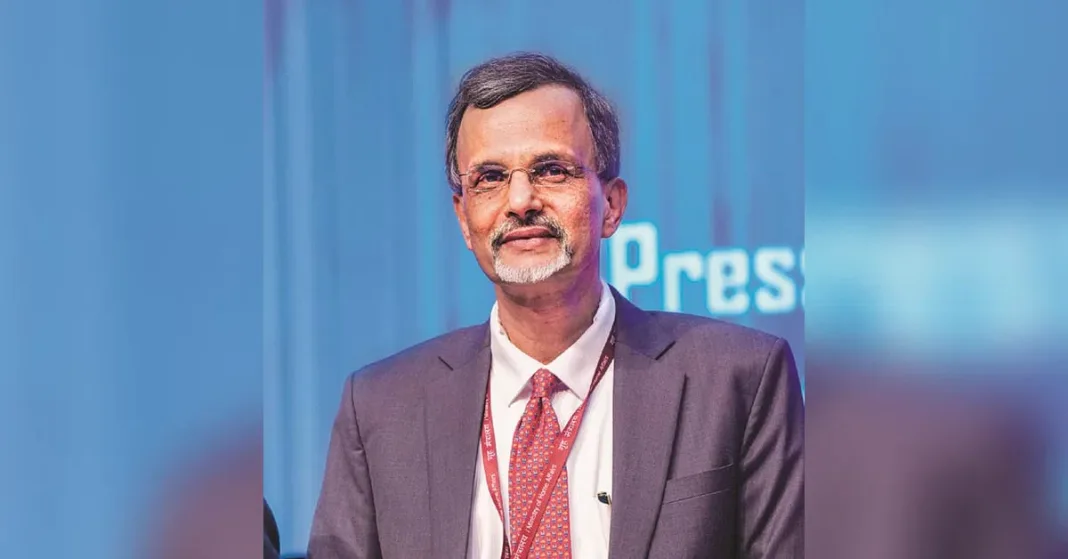

India needs to become globally indispensable in carefully chosen sectors to build strategic leverage for accessing geopolitically contested resources, as a series of external shocks rendered 2026 an inflection point for the country, Chief Economic Advisor (CEA) to the Government V Anantha Nageswaran said on Thursday.
Nageswaran said India needs to simultaneously pursue import substitution, stronger local manufacturing and higher export competitiveness.
He cited agro-processing as one area where India can build strategic leverage.
The chief economic advisor’s comments come in the context of resources including critical minerals, semiconductors and market access for goods being leveraged by countries to achieve trade related and strategic goals. The latest instance is China’s export controls on tunnel boring machines, announced last week. He also said that unlike the import-substitution policies followed in the decades after independence, the current approach must require industries to demonstrate export competitiveness or the ability to compete with imports at comparable prices.
“In the past, we used to look at import substitution, strategic resilience and strategic indispensability separately. We had in fact not even gotten to the last two pillars on this in the last 60 years or so,” Nageswaran said. “Now the challenge for India is to do all three simultaneously because the window of time is short and import substitution has to be done.”
He explained that simply saying ‘Let us increase the share of manufacturing in GDP’ was not enough.
“Leveraging comes from mastering narrow, critical infrastructure that others cannot so easily replace,” he said, adding that one can imagine the complexity and knowledge required for both policymakers and the industry to pinpoint what India needs to build to become globally indispensable and, in the process, strengthen the country’s own resilience.
“For about four decades, until the pandemic, the question was how cheaply India could produce. Now, the question is how much the world comes to rely on what India produces or will produce, and how well India withstands what others withhold. In other words, it’s about how much leverage you can exercise to receive what you need, given the contestation for real resources,” Nageswaran said.
“These resources will not be as readily available. The market will not provide them as easily, smoothly, and frictionlessly as we became accustomed to for the bulk of the 40 years leading up to the pandemic.”
CEA said building manufacturing resilience would require India to reduce its dependence on imported critical inputs, including crude oil, industrial metals, fertilisers, active pharmaceutical ingredients, rare earths, critical minerals and battery chemicals.
The country would need to build strategic buffers of such commodities to guard against supply disruptions, he said, adding that expanding manufacturing’s share in gross domestic product alone would not be sufficient.
“We have to insist on quid pro quo from the industry in terms of export competitiveness and import parity?, otherwise, we will not be able to achieve resilience,” the CEA said. “And resilience also requires us to create the buffers of commodities we need for production.”
The chief economic advisor said that fiscal policy typically provides support by stimulating sections of the economy where animal spirits are weak. But it will work only if it is targeted at production and productivity, with clear goals and end dates.
Nageswaran said the last six years saw several supply-side shocks, starting with the pandemic, followed by the Ukraine war, semiconductor chip shortages, weaponization of certain critical raw materials and minerals, US tariffs and the West Asia war. These underscore our vulnerability not just with respect to crude oil, but also to several other commodities like natural gas, fertilizer, and cooking gas, Nageswaran said.
“Basically, 2026 resembles 1991,” he said cautioning that resemblance should not be confused with being identical, which has a different meaning. Nageswaran sought to explain that the 1991 crisis was one of balance of payments.
The current circumstances underscore the need for resilience in many commodities, the chief economic adviser said.
“The difference is, in 2026, the challenge is not only external, structural constraints in manufacturing, energy, agriculture, and technology add to the pressure to change and change more rapidly.”
The CEA also suggested that support to industry needs to be linked to performance.
“We saw China announcing export licensing regime for tunnel boring machines and for many other products of infrastructure goods which India will be needing,” CEA said.
Economists said India’s demonstrated economic resilience sets it apart from previous episodes of economic shocks.
“The kind of resilience the Indian economy has demonstrated, with 7.8 per cent growth in Q1, was not seen during any previous economic shock — be it in 1991, 2008 or 2013,” said N.R. Bhanumurthy, director of the Madras School of Economics.
Bhanumurthy also said pursuing import substitution and improving export competitiveness simultaneously could be challenging, given the interdependence between the two.
“There are certain inputs that India needs to import to manufacture products for export,” the economist added.
Ajay Srivastava, founder of the Global Trade Research Initiative (GTRI), said strengthening domestic manufacturing should be the government’s top priority. “That will eventually reflect on the other two — import substitution and export competitiveness,” he added.
Given the difficult global environment, India would have to be selective about the sectors it prioritises, building competitive strengths in areas where it could gain leverage and using those capabilities to strengthen the wider industrial ecosystem, Nageswaran said.
On the policy front, the CEA called for treating energy as a macroeconomic policy issue and directing fiscal support towards easing supply-side constraints and lowering input costs, particularly for small and medium enterprises.
“Energy and land cost have to be lower for us to become competitive, diversify our sources of inputs in order to avoid a chokepoint weaponisation, and hold buffers of strategic inputs,” Nageswaran said.
He also suggested building strength in those areas where it is scarce, not necessarily complicated. Nageswaran also stressed the need to ease regulatory and supply constraints at the state and local levels, alongside building domestic capabilities in areas where supplies were scarce, even if the technologies involved were not necessarily complex.