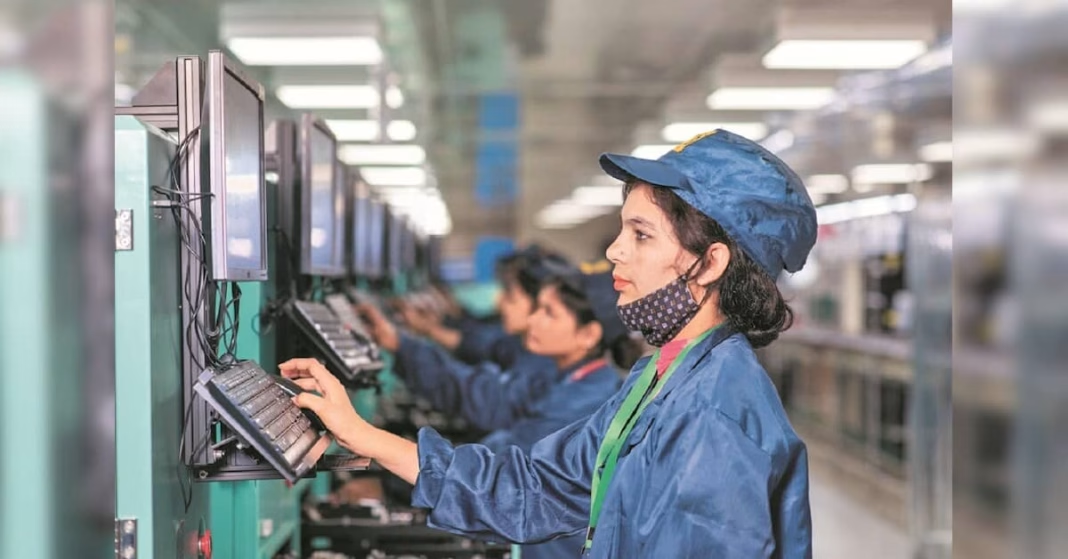

Women accounted for 29.5 per cent of apprentices engaged under the National Apprenticeship Promotion Scheme (NAPS) in 2026-27 (FY27) so far, according to an analysis of data from the scheme’s performance dashboard.
The share of women remained below a third despite the government’s continued emphasis on increasing their participation through apprenticeship melas and stakeholder consultations. The figures come amid persistent concerns over women’s low participation in India’s workforce and efforts to expand their access to skills and employment.
Of the 1.35 million apprentices engaged under the scheme in FY27 so far, around 399,000 were women, 955,000 were men, and 12 were transgender, according to the data. The figures cover only part of the current financial year and are not directly comparable with full-year numbers from previous years.
The Ministry of Skill Development and Entrepreneurship (MSDE) has said it is placing special emphasis on increasing women’s participation through consultations with state governments, industries, and other stakeholders. The ministry has also cited apprenticeship melas, which connect prospective apprentices with employers, as a means of mobilising more women to join the scheme.
“To increase participation of women in apprenticeship training and expand apprenticeship opportunities across sectors, NAPS encourages engagement of apprentices, including women, across diverse sectors such as manufacturing, engineering, logistics, agriculture and allied activities, food processing, retail, healthcare, tourism and hospitality, IT/ITeS, electronics, and other service sectors,” the ministry said in a statement in August.
However, women’s participation remains low in several of these trades. Data from the NAPS dashboard showed that women accounted for only 6 per cent of people enrolled as electricians under the scheme, while they made up just 2.6 per cent of fitters, who install, assemble, maintain, and repair machinery and mechanical equipment.
Several skilled trades, including welding, diesel mechanics, and lineman courses, had no women enrolled, with participation limited to men, according to the dashboard.
The top courses in which women enrolled under the scheme included automotive assembly operator, computer operator and programme assistant, retail sales assistant, and customer care executive, the dashboard showed.
The Parliamentary Standing Committee on Labour, Textiles and Skill Development observed in its report on the MSDE’s Demands for Grants for 2024-25 that NAPS did not have specific targets for women. The committee also called for continued efforts to increase women’s participation in the scheme.
Women continued to account for a minority of apprentices under NAPS, although their share gradually increased over the years. They made up just 11.8 per cent of apprentices in 2018-19 and 22.5 per cent in 2024-25 (FY25), before their share rose to 32.4 per cent in 2025-26 (FY26).
The number of women apprentices increased to around 779,000 in FY26 from 316,000 in FY25. However, women still accounted for less than a third of apprentices in most of the years covered by the data, according to the dashboard.
Launched in 2016, NAPS entered its second phase in 2022-23. Under NAPS-2, the government contributes 25 per cent of the prescribed minimum stipend, subject to a ceiling of ₹1,500 per apprentice per month, through direct benefit transfer.
The scheme is part of the government’s efforts to expand industry-linked skill development by encouraging employers to provide structured, on-the-job training. Apprenticeships combine practical experience with trade-specific training, allowing participants to gain exposure to workplace requirements across sectors.