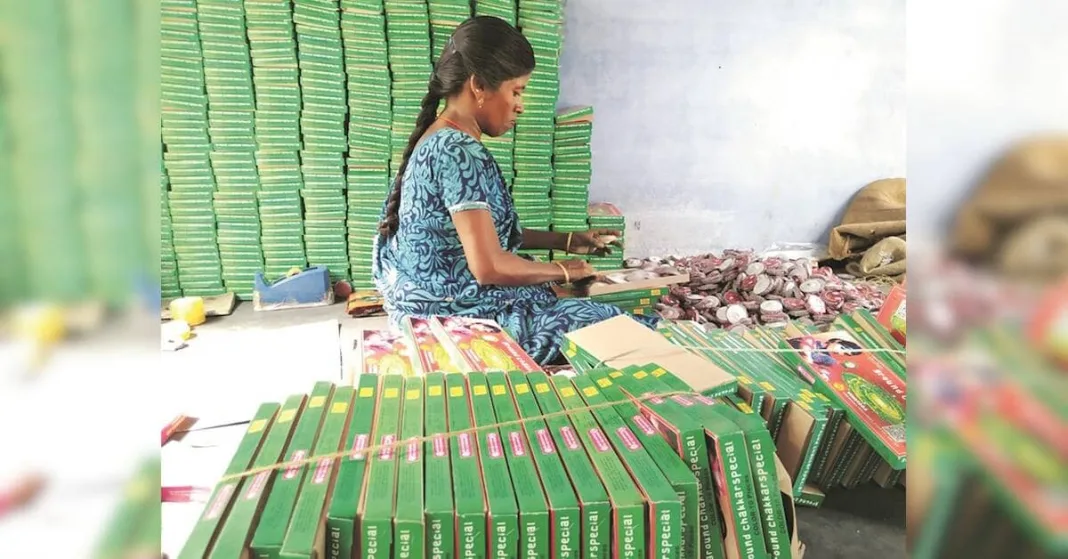

As Diwali nears in 2026, Nehru’s Kutty Japan is pinning hopes on two major developments – a rise in sales driven by Supreme Court relief on fireworks bans and the use of joined green crackers, and a turning point in its history through the start of exports.
Sivakasi has already started receiving firm enquiries from European and United States customers, with one Poland-based company already showing strong interest. This also includes companies that used to place large orders in China. If plans by the C Joseph Vijay government become a reality, a policy that may bring Sivakasi in line with global standards will be in place soon, and the state is also pitching for certain policy relaxations from the Centre to boost exports. Industry sources reveal that Sivakasi is also witnessing a marginal rise in orders this festive season, despite a price increase of between 30 and 50 per cent.
“We want Sivakasi to compete with the world through better technology, higher standards and new markets, while ensuring that the dignity, welfare and livelihoods of its workers remain at the heart of this transformation,” state industries minister and Member of the Legislative Assembly for Sivakasi, S Keerthana, told Business Standard. If export plans become a reality, Indian manufacturers will soon be able to pitch Sivakasi as an alternative to China’s Liuyang as an export hub in the global market.
The size of the Indian fireworks industry is around Rs 6,000 crore, of which around Rs 5,100 crore comes from Sivakasi. Of the total sales from Sivakasi, nearly 80 per cent, or over Rs 4,000 crore, comes from Diwali markets across the country, while around 10 per cent comes from Vishu sales in Kerala, and another 10 per cent is accounted for by all other festivals, including Ganesh Chaturthi in Maharashtra. The Tamil Nadu government is trying to improve logistics and transport infrastructure to facilitate exports from Chennai and Thoothukudi ports.
“There are queries coming in. Some companies that used to purchase fireworks from China are now making enquiries in India for various reasons. If we can meet the standards and supply, it would be a great achievement for Sivakasi,” said Murali Asaithambi of the Sivakasi Fireworks Manufacturers Association (SFMA). At present, two-thirds of the world’s fireworks originate from Liuyang in Hunan province, China, and industry experts highlight that recent regulatory curbs, US tariffs and diversification strategies may be the triggers for global buyers looking at Sivakasi.
“We are working on three priorities: strengthening worker safety, investing in research and modernisation, and removing longstanding barriers that prevent our manufacturers from reaching international markets,” Keerthana said.
According to SFMA, India is the largest market where consumers themselves buy and burst fireworks on a large scale. In Europe and other areas, fireworks displays are conducted by professionals, with demand for sparklers and Roman candles on the higher side. A section of manufacturers believes that production needs to be increased to meet not just overseas demand but also rising domestic demand.
“Our production is not keeping pace with demand. The quantity we have produced over the past 11 months would only be enough to meet the demand for this Diwali season. We have to get faster clearances too,” said J Tamilselvan, president of the Indian Fireworks Association (IFA). Demand is high after a Supreme Court order in September conditionally permitted the industry to manufacture next-generation joined green crackers, a pending demand since 2018. Similarly, the Supreme Court also rejected a complete blanket ban on firecrackers while permitting their use during specific time windows rather than imposing a total prohibition, giving much-needed relief to the industry.
To improve the Sivakasi fireworks ecosystem, the Tamil Nadu Industrial Development Corporation (TIDCO) is in the process of developing a Sivakasi Pyrotechnic Common Facility Centre (SPCFC) in Virudhunagar district. This is being conceptualised as India’s largest fireworks manufacturing cluster, looking beyond traditional commercial firecrackers into higher-value defence and space pyrotechnics. This will be an integrated facility for testing, certification, research, automation, skills training and technology commercialisation. “Growth cannot come at the cost of workers’ lives, and we are committed to providing the firecracker industry with the opportunity to modernise,” she added.