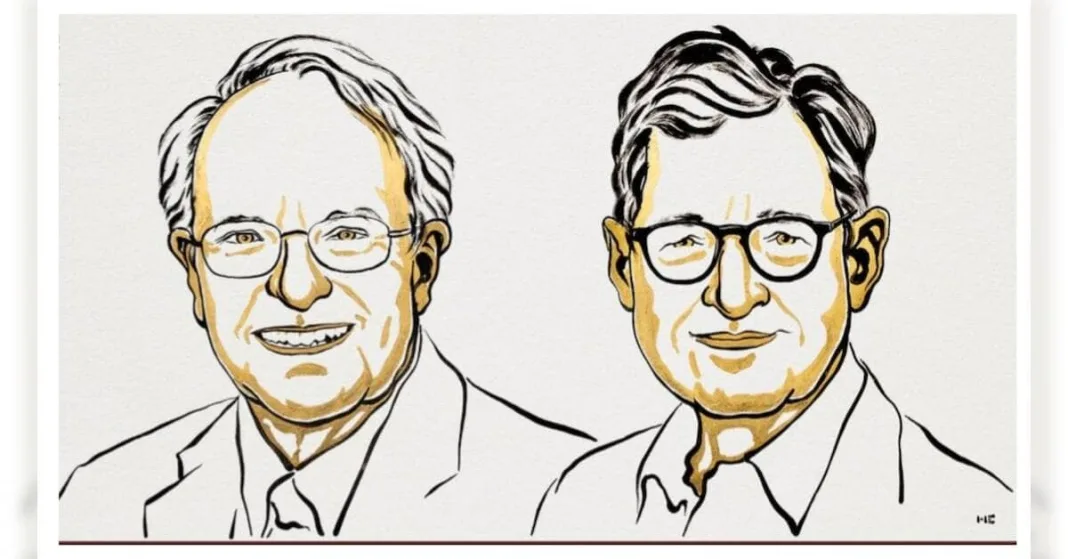

The 2026 Nobel Prize in Economics has been awarded to Robert E Hall and Michael Woodford for their research that has generated a paradigm shift in stabilisation policy. Their research has resulted in New Keynesian models that explain and quantify how stabilisation policy affects business cycles and are now used by central banks and finance ministries around the world.
The Royal Swedish Academy of Sciences awarded them the prize “for microeconomic foundations of macroeconomic stabilisation”.
To understand how their research has changed policymaking, we need to understand how decisions about interest rates, spending and inflation were made before the oil crises of the 1970s and how these crises challenged the traditional Keynesian model.
Modern macroeconomics is based on John Maynard Keynes’s almost century-old work, where he explained that demand and supply cannot always be balanced merely by market forces. It requires intervention from governments and central banks to stabilise the economy.
The economy cannot always produce exactly the quantity of goods and services that households and businesses demand. So, a problem occurs where, if demand is too low, there will be high unemployment and low growth. If it is too high, the economy will overheat and inflation will rise.
These peaks and troughs can be evened out by stimulating demand when it is too low and slowing it when it is too high.
Consider that an economy is like a car:
If the car moves too slowly, policymakers need to press the accelerator.
If it moves too fast, it risks overheating, so policymakers need to apply the brakes.
The only problem is determining when and how hard to press the brakes or accelerator to stabilise it.
So, if this was the model on which economic policies were being made, what caused the change? The oil crisis of the 1970s.
Earlier, economists were using a model where high unemployment was generally associated with low inflation. This relationship was known as the Phillips curve.
In simple terms, if people become unemployed, their purchasing power (money in hand) reduces, causing demand to decline and inflationary pressure to ease.
Another assumption was that when people’s disposable income increased, their spending would also increase in a predictable proportion.
However, all that appeared to change during the oil crises of the 1970s, when:
- Oil became expensive.
- Businesses faced higher production costs.
- Inflation increased.
- Economic growth weakened.
- Unemployment also increased.
This new situation, where low economic growth and high unemployment existed alongside high inflation, came to be known as ‘stagflation’.
The traditional models could not reliably explain why inflation and unemployment were increasing at the same time.
So, what went wrong?
Economist Robert Lucas, who won the Economics Nobel in 1995, argued that the problem was the assumption that relationships between economic variables would remain stable even when government policies changed.
This led economists to focus on microfoundations, which means understanding the overall economy through the decisions made by individual households and businesses.
The research by Robert E Hall and Michael Woodford helped explain how consumer and business behaviour depends not only on economic policies but also on expectations about the future.
What did Robert E Hall discover?
Robert E Hall changed the traditional way of thinking about household consumption. His central idea was that if households are optimistic about their future income, they will consume more than if they are pessimistic.
Hall turned the research approach around. Instead of looking for indicators that could forecast household consumption, researchers should test whether changes in consumption could be predicted at all.
Hall helped explain why people spend money based not only on what they earn today but also on what they expect to earn in the future.
Consider two people earning ₹50,000 a month.
Person A: Expects a promotion and a salary increase next year. They might feel comfortable buying a new car today.
Person B: Fears losing their job. They might reduce spending and save more, even though their current salary is identical.
Hall showed that expectations about future income are crucial to understanding consumption.
But his research went a step further.
In a landmark article published in 1978, Hall argued that if households make spending decisions based on all available information, changes in their consumption cannot be reliably predicted.
Why? Because people will change their spending decisions when they receive new information about their future income. And if that information could be predicted, it would not be new.
Why does this matter?
Suppose the government announces a tax cut.
Earlier models might assume people will spend a predictable proportion of the extra money.
Hall’s research helps explain why the response may differ. People who expect financial difficulties might save the money, while those who feel secure might spend more.
However, not everyone can plan spending based on future income.
Some households live from one salary payment to the next and cannot easily save or borrow. Their spending responds differently.
In 1982, Hall and Fredric Mishkin published research using household-level data. They found that around 80 per cent of households in their study made consumption decisions in line with the theory, while the remaining households lived hand-to-mouth.
This helped economists understand why the same policy may affect different households differently.
What did Michael Woodford discover?
Woodford developed a framework that brings together three important things: how households spend, how businesses set prices and how central banks influence economic activity.
In 2003, Woodford presented a complete New Keynesian macroeconomic model built on microfoundations, incorporating insights from Hall’s research and the work of other economists.
First: Interest rates influence spending
When the RBI cuts interest rates, borrowing can become cheaper, encouraging people to buy homes, cars and other goods. Businesses may also invest more.
When interest rates rise, borrowing becomes more expensive, potentially reducing demand and inflation.
But how does a central bank know whether interest rates are too high or too low?
Woodford’s framework uses the concept of a natural or neutral interest rate, at which monetary policy neither stimulates nor slows economic activity.
If interest rates are below this level, they can stimulate demand. If they are above it, they can slow demand.
Second: Businesses cannot always change prices instantly
Imagine a restaurant facing higher vegetable prices. It may not immediately increase menu prices because changing prices frequently can be costly or discourage customers.
Economists call this sticky prices.
Woodford showed why this matters for inflation and economic growth.
If demand falls but businesses cannot immediately adjust prices, they may reduce production instead. This can lead to lower economic growth and higher unemployment.
Third: Expectations influence inflation
If businesses expect their costs to increase next year, they may raise prices today when they have an opportunity to adjust them.
If people believe the central bank is serious about controlling inflation, their expectations and decisions may also change.
This is why Woodford’s research highlighted the importance of central bank credibility, transparency and communication.
How does this explain the 1970s oil crisis?
Woodford’s framework also uses the concept of an output gap, which is the difference between actual economic output and the level that would prevail if prices could adjust freely.
In simple terms, it helps policymakers understand whether demand is too high or too low relative to what the economy can produce.
Consider the oil crisis again.
When oil becomes expensive, businesses face higher costs and the economy’s productive capacity can decline.
Even if demand does not increase, it may become too high compared with what the economy can now produce.
This can lead to higher inflation, lower economic growth and rising unemployment at the same time.
Woodford’s model helps explain why central banks may need to increase interest rates to control inflation even when economic growth is weakening.
Why does their research matter today?
Hall explained important aspects of how households decide to spend and save, particularly the role of expectations about future income.
Meanwhile, Woodford brought such insights into a broader framework for understanding inflation, interest rates and economic fluctuations.
Their work helped lay the foundations for New Keynesian economic models, which are now widely used by policymakers.
These models have helped central banks and governments respond to economic shocks, including the pandemic and recent energy crises.
The main change is that policymakers no longer need to rely only on historical relationships between inflation, unemployment and growth. They can also examine how households and businesses make decisions and how their expectations about the future influence the economy.