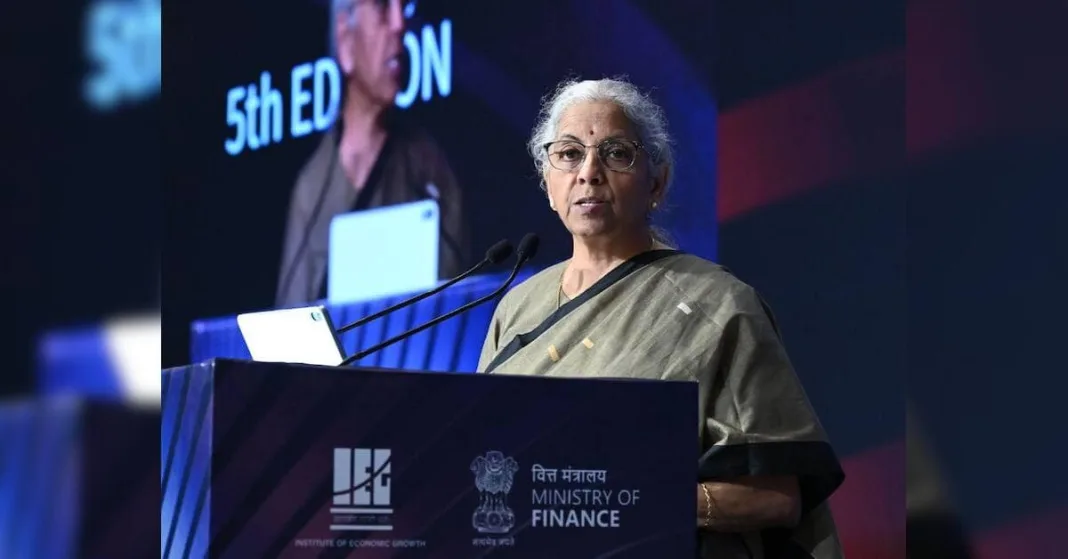

Finance Minister Nirmala Sitharaman on Monday said a new template for bilateral investment treaties is ready and is expected to get Cabinet approval soon in a bid to make it more investor-friendly.
The new template, being prepared over the last one-and-a-half years, seeks to address shortcomings in the model approved in 2016 and provide sharper protection to investors from both sides, she said.
India has continued negotiations on investment protection agreements even as the new template is being finalised, she said at the Munich Security Conference here.
The latest agreement, with Saudi Arabia, goes beyond the 2016 framework and incorporates elements that are more sharply focused on protecting the interests of investors from both countries, she said.
India has also concluded similar agreements with the UAE, Oman and some Central Asian countries, Sitharaman said.
“We have a new template which will be approved shortly. But in the meanwhile, we’ve not halted the process. We are negotiating with countries with a lot more of those elements which are in the new template,” she said.
The minister said negotiations are underway with several countries, including Canada and Russia, on bilateral investment protection agreements.
“If things go well, by December we should be concluding agreements with at least three more countries,” she said, adding that negotiations with Canada could be concluded by December or early next year if they progress as expected.
The 2016 model bilateral investment treaty had replaced an earlier framework and became the basis for India’s subsequent investment treaty negotiations.
A bilateral investment treaty is an agreement between two countries to promote and protect investments made by their investors in the other’s territory. Under investment protection treaties, investors can take a sovereign government to arbitration.
With Outward Direct Investment (ODI) from India increasing, there is a need to ensure that domestic investors and companies investing abroad also get adequate protection.
The current framework requires a foreign investor to wait for five years before initiating a treaty-based arbitration against India.
This means that if a foreign investor has a dispute with India, it should first pursue domestic remedies for five years before bringing a claim under the agreement.
In the last few years, there has been growing opposition to this five-year period, with many seeking to lower it.
Sitharaman said the government believes that the earlier framework does not adequately serve India’s interests and therefore a new template is being formulated.
On the India-US trade agreement, the finance minister said it is yet to be finalised and negotiations have been “hard and very rigorously” conducted.
“The agreement’s negotiations are still ongoing, although we like to believe that both sides have reached a plateau beyond which giving or taking might be very, very difficult. But maybe, if there is room to operate from, both sides would do it,” she said.
Sitharaman said a predominant feature of India-US trade relations is the trade imbalance in India’s favour, with the US seeking to reduce its deficit.
“Naturally, the deficit is there on their side, or the balance is unfavourable for the US, so they would want to reduce that imbalance,” she said, adding that Washington would seek to make up, from its perspective, for what it believes it has lost over the years.
Drawing a comparison with India’s trade relationship with China, Sitharaman said trade imbalances have traditionally been addressed through negotiations, with countries seeking greater market access for their goods and services.
However, she said tariffs are increasingly being used as a tool to address trade imbalances.
“Now the imbalance is being sought to be addressed through other means, where, as you rightly said, tariff has become weaponised. Tariff was an instrument of negotiation, and tariff had a certain framework within which you would apply it. Today, the framework is there, but tariffs are going,” she said.
She questioned whether India could adopt a similar approach in dealing with China, given the significant trade imbalance between the two countries.
“The trade imbalance with China for India, for instance, since 2014, has been growing exponentially. So when you’re talking of trade and trade imbalance being the sole criteria to reduce the imbalance, to what extent beyond negotiation can you go?” she wondered.