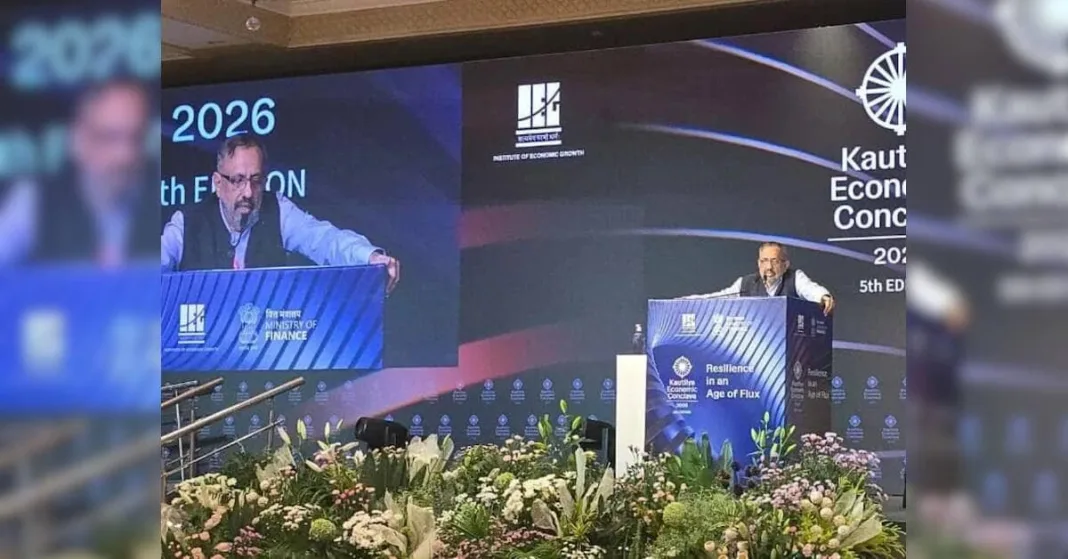

NITI Aayog Member Rajiv Gauba on Saturday called for a shift towards light-touch and risk-proportionate regulation, saying regulatory frameworks must keep pace with changes in technology, business models and the global economic environment.
Speaking at a plenary session on “Regulatory Oversight in an Age of Disruption” at the fifth Kautilya Economic Conclave in New Delhi, Gauba said the objective should not be to choose between regulation and growth, but to manage risks while supporting innovation, competition and investment.
The three-day Kautilya Economic Conclave is being held from October 3 to 5 under the theme “Resilience in an Age of Flux”. It has brought together policymakers, economists, academics, financial experts and international participants from around 30 countries, according to the Ministry of Finance.
Regulation should be proportionate to risk
Gauba said regulatory requirements should be calibrated to the nature and consequences of the risks involved.
“The goal should be a State that is ‘firm where risks are high, and light-touch where risks are low,’ but predictable in both cases,” he said.
He said regulators should assess whether new rules are warranted before intervening in new and rapidly evolving sectors.
Gauba also called for greater coordination among regulators to address overlapping mandates, avoid duplication and close regulatory gaps.
Accountability and regulatory capacity
Gauba said regulatory independence should be accompanied by accountability.
“While regulators need autonomy to take difficult decisions free from undue influence, public confidence requires transparent decision-making, clear procedures, effective review mechanisms and accountability for regulatory performance,” he said.
Gauba also called for stronger regulatory capacity as markets and technologies become more complex. This would require specialised expertise, stronger analytical capabilities and engagement with industry, academia and technology institutions, he said.
“The goal should be a State that is ‘firm where risks are high, and light-touch where risks are low,’ but predictable in both cases,” Gauba said. He linked the approach to sustaining the high growth required for Viksit Bharat by 2047 and referred to the government’s Trust Based Governance or Jan Vishwas approach.
Earlier in the day, Finance Minister Nirmala Sitharaman, Principal Secretary to the Prime Minister P K Mishra and RBI Governor Sanjay Malhotra also spoke at the conclave on different aspects of India’s economic priorities, resilience and financial stability.