
When Chandra Pandula, a Los Angeles-based Overseas Business Executive for Ramoji Film City, showed a team from Amazon, including its director for International Original Productions John Holmes, around the Hyderabad facility in March, it was part of the company’s initiative to enlist global filmmakers as clients. This month, Ramoji Film City took its first official step in this effort with its presence at the inaugural TIFF: The Market, the film bazaar that is set to be part of the annual Toronto International Film Festival.
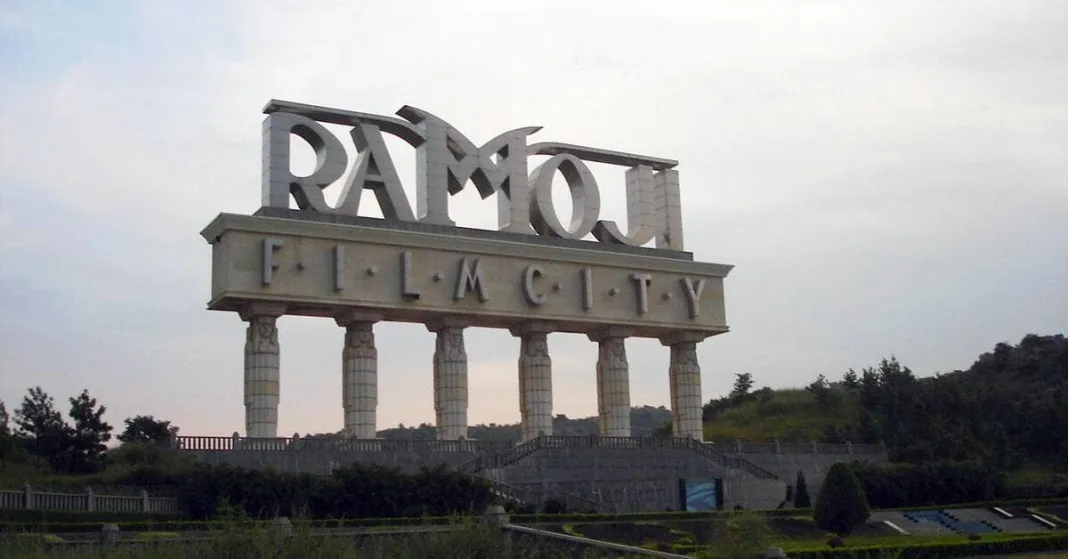
Ramoji Film City has been a fixture in the Indian film industry since it was founded 30 years ago, with blockbusters like Baahubali and RRR having been shot there. It’s also home to S S Rajamouli’s upcoming epic Varanasi. The company’s managing director, Vijayeswari, who was at TIFF, said, “Ramoji is being preferred by Tamil, Telugu, Kannada, Marathi people. All come and shoot, Hindi movies also shoot here.” She added, “Rohit Shetty says, ‘If I come to Ramoji Film City, I am sure that I can release the film as planned.’” Officials said it handled films with budgets ranging from ₹4-5 crore to well over ₹400 crore. The facility typically hosts over 400 productions annually and has been home to over 3,500 films so far.
Ramoji’s exhibit at TIFF proclaimed its recognition by Guinness World Records as the “world’s largest film studio complex” as its team pitched its 800-hectare facility in Hyderabad as a one-stop filmmaking destination offering sets, equipment, crews, junior artists, accommodation and more. “TIFF is the first formal pitch that we are making to the world, and we intend to continue this with the other major markets also,” Vijayeswari said.
Apart from deals on acquisition and greenlighting of films, these are the kind of connections that TIFF hopes will make its Market the dominant North American hub for the global film and entertainment industry. Over 6,500 industry delegates and 250 international buyers attended its first edition.
For Ramoji, it meant a large pool of potential clients to highlight the time efficiencies offered by its integrated facilities and cost efficiencies of nearly 30 per cent due to lower costs of production and labour in India.
But Ramoji’s officials were also concerned about the status of the production incentive for foreign films offered by the Indian government, under which qualifying production expenses could be eligible for a cash rebate of up to 40 per cent. Vijayeswari said, “The tax credit gives us a cutting edge, and apart from tax credit of 40 per cent, if a foreign production comes, we can show the savings to 25, 30 per cent, so that becomes a total of 70 per cent, which I can challenge nowhere in the world can be given.” Voicing the industry’s apprehension that the incentive was being suspended or at least not promoted actively, Ramoji Group’s chairman, Kiron, added, “Probably they have taken a pause to make it better or to improve. So, probably something better is in the offing is what we are hoping.” Several other countries at TIFF’s Market were promoting their own production and tax incentives ranging from 15 to 60 per cent for shooting and producing films in those locations.
India also has film co-production agreements with over a dozen countries, including Canada, but Vijayeswari made it clear that Ramoji was not interested in co-production. The film city had hosted about half a dozen Hollywood films with production budgets of $2-3 million between 2000 and 2004, but could not continue the business at that time. “Twenty years back, we had some Hollywood productions but later on the model changed, saying that it needs to be done on a co-production model. We were not really so happy about investing in the Hollywood or different markets, we were looking at a film production that can be completely shot, wherein we can deliver the best services. We are not keen on investing in foreign films,” Vijayeswari explained.
Pandula highlighted other advantages that India could offer, including lower insurance costs for producers due to the country’s political stability compared to many other locations in Africa, South America or Asia. He also said Hyderabad’s infrastructure and international connectivity had been transformed over the past two decades, making it a much more attractive destination at present.
Another Indian company at the TIFF Market was Mumbai-based NH Studioz, which was seeking licensing and distribution deals. It claims the title of being India’s largest film library with over 5,000 titles valued at $2.5 billion. Shreyans Hirawat, who heads the company, said 95 per cent of its business was domestic, but he is keen to expand the 5 per cent share of its global business. North America is one of its key overseas markets, and Hirawat plans to add TIFF to his itinerary of visiting 8-9 film bazaars every year. “AFM, which is the American film market which happens in November, has been moving places and phasing out since quite a while, and there was a strong need for another film market to happen where all the American buyers could meet. TIFF has been there for almost fifty-one years, but they didn’t have a marketplace, so this year I think they have created this marketplace out of sheer demand for such B2B meetings,” Hirawat said.
Reflecting the recent thaw in bilateral relations, the Indian government also had a major presence at TIFF this year with twin objectives – to highlight next year’s WAVES summit and its own upcoming WAVES film bazaar at this year’s International Film Festival of India in Goa.
Last year, even without an official market, TIFF saw the highest-grossing film festival acquisition of all time, as an unknown horror film, Obsession, made on a budget of $750,000, was acquired for a reported $15 million and went on to gross over $500 million globally. That’s the sort of game changer that Market exhibitors like Ramoji Film City will be hoping for. As Vijayeswari noted, “All the visitors to our stall, they are not even aware that such a large facility exists, so this is an introductory thing.”