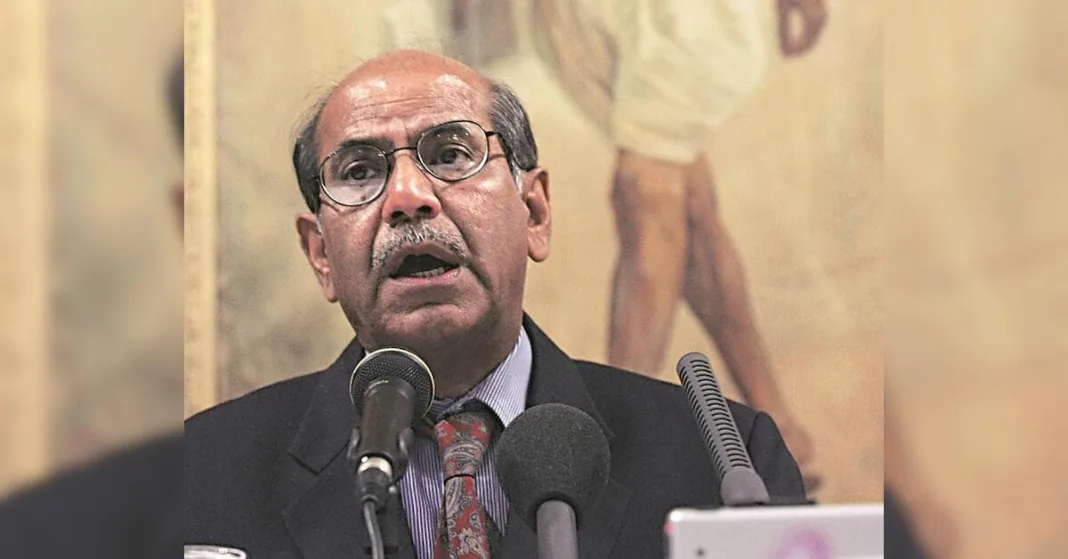

What was it like being in the PMO in 1991?
I was joint secretary in the external affairs ministry before I joined the PMO in early 1991. I left in December 1992, just when the Babri Masjid was demolished. So, I was in the PMO when Chandra Shekhar was prime minister. Even before that, when I was joint secretary in charge of East Asia, we were aware of the grave economic situation we were facing.
You were involved in negotiations with multilateral agencies. Was there already pressure before the 1991 reforms to bring in those measures?
There certainly were discussions on quite a lot of the measures, but not in the focused manner that was employed in 1991. For example, with the new government, when Manmohan Singh was brought in, the basic blueprint was already there. I think the person who took it up and managed to run with it was the principal secretary to the Prime Minister AN Verma.
We had a lot of debate about how far we should go on a very ambitious agenda. There was strong pushback from major industrial houses. I used to be sitting in the South Block in the PMO, and every now and then, I would see some of the captains of industry, including Rahul Bajaj, coming to meet Verma.
There was a considerable amount of concern amongst the major industrial houses that that whole edifice built during the post-Independence period was being dismantled. They argued that even if it had to be done, it should be gradual. Quite rightly, people like Verma and Manmohan Singh felt that if we didn’t do it in one go, taking advantage of the crisis, then once the crisis subsided, the momentum for reform would go – that it would be somewhat revolutionary from the Indian experience, but that this was the best way.
Of course, Narasimha Rao himself was conflicted. Sometimes I would find him tending towards a more gradualist, incremental approach; at other times, he would accept it couldn’t be done that way. Don’t forget that much was dependent upon our ability to get support from the IMF (International Monetary Fund) and World Bank. It was unlikely that kind of support would have become available if we did not undertake the reforms as a complete package.
Had Rao not taken the political risk, these reforms would not have happened – irrespective of the role Manmohan Singh and the others played. We must not take that credit away from him because ultimately, he had to carry it on his shoulders.
What about the external challenges?
What is not fully appreciated is that India faced not only an economic crisis but a concurrent crisis in its external relations as well. Precisely at a time, there was a huge turn in geopolitics because of the sudden collapse of the Soviet Union. The USSR was a strong pillar of our foreign relations; not only a political but a long-standing economic partner. A lot of our industrial investment, particularly in the public sector, was from the Soviet Union.
Many products, like our tea or cotton textiles that would not have readily found demand in the West, had a captive market in the Soviet Union. The sudden loss of this market created a worrying situation.
Then US Under Secretary of State Nicholas Burns (left) with then Indian Foreign Secretary Shyam Saran ahead of their meeting in New Delhi on October 21, 2005. Saran and Burns helped negotiate the landmark India-US civil nuclear deal | Photo: Reuters
Did the collapse of the USSR improve our relationship with the US and the West?
It should come as no surprise that there was an element of triumphalism in the US and Europe over the end of the Cold War. There was a sense that India had made the wrong bet and was suffering the consequences. Of course, this wasn’t said in as many words, but you could discern it.
The Americans had started getting closer to China, but that cooled after the Tiananmen Square massacre in June 1989. Even then, the US continued its engagement with China and their commercial exchanges expanded. The US decided to sponsor China into the World Trade Organization (WTO) in 2001.
Now, theoretically, there should have been an easing in tensions between the West and us, since the Soviet factor was no longer there, but this happened in gradual steps as the perception of a Chinese threat increased. And also when they saw that the reforms had actually started opening up opportunities in India, and that we were moving more towards a market-oriented economy.
Were there still some differences to be ironed out?
In the early period, it was not as if the US suddenly became very supportive of India. Let me give you an example. We used to import a lot of technologies and components for our space programme from Russia.
When [Russian President] Boris Yeltsin came in, in 1991, the Americans supported him and initiated a huge economic adjustment programme through the so-called “shock therapy”. They prevailed upon Yeltsin to not continue with the cryogenic engine deal for our space programme because they said it would violate the Missile Technology Control Regime [a multilateral agreement to limit the proliferation of missiles and so on].
During that period, I found the Americans to be very negative about us, taking advantage of our vulnerability. They thought they could cripple our nuclear and space programmes through technology denial and sanctions. This continued for some time. I am glad we resisted such pressures.
How did we overcome that?
Whenever we could spot an opportunity to ameliorate our situation, we tried to do so. For example, the decision to establish full diplomatic relations with Israel was taken up at that time. [Palestinian leader] Yasir Arafat had come to India on an official visit and I recall Prime Minister Narasimha Rao taking him aside for lunch on the lawn of his official residence at 7 Race Course Road. We told him that if we establish a relationship with Israel, we could be helpful to him as well. He very graciously agreed.
That was important because it helped us on the technology front, considering the kind of technology denial regimes we were facing, particularly from the US and the West. To some extent, this was a walk around through Israel.
The second big initiative was the Look East policy. There was a considerable amount of discussion to revive our relations with the Asean (Association of Southeast Asian Nations) bloc, because we had almost completely neglected the East. There, the Singaporeans were very helpful, first in establishing a sectoral dialogue with Asean and eventually a strategic partnership. I think the Singaporeans were perhaps the earliest to see that the reforms represented a major change and would create a lot of opportunities for them. Now we have an Act East policy.
How did the perception of India change?
The fact that we undertook economic reforms was seen as a positive – that even though this is a very noisy democracy, it is capable of taking hard decisions when the need arises. The second important thing was that this was not just a projection of the government; the private sector played its part, too.
It was for the first time that delegations of the Confederation of Indian Industry (CII) or Federation of Indian Chambers of Commerce & Industry (FICCI) would accompany the Prime Minister on his visits to various countries. They testified that the changes in India were real. That made quite a big difference. The messaging may not have been as effective if that parallel private sector outreach was not there.
For instance, an Indian prime minister [Rao] went to speak at Davos for the first time in February 1992. That was a big message in itself. On that occasion, the CII went to town, plastering Davos with banners that said India is open for business. It created a kind of India fever.
However, Rao was not always very comfortable in the role of what he saw as a salesman for India. This was new for an Indian prime minister.
Multilateralism has nearly come to an end. Everything is being weaponised, including semiconductors. How should we navigate the current scenario?
We should not succumb to pressure. I say this not because of national pride, but by looking at the experience of dealing with [US President Donald] Trump. If you succumb, more pressures are piled up on you. It does not work.
He has made unreasonable demands even on allies, who have given up long-held positions under pressure. Purely as a negotiating strategy, giving into this only opens you up to even more demands, weakening your position as the allies in Europe are discovering.
Look at energy, where our traditional sources of supplies have been disrupted by the actions of the same actor. Where do we go? I would say our reaction should be: Thank you very much, you have taken a certain stand, but we would like you to appreciate our overriding concerns about the energy security of our people.
In our pursuit of higher economic growth, have we neglected the environment?
We have lost out because we have not paid much attention to ecology. I am not talking just from the climate-change perspective, because we have invested quite heavily in renewable energy.
I think what, perhaps, is not recognised is that climate change is only a small component of a much larger ecological challenge we are facing. There are intersecting issues and feedback loops, like the loss of biodiversity, which is actually causing greater global warming, and global warming that is also ruining biodiversity.
Look at what has happened on the border between China and Nepal. Several big dams were washed away in one fell swoop. That means you have incurred a huge loss. How does it make sense that you invest thousands of crores in such projects without taking into account how they may be affected by climate change?
What about our position at climate summits?
The effort on the part of the western countries has been to systematically shift the whole burden of adjustment on to the developing countries. The West is not prepared to make the kind of sacrifices it should, given it is most responsible for climate change. These countries thought this is mainly a problem of the tropical countries, that we in the temperate zone are quite safe. Now, it is coming home to them with record-high temperatures in Europe. They are not safe. The only way that you can deal with this is through a global collaborative response, not a competitive one.
There is a narrative that India is standing in the way by being a large carbon emitter. All we were doing was asking them to deliver on the commitments they made in a consensus treaty, the United Nations Framework Convention on Climate Change (UNFCCC). They have succeeded in eviscerating the UNFCCC.
You were a crucial member of the team negotiating the India-US civil nuclear deal. How did that change things for us?
The economic reforms put India on a high-growth path. As foreign secretary [from 2004 to 2006], I had more diplomatic leverage because of that. Since India was growing at 8-9 per cent, the international narrative at that time was that it is shrinking the gap with China, and could even become the next China.
We were a beneficiary of that because of two things that happened: One, the perception of India as an emerging power became fairly well established; second, the perception of China as the peer competitor to the US became more salient.
So, the American perception was that if they were to look for a credible countervailing power to China in this region, which was becoming the centre of gravity of the global economy, then India was a potential partner. It would follow policies to constrain Chinese power in its own interest. This would converge with American strategy without India being an ally.
Therefore, it was in the US’s interest to support India’s rise as a substantial power. The nuclear deal happened against that changed geopolitical context.
Was there still some scepticism in the US about India?
There have always been two schools of thought in the US on India. One believes it makes sense for the US to build relations with India, even if it does not get much in return, because India will counterbalance China. This was seen as a good enough quid pro quo.
But there has always been another school of thought that believes this is a bad bet. It feels that when it comes to the crunch, Indians are not going to fight for them. That is precisely what has happened under Trump. That negative or sceptical part of the US public opinion and security community has become more dominant.
How do you feel relations have panned out in our neighbourhood, especially considering the rising influence of China?
We say we have a neighbourhood-first policy, but that has not translated into actual implementation in terms of material or human resources needed to manage our periphery. The rhetoric has not translated into actual action.
While the legitimate aspiration is to play a larger global role, that cannot happen unless we get our periphery right. If that is disturbed and becomes a drag, then we cannot play a bigger role. China knows this, and keeps us bogged down in the subcontinent, with Pakistan’s help. We should try and make certain that we don’t fall into that trap.
We have so many assets. Thanks to the reforms, we are one of the most dynamic economies in the region. All the countries around us are smaller. Supposing we opened up our market to anything that our neighbours can produce and sell, it would be a tiny fraction of our market.
Or, if we became the transit country of choice in the neighbourhood; say, let Nepal use any railway line, highway, or port it wants, and you give it national treatment as far as the use of the transportation network is concerned. The transport network becomes a positive leverage. Why don’t we open up?
Today, if a container has to go from, say, Dhaka to Islamabad, it has to go first to Chittagong port [in Bangladesh], then sail right around the Indian subcontinent, reach Karachi port, from where it will have to be transshipped to Islamabad. This takes about three weeks, and the cost is probably five or six times what it could have been had we allowed it to go straight on a railway line that is already there, though it is not open to crossborder traffic. But we don’t want to allow transit. We use that as negative leverage; we don’t have the concept of positive leverage. How can we complain if we leave open spaces in our neighbourhood and somebody walks in?
We did a lot of work on connectivity with Nepal, for example. I had been pushing for improved connectivity for a very long time, before it became a buzzword. When I was posted in Myanmar, and then in Nepal, I could see that connectivity was so poor from our side, while the Chinese were hacking through the mountains and building highways. We had difficulty in crossing the border, even though we were on the plains. There has been improvement in physical crossborder infrastructure, but the software of connectivity in terms of more efficient regulations lags.
Do you think we should open up to foreign direct investment from all countries, including China, to ensure we plug into the global supply chain?
We may get sucked into a Chinese supply chain, not the global supply chain. Let us recognise that most of the supply chains we are talking about are dominated by China today. And whether we like it or not, there is an element of risk involved.
I am not suggesting that there are no possibilities of economic collaboration with China or areas of mutual benefit in terms of trade, but we must be very, very clear about sensitive sectors in terms of security. For instance, the digital economy is a source of strength for us. Would we want to open that up? They certainly don’t want to open their market to us in areas where we have competitive advantage.
This is the largest mobile phone market for Chinese companies, despite all the political troubles we have had, because it is the only large, expanding market for smartphones in the world. So, by all means, use this as leverage to get a better trade deal with China.
They will be interested because there is saturation in China itself, and there is saturation in the global market, too. So, be judicious in selecting the areas that we can safely open up without facing a security risk.
Should India look more at bilateral trade deals now?
One cannot make blanket statements saying this is good for us, that is not, as is the case usually with commentary on this subject.
In theory, having a rules-based multilateral system is good for India. The question is whether it is feasible in today’s world. It is much less feasible today. Do we, therefore, make compromises and join some of the plurilateral groupings where we have interest-based coalitions?
Since we have entered many free trade agreements recently, we have accepted that such limited deals may be easier.
We could, perhaps, work in smaller coalitions of interest. We can exercise that same judgement with regard to several of the issues that are before the WTO.
We need better analysis of where our interests are best served. One thing I would say, though, is that even if you are sceptical about a particular [plurilateral] agreement being negotiated, it isn’t a good idea to not be a part of those negotiations. If you aren’t a part, you cannot influence them. Of course, that doesn’t mean you have to accept the outcome of the negotiations if they don’t serve our interests.