
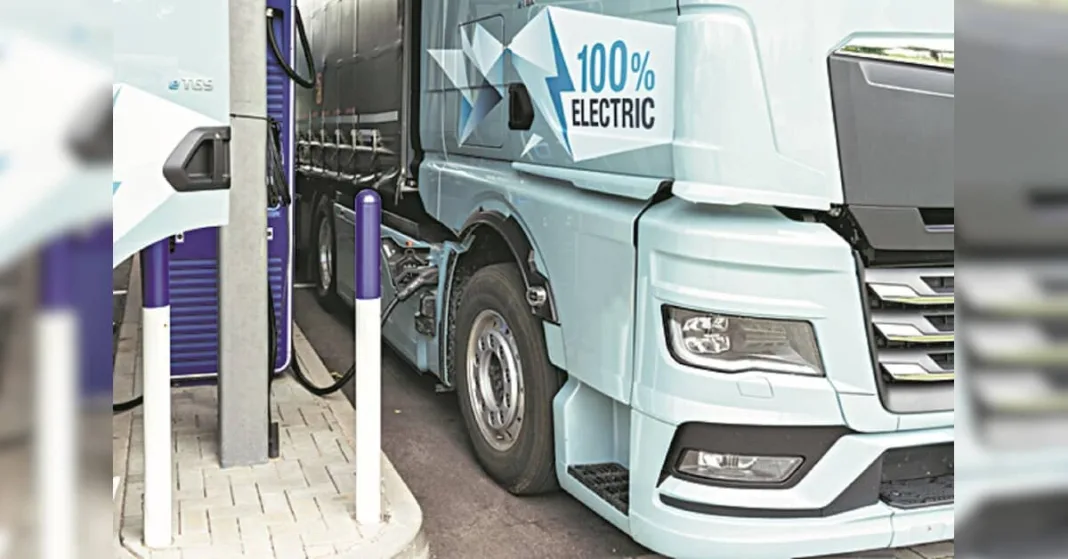

The group on Tuesday launched AMPSTAR, the electric commercial vehicle brand of JSW Greentech, under which it will manufacture electric trucks and buses. The initial investment is around Rs 2,000 crore, comprising about Rs 1,500 crore of debt and Rs 500 crore of equity from the parent, according to the company.
Its first plant, spread over 90 acres at Chhatrapati Sambhajinagar in Maharashtra, will have an annual capacity of 15,000 vehicles — 10,000 electric buses and 5,000 electric trucks. The company will start its truck portfolio with a 55-tonne tractor-trailer and subsequently add tippers, fixed-body trucks and dumpers.
But the first factory is only the entry point. JSW Group Chairman Sajjan Jindal expects electric commercial vehicles — particularly heavy trucks — to scale rapidly as their operating economics become compelling for fleet owners.
Jindal said JSW wants AMPSTAR to be a “catalyst for changing the way India moves,” but acknowledged that adoption would ultimately depend on the business case for fleet operators. “The economics have to make the case — not sentiment,” he said.
Jindal sees the opportunity eventually supporting an electric truck business of around 100,000 units, with 2030 as a possible timeframe. That would be a dramatic scale-up from the market today.
India’s electric truck market remains nascent. Sumit Mittal, chief executive officer of JSW Greentech, estimates that around 800 electric trucks were sold in India last year and expects the market to reach around 3,000 units this year.
Government data also underscores how early the transition is. The Ministry of Heavy Industries’ PM E-DRIVE dashboard showed only 238 e-trucks registered under the scheme in 2026-27 as of September 20. PM E-DRIVE has earmarked Rs 500 crore to support up to 5,643 electric trucks, covering N2 and N3 vehicles up to 55 tonnes.
Electric buses, by contrast, are further along, helped by government procurement and gross-cost-contract models. Close to 3,000 e-buses were registered in the first half of 2026, up nearly 40 per cent year-on-year. Separately, the Centre has allocated Rs 4,391 crore under PM E-DRIVE for 14,028 e-buses, while 5,299 e-buses had already been deployed under the earlier FAME-II programme by the end of July.
That difference partly explains why JSW’s strategy stretches across both segments. Buses provide a more established electric market, while trucks potentially offer the larger disruption opportunity.
JSW’s own freight ecosystem offers early demand
JSW also enters the truck market with an advantage unusual for a new vehicle manufacturer — it is itself a substantial user of road freight.
Around 17,000 trucks operate across the JSW ecosystem, carrying raw materials and finished products for businesses including steel, cement and ports. Much of the movement is handled by logistics contractors.
Mittal estimates that 40-50 per cent of this fleet could potentially be electrified relatively quickly, particularly on closed-loop routes where trucks repeatedly travel between fixed points and charging infrastructure can be planned around their operations.
JSW intends to work with fleet operators. Jindal said the group can provide operators with utilisation commitments and help make financing easier, creating an initial base load for electric trucks while allowing transport companies to continue owning and operating the assets.
The economics are central to that pitch.
Electric heavy trucks currently cost significantly more upfront than comparable diesel vehicles. A conventional 55-tonne tractor-trailer typically costs around Rs 40-45 lakh, while electric models in the segment are priced at roughly Rs 95 lakh to Rs 1.3 crore.
Mittal points to the fuel bill of a conventional heavy truck: one running approximately 100,000 km annually and delivering loaded fuel efficiency of around 2.5 km per litre would consume roughly 40,000 litres of diesel a year. At around Rs 100 a litre, that translates into fuel expenditure of about Rs 40 lakh annually, or around Rs 4 crore over 10 years, he said.
For JSW, the proposition therefore rests on getting fleet operators to look beyond the upfront cost and evaluate expenditure over the vehicle’s operating life, particularly the large cumulative fuel cost associated with diesel trucks.
AMPSTAR is consequently being positioned as a full-stack commercial mobility offering, covering charging infrastructure, operating solutions, financing and after-sales support. Customers will be able to choose among outright purchase, leasing and battery-as-a-service models.
JSW Greentech is also looking beyond road transport at the electrification of locomotives. Jindal said the group has around 300 locomotives, with one electric prototype running for about six months and another under development. The company is also exploring opportunities for electric locomotives for shunting operations with Indian Railways.
Focus on technology and localisation
JSW is also trying to retain control of some of the higher-value technology rather than assembling an electric drivetrain entirely around externally supplied systems. “We are designing, engineering and building these vehicles in India, from the ground up — our own drivetrain, our own software,” Mittal said.
JSW Greentech has developed the base logic, software and algorithms for the electric drivetrain in-house, allowing power and battery configurations to be adapted to different operating requirements. The company says the vehicles have also been engineered for Indian road and climatic conditions.
Mittal said 88 of the company’s first 100 hires were in research and development, reflecting an attempt to build engineering capability internally. Localisation is expected to reach around 50 per cent within six months, even though battery cells will initially be imported.
Jindal’s longer-term ambition extends to the cell itself. He expects the group eventually to develop cell technology domestically, describing the battery cell as the “new oil” for an electrified transport system.
The commercial vehicle entry is the latest piece of a much broader automotive strategy at JSW.
Its partnership with SAIC in JSW MG Motor India has already given the group a sizeable position in passenger EVs. JSW holds 35 per cent in the joint venture. JSW says the company has sold more than 150,000 EVs since its first electric model was introduced, while its share of India’s passenger EV market has risen to around 35 per cent from 26 per cent in 2024.
The Windsor has been central to that growth. MG says the model crossed 75,000 sales in less than two years. In August, JSW MG wholesales rose 14 per cent year-on-year to 7,508 units.
JSW’s ambitions, however, now go beyond its partnership with SAIC. JSW Motors is preparing to introduce passenger vehicles under JSW’s own brand before the end of 2026.
For Jindal, the common thread is electrification — and scale.