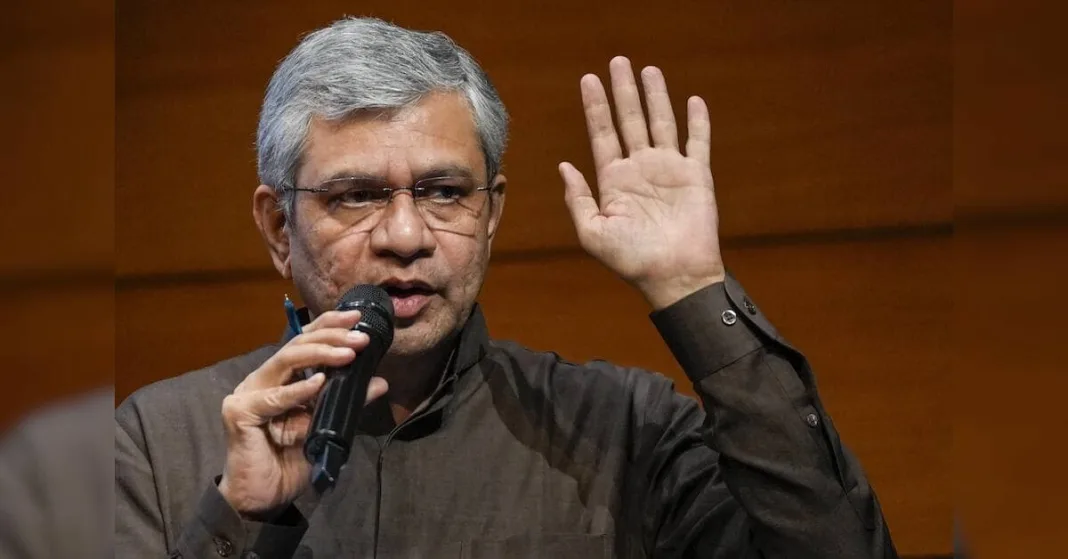

India will soon have its first Precision Manufacturing Institute alongside a model for developing talent, according to Ashwini Vaishnaw, Union Minister for Electronics and Information Technology, Railways, Information and Broadcasting.
Positioning precision manufacturing as an enabler across mobile manufacturing, aerospace, defence and semiconductors, the minister emphasised the need to support it at a fireside chat at Semicon 26 here.
“In a sense, we should be able to take a young person who is like a high school passed…and (provide) that person over a period of time will have different levels of skills, equivalent to a good B.Tech engineer from any other part of the world,” Vaishnaw said.
The minister mentioned a skilling model under discussion with around five levels. “The level one course will be about 240 hours, level 2 course will be bigger than that,” he added.
Further, Vaishnaw highlighted that with Semicon 2.0, the focus will be on upgrading the curriculum, including a shift in focus from chip design towards system design.
“System design would mean that the students who pass through that course will be extremely sought after in the industry,” he said, adding that there is a huge demand for skilled talent.
The minister said that the target of training 100,000 technicians set under ISM 2.0 might be increased due to heightened demand within the industry.
Asked about challenges, the minister pointed to growing debt levels in developed countries: “the global debt which has got accumulated in the rich world, if that unravels in a very disorderly fashion, then what will happen to the investments which are about to come?” Vaishnaw said.
He underlined that the government had prepared a two-decade roadmap for the semiconductor industry owing to the sector’s complexity and added that Semicon 2.0 is expected to achieve its targets before the deadline, similar to Semicon 1.0, which finished in four years against a target of six years.
“It’s like a classic S-curve. Once you are able to move on, initially you have to put in a huge effort. But then once that momentum begins, then the effort is much less,” Vaishnaw said.
The government recently approved Semicon 2.0, with an outlay of ₹1.275 trillion, which rests on six pillars: design, materials and machines, additional fabs, more ATMP capacity, research and development, and talent.