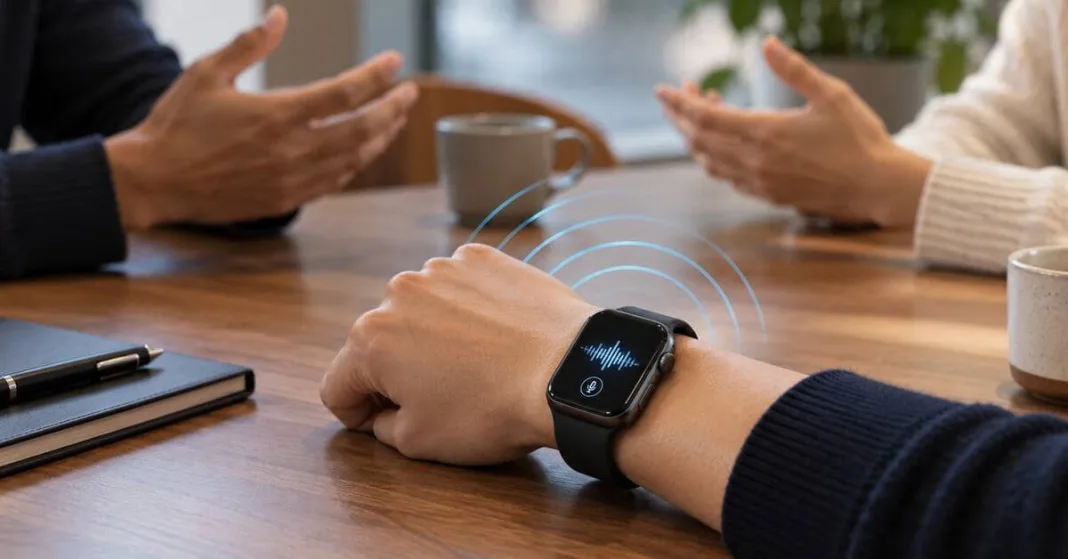

A person wearing an AI-powered device may know that the device is listening. The person sitting across the table may not. That gap is becoming harder to ignore as wearables move beyond tracking steps and heart rate to understanding conversations, recognising surroundings and turning what they hear and see into information.
Apple’s new Watch Series 12 offers a useful example. Its Live Rewind feature can show a text snippet of what was said during the previous 15 seconds, while Siri Recap can create high-level summaries of conversations. Both features are designed to work around the user’s conversations rather than simply respond to a command.
At almost the same time, Meta is reportedly preparing a camera-free version of its smart glasses, codenamed Luna. According to Reuters, citing a report by The Information, the glasses are expected to remove the camera while retaining microphones, speakers and AI capabilities. The reported move comes amid increasing scrutiny over the privacy implications of camera-equipped wearables.
The two developments approach the same problem from different directions. One makes a wearable better at understanding what people say. The other reportedly removes one of the most obvious sensors associated with privacy concerns.
The question is what happens to everyone else within range of these devices.
The person wearing the device is only one part of the conversation
Apple says Live Rewind is opt-in and only activates when the wearer double-presses the Digital Crown. It captures the previous 15 seconds of speech, displays a text snippet and does not continuously transcribe conversations in the background. Siri Recap is also controlled by the user and can be scheduled for particular times or locations.
Apple has also built several privacy measures around the features. Live Rewind is processed on the device, while Siri Recap uses Apple’s Private Cloud Compute for parts of the processing. Apple says saved summaries and Live Rewind snippets are end-to-end encrypted through iCloud and that Siri Recap data is automatically deleted after seven days if the user does not save it.
These controls give the wearer some visibility into when the feature is active and what happens to the resulting data. The person sitting opposite the wearer has a different set of circumstances.
They may have no Apple Watch. They may not know that a conversation is being processed. They may be comfortable with being heard but not with their words being converted into notes, stored, summarised or potentially analysed by an AI system.
This creates what could be described as bystander privacy. The wearable belongs to one person, but its sensors operate in an environment occupied by several people.
Dhananjay Yadav, co-founder and CEO of Indian AI wearable startup NeoSapien, said the industry needs to recognise this distinction.
“The person buying a wearable is not the only person affected by it,” Yadav said. “Their acceptance of an app’s terms cannot reasonably represent everyone they later meet.”
For Yadav, consent also needs to be separated by purpose. Someone could agree to a meeting being transcribed but object to their emotional state being analysed, or to their words being used to train an AI model.
“These are different permissions,” he said.
A microphone can be as consequential as a camera
The privacy discussion around smart glasses has largely focused on cameras.
That concern has already reached regulators. Ireland’s Data Protection Commission engaged with Meta over its Ray-Ban smart glasses, raising concerns about whether people captured by the glasses would receive adequate notice. Following the engagement, Meta increased the size of the external privacy LED and added a blinking pattern when recording.
Meta has continued to face scrutiny over the recording indicator. The Verge reported earlier this month that the company had introduced another privacy measure after users found ways to obstruct the recording LED, with the glasses now disabling the camera if the indicator is covered.
Yet a camera is only one way a wearable can observe its surroundings.
A microphone can pick up a conversation without creating a visual record. AI can then turn that audio into searchable text, extract names, identify decisions, summarise discussions or potentially derive information from the way something was said.
This is where the move towards AI changes the privacy equation.
The Information Commissioner’s Office in the UK has previously warned that immersive technologies such as smart glasses can deliberately or inadvertently monitor people close to the device. It has also pointed to the problem of increasingly discreet devices making covert surveillance easier.
The privacy question becomes more complicated when the device is not simply recording, but interpreting. A photograph can become a description of a scene, an identified person or an extracted piece of text. Audio can similarly become a transcript, a summary or an inference about what was being discussed. AI can therefore create several layers of information from a single interaction.
Deleting audio does not necessarily solve the problem
Capturing information is only the first stage. What happens to that information afterwards creates another set of privacy questions.
Yadav said companies need to distinguish between protecting information after it has been captured and establishing whether that information should have been captured in the first place.
“Protecting captured information and establishing permission to capture it are separate responsibilities,” Yadav said.
That distinction matters because deleting the original recording does not necessarily remove everything generated from it. A transcript or summary can retain another person’s words after the audio itself has been deleted.
The UK’s ICO said in its 2026 guidance for consumer IoT products that consent should be real, specific and freely given, while privacy information should be provided in plain language and data collection should be limited to what is necessary.
For wearable AI, that principle becomes complicated because the person whose information is being collected may not be the customer.
A wearable may be recording a conversation that is important to its owner, but the conversation itself involves other people whose words become part of the resulting transcript or summary. That makes retention another part of the bystander privacy question, particularly when derived information can persist beyond the original interaction.
A recording light is useful, but it has limits
A visible indicator is an obvious solution. If a light turns on when a wearable records, people nearby at least have a signal that something is happening.
Apple has taken this approach with Live Rewind. The company says the feature plays an audible chime when activated and displays a microphone indicator and full-screen animation.
Yadav also sees indicators as an important starting point. He said Neosapien’s Neo1, a wearable pendant-like device that can transcribe and summarise speech, uses a white light to indicate active listening and has a mode that allows capture to be paused.
But an indicator solves the problem of notice, not necessarily the problem of choice.
A person can know that a device is recording and still have no practical way to prevent their voice from being captured. In a restaurant, office or public transport, walking away may not be realistic.
The ICO’s guidance on body-worn recording makes a similar distinction. It recommends clear privacy information, visible indicators and retention controls, while warning that continuous recording can capture people going about their daily lives and may be excessive.
For consumer AI wearables, this suggests that the recording indicator cannot be the entire privacy system.
Yadav said safeguards should cover “what is captured, what is inferred, where it is processed, how long it is retained and who can access it”.
He also argues that companies should provide a practical way for bystanders to raise concerns or request removal without requiring them to become customers.
Wearables may need to design for the person across the table
The basic proposition behind AI wearables is that the device can remember what the wearer forgets, understand what the wearer sees and hears, and reduce the need to interact with a phone.
But the environment around the wearer is part of the input.
That makes bystanders part of the product experience, whether manufacturers intended them to be or not.
Yadav said companies should test products with people sitting across from the wearer, rather than testing only with customers. Their ability to understand what is happening and say no should become part of product design.
That could mean clearer recording signals, easier ways to pause capture, shorter retention periods, local processing, automatic deletion and restrictions on secondary uses. It could also mean designing devices to minimise unrelated speech rather than simply capturing everything within microphone range.