

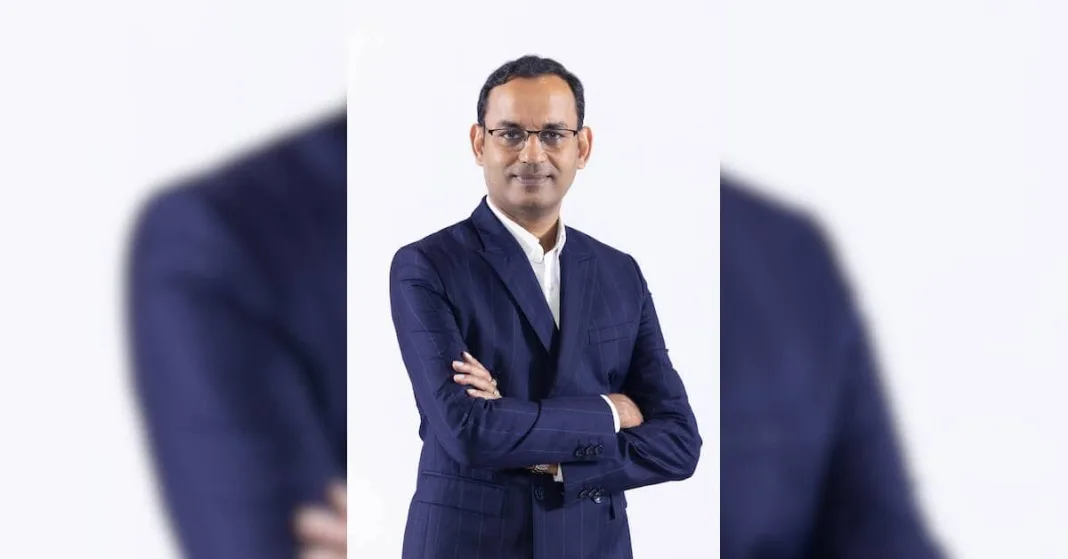

Q: It has been around 16 months since you took over this role. Have you made any strategic changes for Dell in India during this period? How would you look back at the past year?
A: I think what is more pertinent is how the industry has changed over the last year. The pace of change has increased dramatically. I said exactly the same thing a year ago, but with AI becoming front and centre, everything is changing at a phenomenal pace.
About a year ago, we were talking about generative AI. Today, everyone is talking about agentic AI. We are used to humans interacting with machines, but now machines are going to interact with machines, and that is going to create a tremendous amount of data.
As customers go through the journey of modernising themselves and adopting and transforming through AI, they need partners who can connect the pieces. We have the distinct advantage of being an end-to-end organisation. You can think of us from client to edge to core to cloud; we have a play in each of those areas.
That has been the most fundamental change. It has also required us as an organisation to upskill ourselves and build more capabilities. We have done significant projects at scale over the last year, and some of those could only have been done through skill development, capacity enhancement and capability enhancement.
Q: How has the AI opportunity impacted Dell India’s business? How have initiatives such as the hardware PLI scheme and the government’s push around data centres helped Dell strengthen its position in the Indian market?
A: There are a couple of things that have really worked for us. Number one, globally, we are one of the largest AI infrastructure providers. That gives us a native advantage in terms of understanding the ecosystem.
Number two, we have created offerings such as the Dell NVIDIA AI Factory that go right from outcomes. We bring the outcomes, create the use cases, look at the data and create the data pipeline, and then look at the infrastructure with an open ecosystem.
We have created the entire end-to-end stack that we are able to bring to customers so that they can go to market much faster. We have seen success with that, for example, in the legal sector with Lakshmikumaran & Sridharan Attorneys deploying the Dell AI Factory. An organisation like Zoho, which is significantly larger and very strong in the IT space, has also deployed the Dell AI Factory to deliver these outcomes.
The other advantage is that because we have an end-to-end portfolio, from clients to core to cloud, we believe that desk-side agentic deployments are starting to increase. If an organisation wants to run AI in its data centre, we have an offering. If it wants to run it next to the developer, we have an offering. All of these things have significantly helped us create an end-to-end proposition, and the market has rewarded us with trust and partnerships across customers and the partner ecosystem.
Q: Dell has participated in the Indian government’s Production Linked Incentive (PLI) schemes. Could you share how has your manufacturing capacity caters to the domestic market and for exports?
A: Dell India is really a microcosm of Dell globally. We have the second-largest number of patents coming out of India globally. Pretty much all the products that we have globally have a footprint in India. Be it storage, servers, or the client side, a lot of the engineering effort comes out of India. We also have legal, accounting, and service support here. Pretty much every function that exists globally has a footprint in India. That gives us a significant advantage in terms of the talent pool.
On manufacturing, we have been here since 2008. It has been an evolution. The products have changed and the capabilities have continued to evolve. As we participate in PLI, we continue to evolve our capabilities in terms of what we manufacture here. We manufacture desktops and laptops, and a significant portion of our server portfolio is manufactured in Chennai. It is a fairly large operation, and we are continuing to scale it up.
Dell Technologies spends approximately $1.1B (₹87.4B) with suppliers in India for the India market and we trigger $14.2 million (₹1.18B) in daily sales activities in-country (Dell Economic Impact Report, India, 2024).
Q: Overall PC penetration in India has not increased significantly. At the same time, despite a lot of discussion around AI PCs, we have not seen significant market penetration yet. How do you see the adoption of AI PCs in India?
A: I think, quite to the contrary, I would say the AI PC mix has increased significantly. Whether overall PC penetration has improved enough is debatable, but within the PC market, the contribution of AI PCs has increased significantly. If you look quarter by quarter over the last six quarters, it has been growing significantly. There are a couple of things to remember here. When we talk about large language models, we tend to think of them as the only model. But a lot of small language models are going to be purpose-fit, and they can run on the PC. A lot of application providers will also have AI applications running on PCs. That development is in progress, and increasingly more ISVs are doing this.
The refresh cycle of a PC, depending on the enterprise, is anywhere between three and five years. If somebody is buying a PC today but not buying an AI PC, they would not be able to use the capabilities of the application ecosystem that will be available one or two years down the line. That is why organisations are increasingly moving towards AI PCs.
The ability to run small language models on PCs is also what gives power to the developer. We have the GB10, which is something you can hold in your palm and is lighter than possibly a laptop, that can run a 200-billion-parameter model. Then there is a Dell Precision 9 that can run a 500-billion-parameter model, and a GB300 that can run a trillion-parameter model, all sitting on the desk. What used to take a floor of a data centre earlier is something that I can have under my hood tomorrow.
Q: Token consumption is rising sharply as enterprises scale their use of AI. How are you addressing concerns around the cost of tokens for your customers?
A: There are two forces at work here. The first is that token consumption has gone up significantly. It has gone up more than 300 times. But, on the contrary, the cost of tokens has reduced drastically. It has gone down by 80 per cent year-on-year. That is the journey we will continue to be on as new infrastructure and new technologies come into the market.
The second part is that how organisations architect their AI infrastructure can significantly define their cost of tokenisation. Some of the examples I gave you around desk-side agentic can significantly bring down the cost of tokens because you can do a lot of that locally, on your premises and next to the desk. With desk-side agentic, we have seen token costs reduce by as much as 87 per cent. This is really about how you architect it in the best possible way so that token costs can be limited while organisations continue to take advantage of what the technology brings to the table.