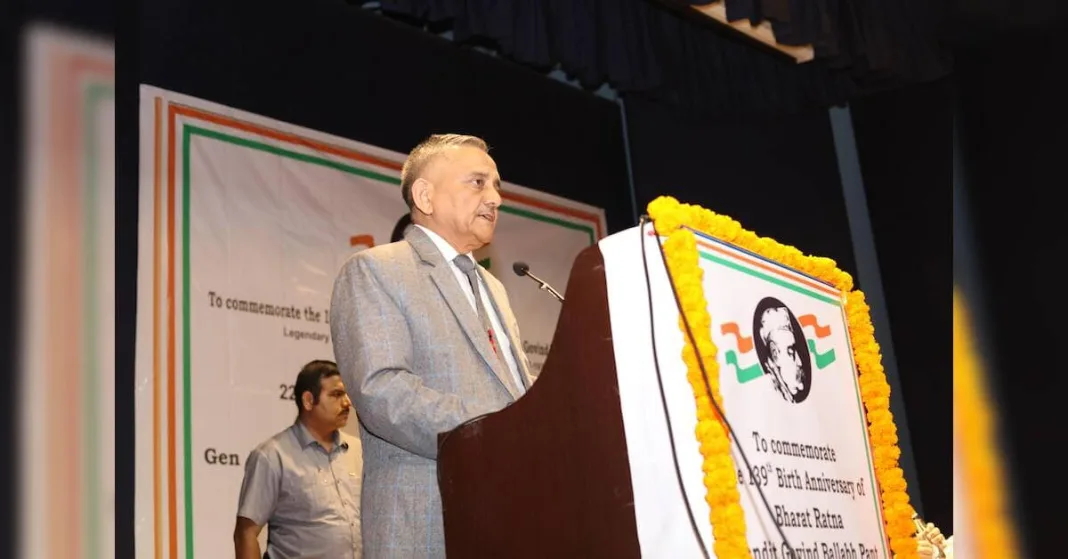

Pakistan will remain a security concern for India, former Chief of Defence Staff General Anil Chauhan (retired) said on Saturday.
While delivering the Govind Ballabh Pant memorial lecture, Chauhan, who retired in May, said, “Pakistan will remain a security concern or threat for the times to come.”
The topic of Chauhan’s address on the birth anniversary of Pant, who was a freedom fighter, the first chief minister of Uttar Pradesh and the country’s Home Minister from 1955 to 1961, was India’s threats and challenges.
Chauhan explained to his audience at the Teen Murti Bhawan, a historic estate in New Delhi, that a threat is relatively immediate, visible and identifiable, requiring action to mitigate it. A challenge is long-term, less distinct and evolving. It may or may not demand an immediate military response, but if neglected, it could mature into a threat.
India has reduced the space for conventional operations with Pakistan through three recent military campaigns: Operation Sindoor (2025), Balakot (2019) and Uri (2017). He said while “terrorism and proxy wars will remain a challenge for us”, India should continue to build credible deterrence.
Pakistan’s recent signing of an accord could lead to its overconfidence, and it might make “some kind of a miscalculation”, he said, without naming the trilateral agreement, called the Mecca Pact, which was signed among Pakistan, Saudi Arabia and Türkiye on August 7.
“We got to be careful about that.”
China, on the other hand, presents a different, long-term and comprehensive challenge, Chauhan said, adding that “the boundary issue remains unresolved and there’s no mutually agreed definition” of the Line of Actual Control (the de facto border).
The differences in perceptions, along with infrastructure development, have increased the space for friction, he said, adding that the Indian armed forces should stay vigilant and agile. He welcomed the new India-China measure of having more military hotlines and corps commander-level talks.
“But our relationship with China cannot be held hostage to only boundary issues,” Chauhan said.
Safeguarding national security today means simultaneous engagements, he said.
The global security flux and the uncertainties it has brought present the biggest challenge to India’s national security at this time. The old balance of power has weakened, and the structures of the new order have yet to emerge fully. Some call it a disorder, and it might prevail for some time. Alignments have become issue-based and transactional, he said.
“It is increasingly difficult to place countries into permanent categories of friends and adversaries,” he said, adding that a security partner on one front could hold a different position on another.
“Military power is being employed not as a last resort but as a first instrument of state policy.”
Pant’s son, K C Pant, was India’s Defence Minister over 1987-89, when a task force was set up to draw India’s national security architecture.