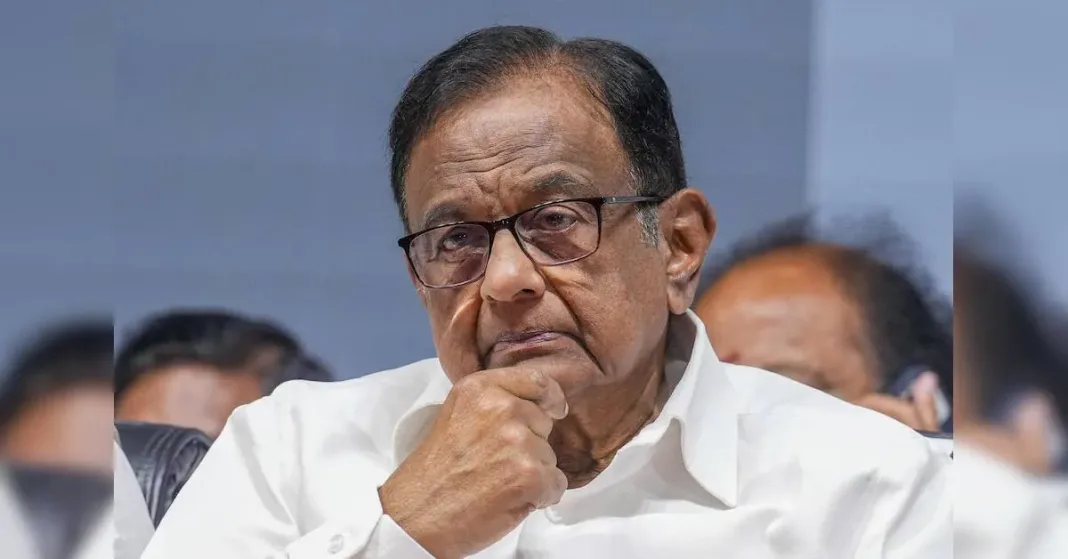

Congress leader P Chidambaram on Saturday dubbed a bill recently passed in Parliament to prevent unfair means in exams as without any use, alleging exams are being cancelled daily in states, including Maharashtra.
Speaking at an event here on the recently concluded monsoon session of Parliament, Chidambaram hit out at the BJP for claiming to have passed several bills though they merely passed “useless bills” without any debate.
In the Tamil Nadu Assembly, Ministers, the Leader of the Opposition, the Deputy Leader of the Opposition, and members all speak, while the Speaker issues rulings.
Watching this makes one feel that being a Member of the State Assembly –Tamil Nadu– is far better than being a Member of Parliament, he said.
In Parliament, no such debate takes place, he claimed.
The Leader of the Opposition is not permitted to speak, Ministers do not answer questions, members do not talk, and the Speaker simply instructs everyone to sit down without rendering rulings.
The most concerning aspect of this monsoon session was the absence of debate.
Although a list was released claiming that 12 bills were passed, not a single one was passed following discussion, he alleged.
On the Public Examinations (Prevention of Unfair Means) Amendment Bill, 2026, he said the provisions merely lay down punishments. This should have been titled a bill prescribing punishments rather than one aimed at prevention. As the English proverb goes, it is like locking the stable after the horse has bolted.
He said: “Now, with this law, will unfair practices stop happening hereafter in public examinations? Just yesterday, a public examination was cancelled. The day before yesterday, another public examination was cancelled. In Maharashtra, two public examinations were cancelled. In Rajasthan, one public examination was cancelled. Therefore, this is a useless law. Daily, after this law was passed, public examinations are being cancelled. In Maharashtra, Rajasthan, Bihar, and Uttar Pradesh, public examinations are being cancelled.
After passing useless bills without any debate, they (BJP-led government at the Centre) boast that they adopted several bills. Therefore, there is no use in enacting such useless laws, he alleged.
Out of the 12 bills passed, two are mischievous and it includes the Mines and Minerals (Development and Regulation) Amendment Bill, 2026 to amend the Mines and Minerals (Development and Regulation) Act, 1957.
Providing a context to this Bill passed in the Parliament, Chidambaram said the Supreme Court had ruled that the Central government had the authority to levy taxes, but state governments also had the authority.
The Supreme Court gave a judgment stating that state governments can also levy taxes over and above the Central government’s tax.
He said: “We didn’t say the central government levying taxes is wrong. It is permitted under the law. But after the supreme court ruled that state governments can also levy taxes, some states imposed taxes. Whether that tax is a burden or not is a separate debate. Now, the controversy is not about the tax burden; it is about the right to tax.” According to the Supreme Court judgment, both governments can levy taxes. If both governments levy taxes, the tax burden increases and that is a different matter. Then the central government can lower its tax, or the state can lower its tax and that is a separate debate.
Diluting that judgment, they amended the law stating that if state governments levied taxes, the power to regulate it was with the union government, he said.
“Listen carefully. Contrary to the Supreme Court’s judgment that both the central and state governments have rights, they passed a law stating that if state governments levy taxes, the Central government has the authority to regulate those taxes. What does that mean? If Odisha, Tamil Nadu, or Bihar levies a tax, there may be a ceiling on that tax and it could not go beyond a certain rate and the rules in this regard would be framed by the Centre.” If the Centre makes those rules and laws, the state government’s right to levy taxes will be diluted.
Levying taxes is the right of a State legislature and if a law is passed in Parliament overriding the state legislature to grant rule-making rights to the Centre, the rights of the state government will virtually disappear.
Now, the matter may have to go to the SC again and there will be another dispute.
It took seven to eight years just for the old dispute to end.
If this new dispute starts, it will take another seven to eight years.
During these seven to eight years, state governments will not be able to levy taxes on mines and minerals.
If they levy a tax, the Centre will declare it as not valid.
“That is why the state governments are fighting. They passed this Bill without any debate. There was no debate at all,” Chidambaram, also a Rajya Sabha MP from Tamil Nadu said.
The monsoon session of Parliament commenced on July 20. It was adjourned sine die on August 13, 2026. The total number of Bills passed by both Houses of Parliament during the session was 12.