
Published on August 24, 2026 |

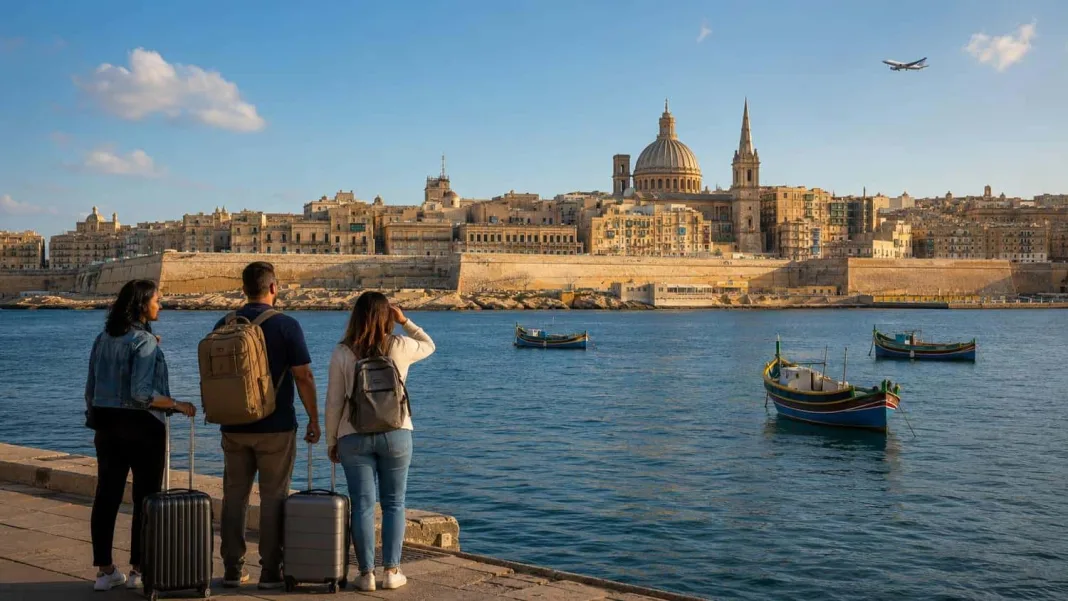
Image generated with Ai
Malta is recording another powerful year for international tourism in 2026. The Mediterranean island nation is attracting more visitors while also changing how it manages the impact of tourism on its infrastructure and environment.
Official figures from Malta National Statistics Office show that 2,131,825 international tourists visited Malta during the first six months of 2026. This represented an 18.1% increase compared with the same period of 2025.
The strong growth puts Malta among the Mediterranean destinations experiencing significant tourism expansion this year. At the same time, the country has introduced a higher environmental contribution and a new collection framework for accommodation providers.
The combination highlights an important challenge for Malta. The destination wants to maintain tourism growth while ensuring that visitors contribute towards the infrastructure and tourism environment that support their holidays.
Advertisement
Advertisement
Malta Tourism Growth Accelerates in 2026
Malta started 2026 with strong visitor numbers.
January alone brought an estimated 235,772 inbound tourists, which was 21.4% higher than January 2025. These travellers generated more than 1.38 million overnight stays during the month.
The momentum continued during spring.
April recorded 409,403 inbound tourists, representing annual growth of 16.6%. May was even stronger. Malta welcomed approximately 457,636 tourists that month, a sharp 22.3% increase compared with May 2025.
Advertisement
Advertisement
June maintained the double-digit trend. Visitor arrivals reached 458,223, up 18.5% year on year. Holiday travel dominated, with 427,333 visitors travelling to Malta for holiday purposes.
These figures provide official evidence that Malta is experiencing a substantial tourism surge rather than a short-lived monthly increase.
More Than 2.13 Million Tourists Arrive in Six Months
The scale becomes clearer when the first half of 2026 is considered as a whole.
Between January and June, Malta received more than 2.13 million inbound tourists, while visitor nights reached approximately 11.8 million. Overnight stays increased 10.1% compared with the corresponding period of 2025.
Tourism expenditure also increased strongly.
International visitors spent an estimated €1.7956 billion during the first six months of the year. That was 14.8% higher than the same period in 2025.
However, expenditure per tourist moved in the opposite direction. Average expenditure per capita fell from €866 in 2025 to €842 in 2026 during the January-to-June period.
This creates an important tourism industry story. Malta is receiving substantially more visitors and generating more overall tourism revenue, even as average spending per visitor has declined.
Gozo and Comino Share the Tourism Boom
Tourism demand is also extending beyond Malta’s main island.
Official statistics show that 1,123,572 tourists visited Gozo and Comino during the first six months of 2026. The figure includes both overnight tourists and same-day visitors and represented 52.7% of Malta’s total inbound tourist count.
In June alone, around 277,985 tourists visited Gozo and Comino.
This wider distribution is important as Malta manages rising visitor volumes. The country’s historic towns, coastal areas, cultural attractions, entertainment scene and Mediterranean setting give travellers several reasons to explore beyond a single tourism centre.
But rising demand also increases pressure on accommodation, public spaces, transport systems and visitor infrastructure.
Malta Raises Environmental Contribution From July 2026
Malta has simultaneously changed the environmental contribution charged on tourist accommodation.
From 1 July 2026, the contribution became €1.50 per night for every person aged 18 or older at the beginning of the visit. The total charge is capped at €22.50 per person per visit.
The contribution applies to stays in licensed accommodation across Malta and Gozo.
Importantly, this is not simply an optional hotel surcharge. It forms part of Malta’s statutory eco-contribution framework.
The Malta Tourism Authority states that the contribution must be charged separately from the accommodation price and shown as a distinct item on the guest’s invoice or fiscal receipt.
New Collection Framework Strengthens Tourism Management
A new centralised system for reporting, administering and collecting the Malta Eco-Contribution also took effect on 1 July 2026.
According to the Malta Tourism Authority, the contribution supports investment connected with Malta and Gozo’s tourism product, visitor experience, public infrastructure, environmental sustainability and safety.
This makes the change particularly significant during a period of rapid visitor growth.
More tourists can generate greater revenue for hotels, restaurants, attractions, airlines and other tourism businesses. Yet higher visitor volumes can also increase pressure on roads, public facilities, coastal destinations and local infrastructure.
Malta is therefore facing the same balancing act confronting many successful tourism destinations: how to keep tourism economically valuable without allowing growth to undermine the places visitors come to experience.
What Malta Tourism Growth Means for Travellers
For international travellers, Malta remains a highly active Mediterranean destination in 2026.
The country’s tourism performance shows that demand is growing rapidly. Visitors should therefore consider booking accommodation and popular experiences early during busy travel periods.
Travellers should also include the environmental contribution when calculating accommodation costs. The individual charge is relatively small compared with the overall cost of an international holiday, but it represents a wider shift towards making tourism contribute directly to destination management.
Malta’s 2026 story is consequently about more than rising arrival numbers.
With inbound tourism increasing 18.1% during the first half of the year and the revised eco-contribution system now in force, Malta is combining rapid tourism expansion with a stronger framework for funding its visitor economy and tourism environment. How effectively the country manages that balance will become increasingly important if visitor growth continues through the rest of 2026.
Advertisement
Advertisement