

Published on August 23, 2026 |

Image generated with Ai
Ithaca and more legendary islands are gaining fresh global attention as The Odyssey puts Greece on the international travel map. The blockbuster is reviving interest in Greece, its legendary islands, ancient stories and spectacular landscapes. Meanwhile, Ithaca tourism is emerging as a major travel conversation, even though the film was not shot there. Other Greek destinations connected with the story and production are also attracting curiosity from travellers. As Greece prepares for another busy tourism season, this new wave of cinematic interest could reshape travel plans. Travel And Tour World urges readers to read the entire story to discover how The Odyssey is influencing Greece travel and inspiring new journeys across its legendary islands.
Ithaca is hoping Christopher Nolan’s The Odyssey will transform international curiosity into a powerful new tourism opportunity. The Ionian island, traditionally identified as the homeland of Homer’s Odysseus, has remained relatively distant from Greece’s busiest tourist centres. Now, the global attention surrounding the blockbuster is giving the destination a fresh reason to appear on travellers’ itineraries.
A Small Island With a Huge Literary Connection
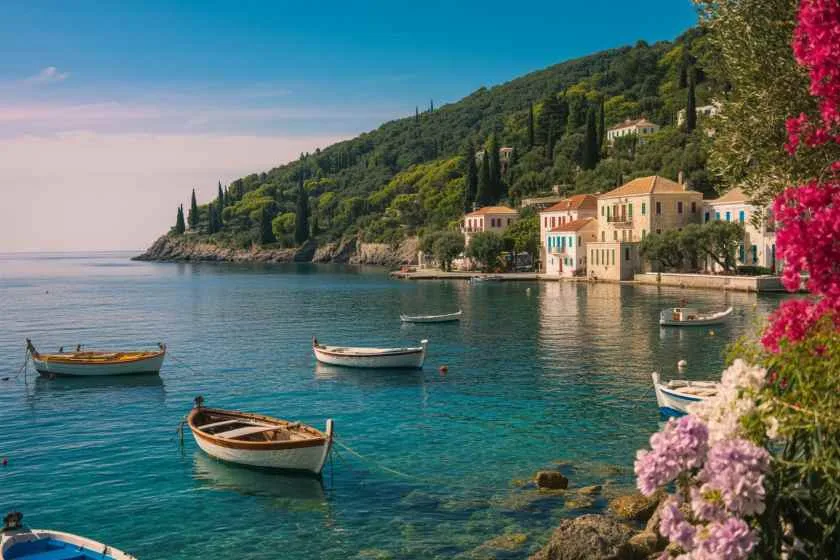
Ithaca lies in the Ionian Sea, off Greece’s western mainland, and has roughly 3,000 residents. Its landscape is markedly different from Greece’s most crowded island destinations.
Visitors encounter rugged hills, olive and cypress trees, clear waters, sheltered bays and small coastal settlements. Even during the busy summer period, the island has generally maintained a calmer atmosphere than major tourism hotspots.
Advertisement
Advertisement
That quieter character could become a major attraction for travellers seeking an alternative Greek island experience.
The Movie Was Not Filmed in Ithaca
There is an important distinction for film-inspired travellers.
Although The Odyssey has renewed attention around Ithaca, the island itself did not host scenes from the movie. Several Greek locations were used for the production, but Ithaca was not among them.
That has created some disappointment locally. At the same time, businesses and tourism representatives see the publicity as a valuable opportunity.
The film received open-air screenings on Ithaca following its worldwide release on July 16, adding another layer to the island’s connection with the cinematic event.
Why Travellers May Want to Visit Now
For visitors, Ithaca offers much more than a connection to a Hollywood production.
Greece’s official tourism portal presents the island through its beaches, villages, natural scenery, cultural heritage and maritime character. Travellers can explore Vathy, the island capital, alongside traditional settlements and coastal areas.
The island also provides opportunities for hiking and exploring its mountainous interior.
This makes Ithaca suitable for travellers who want to combine mythology with outdoor experiences, coastal relaxation and local culture.
Follow Odysseus Through Ithaca’s Heritage
The mythology becomes more tangible through Ithaca’s archaeological collections.
Greece’s Ministry of Culture lists both the Archaeological Museum of Vathy and the Archaeological Collection at Stavros among the island’s cultural attractions.
These museums allow visitors to explore archaeological evidence from Ithaca’s long history rather than experiencing the destination only through the fictional world of cinema.
For culturally curious travellers, this creates an itinerary that links ancient traditions with contemporary tourism.
The Next Greek Island Tourism Story?
Ithaca’s potential tourism boost comes at an interesting moment for Greece.
The country’s biggest destinations already face intense visitor demand, while Ithaca remains comparatively understated. The success of The Odyssey could introduce the island to travellers who might previously have overlooked it.
For visitors planning an Ionian holiday, Ithaca can also form part of a wider island-hopping journey. Greece’s official tourism resources highlight connections between Ionian destinations, making multi-island travel a practical way to experience the region.
The movie may have brought Ithaca back into the international conversation.
But for travellers, its strongest appeal remains the combination of Homeric mythology, archaeological heritage, green landscapes, secluded coastal scenery and a slower Greek island atmosphere.
If the expected tourism increase materialises, Ithaca could soon move from a relatively quiet literary landmark to one of Greece’s most talked-about cultural travel destinations.
The Odyssey Tourism Effect in Greece: Which Destinations Are Already Seeing More Visitor Interest?
Christopher Nolan’s The Odyssey has created a new wave of attention around Greece, particularly the Peloponnese. However, there is an important statistical distinction: the film was released internationally in July 2026, so there is not yet enough official post-release tourism data to prove that individual Greek destinations experienced a full-year increase because of the movie.
The strongest evidence currently comes from early 2026 aviation figures, tourism indicators, destination reports and search behaviour. Greece’s official film agency confirms that filming took place at Pylos, Methoni Castle, Voidokilia Beach, Almyrolaka Beach and Acrocorinth.
Greece’s Overall Tourism Baseline Before the Film Effect
Greece entered the Odyssey release period from a position of strong tourism growth. Bank of Greece data show that inbound traveller flows increased 6.4% in 2025, while travel receipts reached €23.63 billion, up 9.4% year on year. Greece recorded 41.75 million regional visits in 2025, although these are visits rather than unique travellers.
The Ionian Islands recorded 3.78 million visits in 2025, compared with 3.43 million in 2024, an increase of approximately 10.0%. The Peloponnese is included within the country’s mainland tourism system and was already recording growing international air demand before the movie premiered.
Messinia and Pylos: The Main Greek Odyssey Tourism Hotspot
Messinia is the clearest Greek destination associated directly with Nolan’s production. The production used Pylos and surrounding landscapes, making the southwestern Peloponnese the film’s principal Greek geographic cluster. The official Hellenic Film Commission identifies Pylos, Voidokilia, Almyrolaka, Methoni Castle and Acrocorinth as filming locations.
There is already evidence of increased visitor curiosity. The regional tourism organisation says the production has generated an unprecedented wave of international publicity. A hotel near Pylos also reported receiving questions from an American traveller specifically interested in the real locations used for the Cyclops sequence.
However, no official Pylos visitor-arrival series has yet isolated visitors motivated by The Odyssey. Therefore, it would be inaccurate to claim that Pylos has already recorded a quantified movie-driven tourism increase.
Voidokilia Beach and Nestor’s Cave: The Cyclops Effect
Voidokilia Beach and Nestor’s Cave are among the most recognisable Greek locations connected with the film. Nestor’s Cave was used for the Cyclops-related material, while Voidokilia provided the surrounding cinematic landscape.
The attraction is particularly important because these are real, accessible landscapes rather than studio recreations. The Peloponnese tourism authority says the locations have received exceptional international publicity following the production.
Yet there is currently no official government statistic showing visitor numbers at Voidokilia before versus after the July release. Consequently, the most defensible conclusion is that interest has increased, while the size of the actual tourism increase remains unquantified.
Methoni Castle: Heritage Tourism Gets a Hollywood Platform
Methoni Castle became another important Greek filming location. The Hellenic Film Commission officially lists it among the Peloponnese locations used for The Odyssey.
The fortress already had strong historical tourism value before the film. Its new cinematic association gives international visitors another reason to include southern Messinia in their itineraries. Recent reporting from the region indicates that visitors are actively seeking out Methoni alongside Voidokilia and Nestor’s Cave.
Again, there is no published official 2026 post-release visitor count for Methoni Castle that permits a reliable before-and-after calculation. The correct interpretation is therefore increased tourism interest rather than a confirmed percentage increase caused exclusively by the film.
Almyrolaka Beach: A Lesser-Known Location With New Exposure
Almyrolaka Beach near Gialova is one of the less internationally recognised Odyssey locations. Its inclusion matters because film tourism can spread visitor demand beyond famous landmarks.
The official Greek film agency confirms Almyrolaka as one of the production sites.
Before the film, the beach formed part of the wider Gialova and Navarino tourism area. After the production became public, international travel coverage began identifying it as part of the Odyssey itinerary. However, no official visitor counter or tourism-arrival dataset currently separates Almyrolaka’s film-related visitors from normal beach users.
Kalamata: The Gateway Showing the Strongest Measurable Signal
Kalamata is particularly important because its airport provides an objective gateway indicator for Messinia.
Kalamata International Airport handled 368,515 passengers in 2025, representing an 8.7% increase over 2024. International traffic accounted for 92.4% of total passenger movement.
In June 2026, international flights at Kalamata reportedly increased 26.2% year on year. This is an important early signal, but June was still before the movie’s July theatrical release. Therefore, the increase cannot scientifically be described as a post-release Odyssey effect.
The airport is also undergoing a major transformation. Greece’s Growthfund and Fraport Greece announced a €125 million investment programme under a 40-year concession, strengthening Kalamata’s role as the aviation gateway for Messinia and the wider Peloponnese.
Acrocorinth: A Second Peloponnese Film Tourism Opportunity
Acrocorinth gives the Odyssey tourism story a geographic extension beyond Messinia. The ancient fortress was officially selected as a Greek filming location and is considerably closer to Athens than the southwestern sites.
This creates an opportunity for travellers to build a broader film-inspired Peloponnese itinerary rather than visiting only the coastal Messinia locations. However, as with the other sites, official visitor statistics specifically attributing increased Acrocorinth attendance to The Odyssey are not yet available.
The Wider Peloponnese Is Already Growing
The broader regional numbers provide useful context. International air arrivals to the Peloponnese reached approximately 83,000 during January-June 2026, up 3.1% from the same period of 2025. That implies roughly 80,500 arrivals in the comparable 2025 period.
For January-May 2026, the Peloponnese recorded approximately 43,000 international air arrivals, up 10.9%, or around 4,000 additional passengers, compared with the same period in 2025.
These numbers demonstrate genuine regional growth, but they cover periods when The Odyssey had not yet been released. They therefore establish the baseline rather than proving the film caused the increase.
What the Current Data Actually Shows
| Destination | Film connection | Comparable pre-release data | Post-release official data | Confirmed film-driven increase |
|---|---|---|---|---|
| Messinia/Pylos | Major Greek filming area | Peloponnese +10.9% Jan-May 2026 | Not yet available | Not yet quantifiable |
| Voidokilia Beach | Cyclops-related location | No official site-level baseline found | Not yet available | Interest reported, percentage unavailable |
| Nestor’s Cave | Cyclops location | No official site-level baseline found | Not yet available | Interest reported, percentage unavailable |
| Methoni Castle | Filming location | No film-specific baseline | Not yet available | Interest reported, percentage unavailable |
| Almyrolaka Beach | Filming location | No site-level official baseline | Not yet available | Not yet quantifiable |
| Acrocorinth | Filming location | No film-specific baseline | Not yet available | Not yet quantifiable |
| Kalamata | Main gateway to Messinia | 368,515 airport passengers in 2025; +8.7% | June 2026 flight growth reported at +26.2% | Cannot yet be attributed to film |
| Peloponnese | Main Greek filming region | 83,000 international air arrivals Jan-Jun 2026; +3.1% | Post-July figures unavailable | Not yet quantifiable |
The Crucial Point for Travellers and Tourism Businesses
The Odyssey effect in Greece is therefore real as a visibility and travel-interest phenomenon, but still too recent for definitive post-film arrival statistics.
The strongest evidence currently points to Messinia, Pylos, Voidokilia, Nestor’s Cave, Methoni, Almyrolaka and Acrocorinth. The official Peloponnese tourism authority describes the international publicity as unprecedented, while early reports indicate travellers are already asking about the filming sites.
For accurate journalism, however, the 2027 tourism statistics will be much more important. They will provide the first full high-season comparison after the July 2026 release and should make it possible to determine whether The Odyssey created a measurable increase in arrivals, overnight stays and tourism spending.
Until those figures are published, the responsible conclusion is clear: Greece has received a major cinematic tourism boost in global visibility, but the precise number of additional tourists generated by The Odyssey has not yet been officially measured.
Conclusion
Ithaca and other legendary islands are entering a new chapter as The Odyssey brings Greece closer to the global travel spotlight. The film has renewed interest in ancient mythology, dramatic landscapes and destinations linked with Odysseus. However, the biggest tourism impact is still developing, with future visitor data expected to reveal the full effect. For travellers, this creates an exciting opportunity to explore Greece beyond its famous hotspots. Ithaca, the Peloponnese and other destinations offer history, beaches, villages and unforgettable cultural experiences. Travel And Tour World encourages travellers to look beyond the screen and discover the real Greece behind one of the world’s greatest legendary journeys.
Advertisement
Advertisement