
Published on August 23, 2026 |

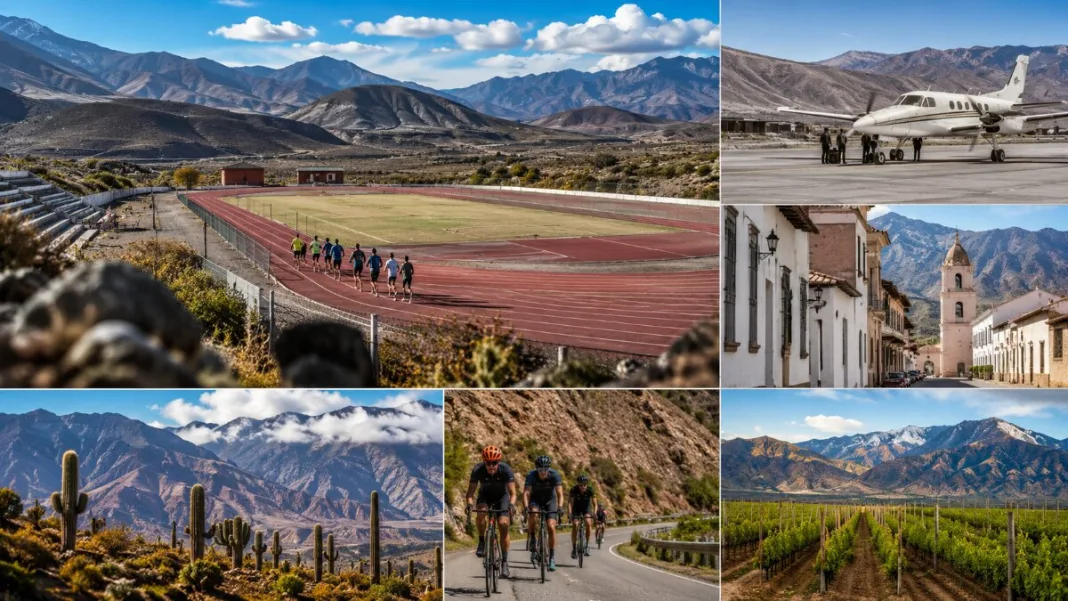
Image generated with Ai
Argentina is developing a stronger high-altitude sports tourism proposition around Cachi, where renewed athletics infrastructure is now intersecting with destination commercialisation and wider tourism planning. Salta’s official 2026 Public Works Plan allocates ARS163,983,604 for support works at Cachi’s High-Altitude Training Centre athletics track and ARS438,735,122 for the aerodrome perimeter enclosure. These are two separate projects worth ARS602,718,726 when combined, not one dedicated tourism investment. Meanwhile, Cachi’s tourism services are being presented to travel agencies as the destination seeks stronger national and international market access.
Cachi’s 2026 Story Moves Beyond an Established High Altitude Training Reputation
Cachi is not a newly discovered altitude-training destination. Athletes have used the locality for high-performance preparation for years. What has changed in 2026 is the quality of the supporting infrastructure and the increasingly deliberate effort to connect that sporting asset with tourism distribution.
The Government of Salta officially reinaugurated the athletics track at the Centro de Entrenamiento en Altura de Cachi in March 2026 following an extensive improvement programme. Provincial information confirms work on the sporting surface, training field, irrigation and drainage systems, access areas and complementary parts of the complex. The provincial government explicitly identified sporting, social and tourism effects as part of the importance of returning the facility to full operation.
The physical upgrade had been progressing before the reopening. Official Salta infrastructure records show that work included a rubber surface covering 2,284 square metres. A 15-millimetre layer of rubber and polyurethane was applied to create a level, non-permeable surface designed for high-performance training requirements. The redevelopment also involved work on the field, irrigation and associated infrastructure.
Advertisement
Advertisement
Argentina’s national tourism authority subsequently placed the development firmly within a tourism context on 19 August 2026, describing sports tourism linked to altitude training as an opportunity gaining prominence in Cachi. The national authority also states that the athletics track has international certification and forms part of a wider complex that includes a sports hall, accommodation and municipal swimming facilities.
Verified Cachi and Salta Figures Behind the Tourism Story
| Indicator | Official figure | What the figure actually represents |
|---|---|---|
| Athletics-track support works in Salta 2026 budget | ARS163,983,604 | Separate public-works allocation for support works at the High-Altitude Training Centre athletics track |
| Cachi aerodrome perimeter project in 2026 budget | ARS438,735,122 | Separate allocation for the aerodrome perimeter enclosure |
| Combined value of those two budget lines | ARS602,718,726 | Arithmetic total of two distinct projects, not an officially designated single sports-tourism fund |
| Athletics surface treated during redevelopment | 2,284 sq m | Area covered by the rubber-surface works |
| Rubber and polyurethane layer | 15 mm | Thickness stated by the Government of Salta |
| Cachi aerodrome perimeter enclosure | 4,142 metres | Completed perimeter length |
| Enclosure height | 2 metres | Official height of the finished aerodrome fence |
| Cachi aerodrome runway | 1,550 metres | Runway length reported by the Government of Salta |
| Aerodrome location | 2 km north-west of Cachi | Officially stated position relative to the locality |
| Cachi–Salta road distance | 162 km | Official Visit Argentina distance via Provincial Route 33 |
| Cachi–Cafayate road distance | 157 km | Official Visit Argentina distance via National Route 40 |
| Salta winter-recess tourists in 2026 | 267,628 | Preliminary provincial tourism count |
| Registered accommodation supply measured | 22,975 places | Provincial supply used in winter-recess analysis |
| Cachi winter occupancy | 63.4% | Provincial winter-recess occupancy |
| Cafayate winter occupancy | 62.7% | Provincial winter-recess occupancy |
| Salta city winter occupancy | 71% | Provincial winter-recess occupancy |
| Salta airport passengers during reporting period | 118,193 | Domestic and international passengers reported for the winter recess |
The investment figures come directly from Salta’s 2026 Public Works Plan, where the athletics project appears as project 289 and the aerodrome perimeter work as project 291.
Travel Agency Distribution Is the More Important New Commercial Development
Infrastructure alone does not turn an athletics facility into an internationally saleable travel product. The stronger B2B development came on 11 August 2026, when tourism authorities and local tourism organisations held a dedicated commercialisation session with travel businesses.
According to the Government of Salta, updated information covering Cachi’s tourism services, providers and experiences was presented to travel agents from Salta, Jujuy and Buenos Aires. The stated objective was to strengthen relationships with outbound distribution businesses, create new sales channels and provide agencies with material that could help them incorporate Calchaquí Valley products into their catalogues.
That distinction matters. Official information does not establish that new Cachi sports-training packages have already entered the catalogues of major operators. What has been confirmed is the commercial groundwork required for broader distribution.
Four days later, on 15 August, provincial authorities, the municipality and tourism organisations established another work programme aimed at strengthening Cachi’s tourism supply, improving destination competitiveness and supporting its international projection. The programme was also connected with Cachi’s 2026 Best Tourism Villages candidacy.
For travel businesses, those August actions may ultimately prove more commercially significant than the physical track upgrade itself. They begin addressing the difficult stage between having an attraction and creating a product that intermediaries can package and sell.
International Athletes Already Demonstrate Real Demand for Training in Cachi
There is also direct evidence that the high-altitude facility attracts athletes from outside Salta.
On 27 March 2026, the provincial government reported that athletes from several parts of Argentina were training in Cachi alongside representatives from Uruguay and Paraguay. Argentine participants were recorded from La Pampa, Chubut, Mendoza, Tucumán, Santiago del Estero, Buenos Aires and Salta, among other locations.
This provides a stronger basis for a sports-tourism story than infrastructure announcements alone. It establishes that Cachi is already receiving geographically diverse users whose primary reason for being in the destination is athletic preparation.
The national tourism authority adds another important characteristic. Adaptation to reduced oxygen availability during altitude training can require stays extending over several weeks, depending on the athlete, sporting discipline and training protocol.
That creates a potentially different visitor economy from ordinary leisure tourism.
Official Visit Argentina guidance recommends one to three days for a conventional Cachi visit. An organised athlete staying for a multi-week training programme could require substantially more accommodation nights, transport, recovery services and day-to-day local support.
No official dataset currently quantifies average athlete expenditure, annual training-camp bed nights or the total economic contribution of sports tourists in Cachi. Those figures should therefore not be estimated or presented as established facts.
Salta Gives Cachi Its Main Gateway While Cafayate Extends the Tourism Circuit
Cachi’s commercial potential is strengthened by its position within the wider Calchaquí Valleys rather than by operating as a standalone sporting enclave.
Official Visit Argentina information places Cachi 162 kilometres from Salta city via Provincial Route 33 and 157 kilometres from Cafayate via National Route 40. The same federal tourism platform recommends one to three days for Cachi and identifies its landscape, colonial heritage, Nevado de Cachi and proximity to Los Cardones National Park among its principal visitor assets.
Cafayate gives tour operators another established destination that can be incorporated into longer programmes. Visit Argentina places Cafayate 183 kilometres from Salta city by National Route 68 and recommends a stay of two to four days.
For B2B planners, this creates a logical three-point geography.
Salta city provides the principal scheduled-air gateway and the largest tourism-services base.
Cachi provides the specialist high-altitude sports proposition.
Cafayate can extend the journey through another established Calchaquí Valley tourism destination.
The Government of Salta’s latest winter-recess figures add evidence of functioning visitor demand across that geography. The province recorded 267,628 tourists against a measured accommodation supply of 22,975 places. Salta city and La Caldera each achieved 71% occupancy, while Cachi recorded 63.4% and Cafayate 62.7%.
During the same reporting period, Martín Miguel de Güemes International Airport handled 118,193 domestic and international passengers, reinforcing Salta city’s role as the principal redistribution point for the province.
Cachi Aerodrome Is an Infrastructure Development but Not a New Airline Gateway
The aerodrome requires especially careful reporting.
The Government of Salta confirmed on 15 June 2026 that construction of a new perimeter enclosure at Cachi aerodrome had been completed. The enclosure extends 4,142 metres, stands two metres high, and was built to requirements cited by the province in relation to the National Civil Aviation Administration, ANAC.
The same official release states that the aerodrome has a 1,550-metre runway and is situated approximately two kilometres north-west of Cachi.
However, the available official sources reviewed for this article do not announce scheduled commercial passenger flights to Cachi. Nor does Salta’s Public Works Plan state that the perimeter project was constructed specifically to support sports tourism.
The correct interpretation is therefore narrower: Cachi received a significant aviation-infrastructure improvement during the same year in which its sporting and tourism positioning strengthened. It should not be portrayed as a new commercial airport project or as evidence of a forthcoming scheduled airline route.
That distinction is important for travel agents. Until an authorised passenger service is officially announced, scheduled-air itineraries should continue to be structured through Salta rather than presenting Cachi aerodrome as an airline gateway.
Official Altitude Figures Differ and Should Be Reported With Care
Cachi’s altitude is central to the story, yet Argentina’s own official platforms use different figures.
Visit Argentina currently lists Cachi at 2,531 metres above sea level. Argentina’s national tourism report of 19 August describes the locality as being above 2,500 metres. Salta’s sports and infrastructure releases, meanwhile, commonly describe Cachi as being around 2,400 metres above sea level.
Another Salta tourism release connected with the Best Tourism Villages programme has used 2,210 metres, demonstrating that different official publications may be referring to different points or datasets within the destination.
For general tourism reporting, the cleanest approach is to use the federal visitor-facing Visit Argentina figure of 2,531 metres, while acknowledging that provincial documents use other measurements. For sports planning, teams should obtain facility-specific elevation and technical information instead of relying solely on general destination descriptions.
Cachi’s Best Tourism Villages Candidacy Adds International Visibility
Cachi also has a separate international tourism storyline in 2026.
Argentina selected eight destinations from 56 applications across 19 provinces to represent the country in the 2026 Best Tourism Villages process. Cachi is one of those eight candidates.
On 25 July, Argentina’s national tourism administration formally confirmed Cachi’s candidature. The official programme information specifically identifies the high-altitude performance centre as a space connected with sports tourism and its relationship with the surrounding Los Cardones National Park landscape.
The international selection is expected later in 2026. Cachi should therefore be described as an official Argentine candidate, not as a Best Tourism Village winner.
This distinction becomes particularly relevant as destination authorities pursue international positioning. A successful recognition could raise awareness of Cachi’s rural tourism credentials, although there is currently no official basis for predicting the result.
Why the New Cachi Model Matters to Argentina’s Tourism Economy
The strongest opportunity is not mass tourism.
Cachi has characteristics that could favour a lower-volume, longer-stay specialist model. High-altitude training can require more time than an ordinary leisure visit. Athletes may need accommodation over several weeks rather than several nights. Supporting teams can expand the number of travellers attached to each programme. Training schedules also create demand outside normal sightseeing hours.
This does not mean the economic effect has already been demonstrated. Official authorities have not published a dedicated sports-tourism revenue series for Cachi.
The opportunity instead comes from the structure of the product.
A destination able to combine a certified athletics environment, accommodation, recovery time, natural landscapes and established regional touring can potentially generate more visitor nights without depending solely on rising sightseeing volumes.
Cachi’s August agency-commercialisation initiative is therefore particularly important. It begins testing whether these assets can move from destination promotion into the organised travel-distribution system.
What Travel Agents and Tour Operators Need to Check
- Use Salta as the principal scheduled aviation gateway unless an authorised service to Cachi is officially announced.
- Do not describe ARS602,718,726 as one sports-tourism investment. It is the combined value of two separate 2026 public-works budget lines.
- Quote the athletics allocation correctly at ARS163,983,604.
- Quote the aerodrome perimeter allocation correctly at ARS438,735,122.
- Do not suggest that the aerodrome enclosure was commissioned specifically for athlete tourism. Official documentation does not establish that link.
- Allow realistic road planning. Official Visit Argentina distances are 162 km from Salta and 157 km from Cafayate.
- Treat altitude programmes as specialist travel. General visitor itineraries and multi-week athletic training stays have very different requirements.
- Check altitude data for the exact facility being used. Government publications contain different figures for Cachi.
- Do not market Best Tourism Villages status as confirmed. Cachi remains a 2026 candidate.
- Monitor travel-agency distribution. The August initiative is designed to help agencies consider Cachi products for their catalogues, but official sources do not yet confirm widespread package availability.
Cachi Enters a More Important Phase of Sports Tourism Development
Argentina now has stronger factual grounds for positioning Cachi as a high-altitude sports tourism destination than it did at the beginning of 2026. The athletics track has been renewed and returned to operation. Domestic and international athletes have used the facility. Separate public investment has supported the athletics site and improved the aerodrome perimeter. Cachi’s products have been placed before travel agencies from three important Argentine markets. Tourism organisations are significantly working on international positioning while the locality is simultaneously competing in the 2026 Best Tourism Villages programme.
Salta and Cafayate add an established tourism geography around this specialist proposition. The next test will not be whether athletes can train successfully in Cachi; that market already exists. It will be whether Argentina can convert Cachi’s combination of altitude, infrastructure and Andean tourism into a consistently bookable specialist product with measurable visitor nights, spending and repeat international demand. As of 23 August 2026, that commercial transition — rather than the existence of high-altitude training itself — is the most important development for the travel industry to watch.
Advertisement
Advertisement