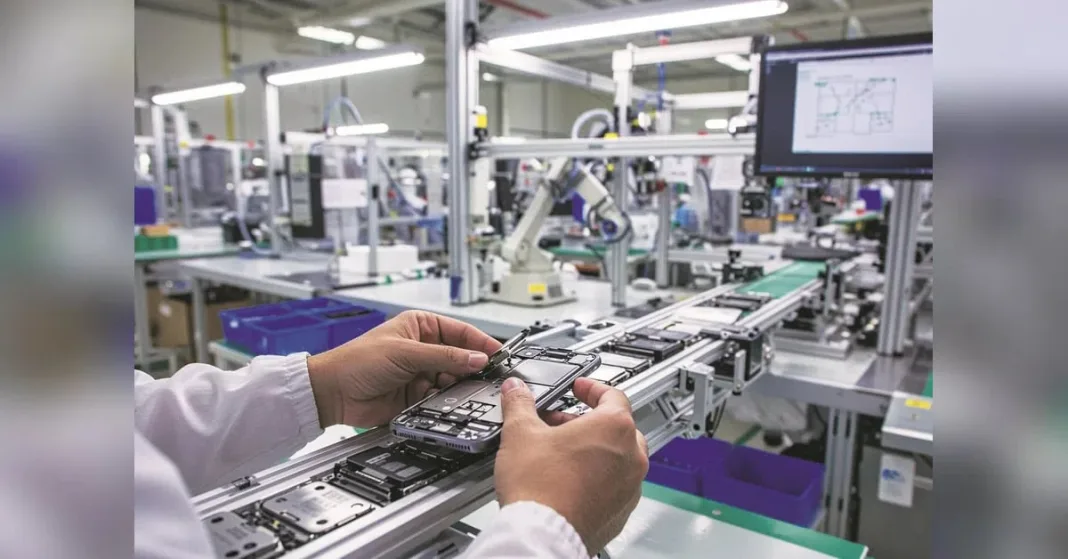

The government today announced the launch of the ₹62,500 crore Mobile Phone Manufacturing Scheme (MPMS), with incentives ranging from 2.5 per cent to 5 per cent for manufacturers and additional benefits for domestic sourcing of key components, as it seeks to deepen domestic value addition and strengthen Indian mobile phone brands.
The five-year scheme, proposed to run from FY27 to FY31, will provide production-linked incentives for mobile phones manufactured in India. It has two target segments — incentivising mobile phone manufacturing and supporting Indian mobile phone brands.
The scheme comes as the government looks to sustain the growth in electronics and mobile phone manufacturing following its earlier policy interventions. The document said electronics manufacturing has grown seven times and exports 11 times since FY15. Smartphones emerged as the country’s single-largest exported product in 2025, surpassing diesel fuel and cut diamonds.
Under the first segment, mobile phone manufacturers, including electronics manufacturing services (EMS) companies registered in India, will need to have a minimum turnover of ₹10,000 crore in FY26 to become eligible.
For existing brands, the scheme sets incremental sales thresholds over FY26 sales. Companies will have to achieve additional sales of ₹5,000 crore in FY27, rising by ₹5,000 crore every year to ₹25,000 crore in FY31. A new brand will become eligible only after achieving annual sales of ₹10,000 crore in India and will subsequently have to meet the ₹5,000 crore year-on-year threshold.
The scheme also introduces a moving baseline for calculating eligible sales. Baseline sales for a financial year will be the brand’s domestic sales in the preceding financial year plus 15 per cent. Eligible sales will be calculated by subtracting this baseline from the brand’s total target-segment sales during the year.
Incentives under this segment will be provided on eligible sales and will follow a tapered structure. One portion of eligible sales will attract incentives of 2.75 per cent in FY27 and FY28, 2.5 per cent in FY29 and FY30, and 2.25 per cent in FY31. Another portion will attract a higher incentive of 5 per cent in the first two years, 4.5 per cent in FY29 and FY30, and 4 per cent in FY31.
Significantly, the scheme proposes an additional incentive of up to 1.5 per cent for domestic sourcing of key components and sub-assemblies. These include display modules, camera modules, enclosures, batteries, including cells, and USB cables and connectors.
To claim the additional benefit, the components or sub-assemblies will have to be localised in at least 25 per cent of the total mobile phone units sold during a financial year. The additional incentive will be paid on a pro-rata basis.
The proposed incentive is 0.3 per cent each for domestic sourcing of display and camera modules, 0.5 per cent for enclosures and 0.2 per cent each for batteries and USB cables, taking the total potential domestic-sourcing incentive to 1.5 per cent.
The second segment of the scheme is aimed specifically at supporting Indian mobile phone brands and carries substantially different eligibility conditions.
Manufacturers, including EMS companies, will need a minimum turnover of ₹1,000 crore in FY26 under this segment. For a brand to qualify as Indian, it should be registered or incorporated in India, its intellectual property and trademark should be held within India, and its management control should lie with Indian citizens.
Indian citizens must also hold more than 51 per cent in the entity claiming Indian-brand status, while the company should have in-house research and development (R&D) and design capabilities in India. There will be no minimum annual sales threshold requirement for Indian brands, with eligible brands to be selected by an Empowered Committee.
Indian brands will receive an incentive of 5 per cent on eligible sales. In addition to the domestic-sourcing incentive available under the first segment, they will be eligible for another 3 per cent incentive for Indian design and R&D of the product.
The government may also provide non-fiscal support to Indian brands, with the Empowered Committee recommending measures as required.
The scheme will be implemented through a Project Management Agency (PMA), while an inter-ministerial Empowered Committee chaired by the secretary of the Ministry of Electronics and Information Technology (MeitY) will consider applications and claims. The committee will include representatives from NITI Aayog and the departments of economic affairs, expenditure, revenue, DPIIT and DGFT.
Companies will be allowed to submit incentive claims on a quarterly basis, subject to meeting the eligibility criteria. The Empowered Committee will also periodically review eligible companies on parameters including employment generation, production and value addition.
Detailed implementation guidelines for the scheme will be issued separately by MeitY. The scheme document also allows the government to review and amend products covered, incentive rates, tenure, sales requirements and other provisions based on the recommendation of the Empowered Committee.