

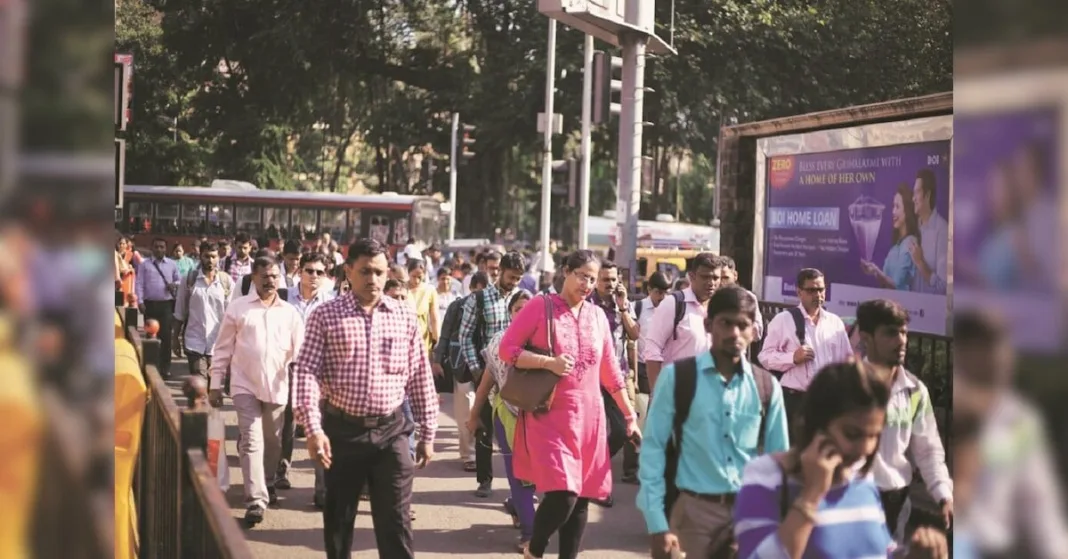

Even as it aims to accommodate an estimated 32 million people in the national capital by 2047, the Centre is seeking private investment to build at least 4 million new affordable housing units and redevelop slums and unauthorised colonies.
As part of the new Master Plan for Delhi (MPD) 2047 notified on Thursday, affordable housing will be promoted in public and private projects, with greater preference given to the development of small-format housing — dwelling units with 25 to 60 square metres of carpet area.
Officials in the know told Business Standard that appropriate incentives will be provided to the private sector for developing affordable rental housing. “Typologies such as hostels, dormitories, and worker housing shall be promoted to provide better housing access to students, labour, working men and women,” they added.
The focus on affordable housing comes even as Delhi has been facing a shortage despite absorbing a growing population. According to a report by Anarock, the share of affordable newly launched homes priced below ₹40 lakh fell from 62 per cent in 2020 to 11 per cent last year.
Most of the growth in housing units has come from outside Delhi because the national capital does not have regulations conducive to high-density construction.
With a view to making colonies more habitable, resident welfare associations would be encouraged to register and adopt a redevelopment framework on the lines of the in-situ redevelopment policy, facilitating planned redevelopment and improvement of existing residential areas.
Final MPD drops GDA plan, relaxes low-density norms
The draft excludes a green development area (GDA) policy, under which roughly 70 villages were slated for development combining residential and commercial hubs with green areas.
While no reason has been given for this, plans have been formulated for low-density areas, including provisions for internal roads with an 18-metre width and master trunk roads with a 45-metre right of way.
To encourage vertical development, the MPD allows a framework for plots carved out in these zones. “This ensures that even if a plot is smaller than 2.5 acres (around 10,000 square metres), the owner receives the full floor area ratio (FAR) entitlement associated with a 2.5-acre plot,” Housing and Urban Affairs Minister Manohar Lal told reporters.
FAR is a zoning tool used to control building density, calculated as the ratio of a building’s total constructed floor area across all floors to the total area of the plot on which it sits.
Under the proposed rules, farmhouses cannot be constructed in these low-density development zones on plots smaller than 2.5 acres. “This will ensure that housing supply is maximised, given the limited availability of land for development,” Manohar Lal added.
However, certain developers and brokers have raised concerns over this particular rule. “On the low-density farmhouse framework, we note that the one-acre (around 4,000 square metre) farmhouse norm that was in the Delhi Development Authority-approved draft last week finds no mention in the gazette notified today,” said Amit Goyal, managing director at India Sotheby’s International Realty.
He added that the requirement of an 18-metre road width alongside a minimum plot size of 10,000 square metres, rather than 4,000 square metres, would render almost 95 per cent of the existing farmhouse development in Delhi unauthorised.
MPD puts commercial, transit hubs at heart of Delhi’s growth
In a first, the master plan proposes round-the-clock commercial city zones with 24-hour transport services, along with new road and development norms for low-density areas. “The concept of 24-hour city shall be promoted by identifying nodes, precincts or circuits to attract tourists and locals,” the MPD 2047 said.
Lal added that public transport, including Metro rail, buses and six new Regional Rapid Transit System (RRTS) corridors, will also be developed in the city.
With the Metro rail network being expanded to 695 kilometres (km) by 2047, the new MPD will include a policy for transit-oriented development (ToD) to promote planned, high-density and mixed-use developments within 500 metres on either side of Metro corridors and within a 500-metre radius of RRTS and railway stations.
The new norms also include flexible development-control norms, with differential distribution of FAR based on factors such as environmental sensitivity, access to mass transit and infrastructure capacity.
BRTS makes a comeback in Delhi’s new master plan
A decade after the national capital abandoned the Bus Rapid Transport System (BRTS), the Delhi Master Plan 2047 has revived the idea of establishing the dedicated corridor system in the city.
A provision in the document says that, in order to provide a public transport network to land pooling areas, an incremental approach will be followed, with the planning and implementation of a new bus route network, BRTS, and high-speed bus routes.
“Concerned agencies may explore options such as BRTS, trams, double-decker buses in identified areas or along specific routes. Such areas/routes may also be identified as a part of the Comprehensive Mobility Plan,” the document said.
Delhi abandoned the BRTS after it became mired in controversies related to accidents and other issues, despite an earlier plan to expand it with several corridors across the city.
Transport planning will now be integrated with the introduction of the Delhi Urban Metropolitan Transport Authority, and expansion will be planned keeping all modes and needs in mind through the unified body, Delhi Chief Minister Rekha Gupta told this paper.
The housing and urban affairs minister said that the plan envisages increasing the Delhi Metro network to 695 km. The expansion will serve all underserved areas, while six new RRTS routes will also help bring more people to public transport, he said.
The existing Metro network shall be reinforced through the implementation of other forms of public transport, such as Metro Lite/Metro Neo or Light Rail Transit systems, BRTS, etc., wherever feasible, MPD says.
The plan also proposes congestion pricing to disincentivise private transport, however, the housing and urban affairs minister denied any such plans.
“Road-owning agencies/transport department, in consultation with traffic police, shall identify areas in the city to be designated as congestion pricing zones. These may include areas around ToD Nodes, Walled City Heritage Zone and the Metropolitan City Centre. radio frequency identification tagging, etc. may be used for implementation of congestion pricing,” the master plan says.
The document also advocates parking demand management and restrictions on public parking at work centres and footfall hubs, especially in areas with high access to public transport. “Dynamic parking pricing (based on location and time of day) to be utilised as a tool to discourage the use of private vehicles,” the plan says.