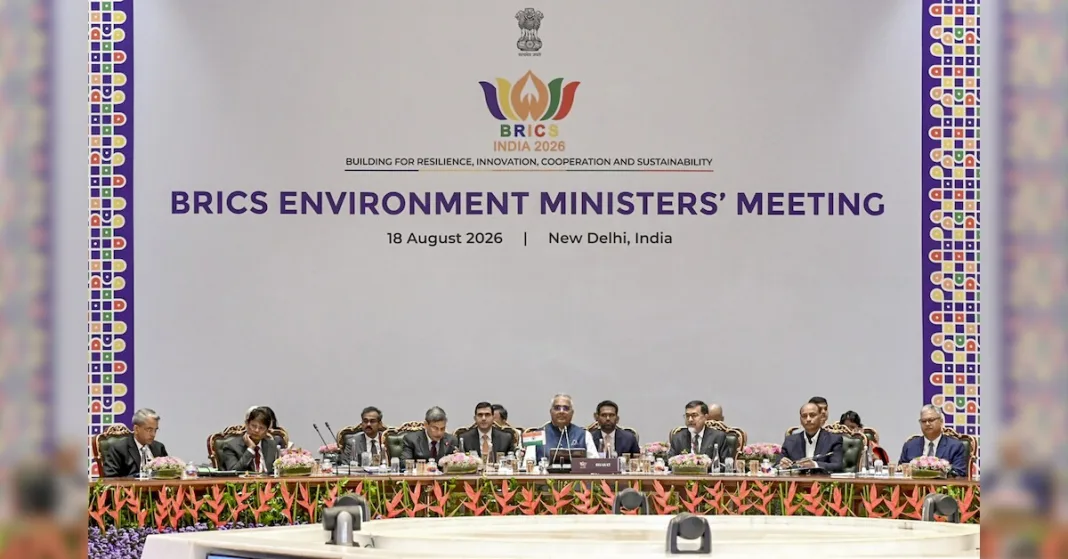

The decision was taken at the 12th Brics Environment Ministers’ Meeting held under India’s 2026 chairship in New Delhi.
Brics countries oppose CBAM
In their joint ministerial statement, the Brics countries said they opposed measures that were not in line with international law.
“We oppose unilateral, punitive, discriminatory and protectionist measures that are not in line with international law, such as CBAM, and express concern that such measures undermine efforts by countries, specifically the developing countries, aimed at addressing the adverse impacts of climate change, increasing adaptive capacity and resilience,” it read.
The statement was adopted unanimously at the conclusion of the meeting. It also raised concerns about the impact of such measures on developing countries’ efforts to address climate change and improve their capacity to adapt to its effects.
India has opposed the EU’s CBAM since its proposal. They argued that CBAM places an additional burden on businesses in developing economies because of the emissions embedded in their products.
What is CBAM?
CBAM is the EU’s carbon border tax on carbon-intensive goods imported into the bloc. It is designed to put a price on the carbon emissions generated during the production of goods entering the EU.
The mechanism covers six sectors: iron and steel, aluminium, cement, fertilisers, hydrogen and electricity. It entered its transition phase in October 2023, when importers had to report embedded emissions but did not have to pay the carbon levy. CBAM came into effect on January 1, 2026.
Under the mechanism, EU importers must buy CBAM certificates corresponding to the embedded emissions in covered imports, unless an equivalent carbon price has already been paid in the country of origin.
Why India is concerned
India exports products covered by CBAM, including iron and steel, aluminium and fertilisers, to the EU. The mechanism also requires exporters to establish systems to measure, report and verify product-level emissions.
The European Union is India’s third-largest trading partner, with goods trade worth €118 billion in 2025, accounting for 11.1 per cent of India’s total trade.
According to government data, India’s iron and steel exports to the EU declined 13 per cent in the four months through April after CBAM’s rollout. An Indian Council for Research on International Economic Relations (Icrier) study estimated that India’s steel exports to the bloc could decline by 24 per cent because of the mechanism.
Other outcomes of the meeting
The four knowledge compendiums prepared by the Brics Environment Working Group were also released during the meeting. The countries adopted four outcome documents, including terms of reference for a network of Brics institutions focused on knowledge sharing, research and innovation in sustainable lifestyles and integrated landscape management for combating desertification.
The Brics grouping currently includes Brazil, Russia, India, China, South Africa, Egypt, Ethiopia, Indonesia, Iran, the UAE and Saudi Arabia. These countries together account for 40 per cent of global GDP.