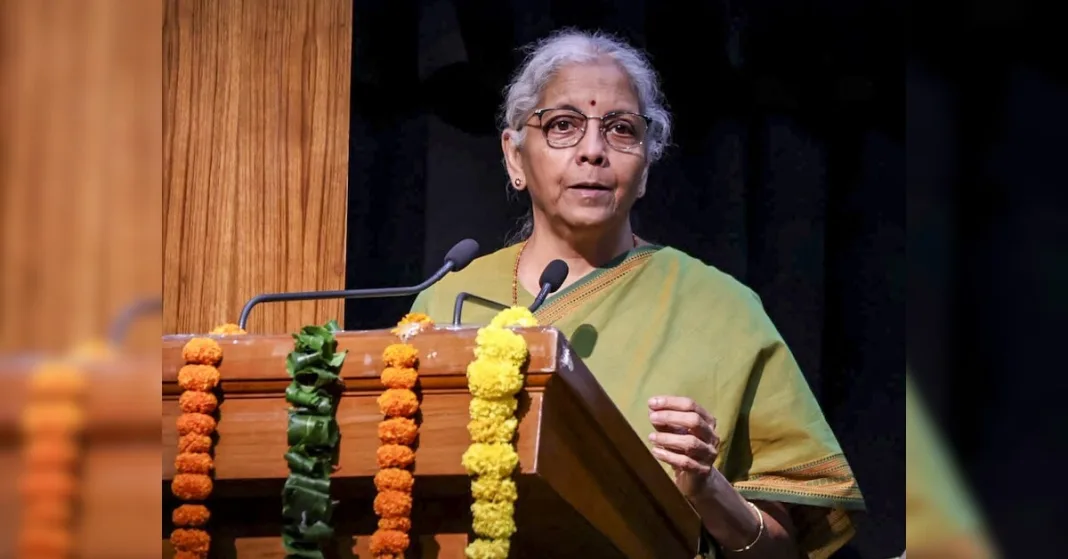

Finance Minister Nirmala Sitharaman on Monday told Rajya Sabha members that any future fee on digital payments will cover only a limited category of merchant transactions above a certain high threshold and consumers would continue to make instant digital payments through the unified payment interface (UPI) without a transaction charge.
The minister was replying to the Rajya Sabha debate on the Taxation and Other Laws (Amendment) Bill, 2026, on Monday. The Lower House returned the Bill, which now requires Presidential ascent to become law.
The Bill sought to amend the Payment and Settlement Systems Act of 2007 for enabling a transaction fee, called merchant discount rate (MDR), but did not impose any tax or transaction charge on UPI users.
It would allow the government to specify through a notification the electronic payment modes that would continue to receive statutory protection against charges.
Once the Bill is passed, a committee would consider whether any merchant discount rate (MDR) should be introduced and, if so, its scope and structure, the minister said.
“No MDR framework has yet been finalised,” Sitharaman said. She also said consumers would continue to make instant digital payments through UPI without paying a transaction charge.
Small merchants, including tea vendors, vegetable vendors, street vendors, flower sellers, auto drivers and kirana stores, would not be subjected to MDR, the minister said.
“Any future MDR will apply only to a limited category of merchant transactions above a certain prescribed high threshold,” Sitharaman clarified, adding that the vast majority of merchant transactions, including ordinary low-value transactions, would continue to remain free.
The minister compared the proposed framework with merchant charges applicable to card payments. Merchants routinely pay MDR of around 1.5-2 per cent or more on credit cards and up to 0.90 per cent on debit cards, she said.
Major retailers generally do not add a separate charge to customers, but instead promote card usage through discounts, EMI offers and cashback, she said.
Sitharaman said a sustainable revenue stream could enable greater innovation, including merchant-issuer offers on UPI.
She cited Australia, Brazil and China as examples of faster payment ecosystems where merchant or payment acceptance charges are applicable.
UPI processed 2,366 crore transactions worth ₹29.9 lakh crore in July 2026 alone, she said, adding that UPI is now available in 11 countries.
The minister said India’s UPI model needed to remain sustainable, safe and resilient, with greater innovation, and that its sustainability was in the country’s interest.
Tax incentive to support electronics manufacturing
The Taxation and Other Laws Amendment Bill, 2026 sought to give tax exemption to foreign companies on income from supplying capital goods, equipment and tools to contract manufacturers in India.
Tax experts said Apple could be a direct beneficiary of the proposal, as it supplies components to contract manufacturers producing its devices in India such as Taiwan’s Foxconn.
Queries sent to Apple and Foxconn on Monday remained unanswered at the time of publishing. (Will update if comments come by 9 pm)
The measure would allow eligible foreign companies to store such components in customs-bonded facilities in India, enabling their timely supply to contract manufacturers.
Sitharaman said such equipment could be specifically designed for manufacturing particular products and may be brought into India for use during production and either taken back or left behind after production is completed.
Under the proposed conditions, ownership of the capital goods, equipment or tools would remain with the foreign company; the equipment would be under the control and direction of the contract manufacturer; the contract manufacturer would be a company resident in India and located in a customs-bonded area; and it would produce electronic goods on behalf of a foreign company for consideration.
The specified products include laptops, all-in-one personal computers, tablets, servers, ultra-small form factor systems and sub-assemblies to finished goods.
The objective, Sitharaman said, is to bring a larger ecosystem for contract manufacturing to India and attract additional investments and employment.
The Bill also proposed exemption from capital gains and interest on investments in specified government securities by foreign institutional investors (FIIs) and the Bank for International Settlements (BIS). These two proposals were part of an Ordnance promulgated on June 5.
The government is also proposing an exemption for a foreign company storing components for sale to a contract manufacturer involved in manufacturing specified electronic goods.
Sitharaman said mobile-phone manufacturing involves several thousand components and manufacturers need timely supplies. Allowing foreign companies to store components in customs-bonded warehouses in India would enable them to supply components immediately to manufacturers instead of waiting for each component to be brought in after an order is placed.
The proposed exemption would be available for 15 years. The specified electronic goods include mobile phones, laptops, all-in-one personal computers, tablets, servers, ultra-small form factor systems, specified sub-assemblies, wearables and accessories related to the specified finished goods.
The amendment is expected to enable a much larger ecosystem for contract manufacturing of mobile phones, laptops, personal computers, servers and related components in India, she said.
Another proposal relates to exemption for a foreign company procuring data-centre services from a specified data centre.
The exemption is proposed up to the year ending March 31, 2047, Sitharaman said, arguing that long-term certainty was required for such big-ticket investments.
The measure is expected to provide ease of doing business for companies providing cloud services by procuring data-centre services in India and enable a much larger ecosystem of Indian data centres providing services to foreign companies.
The reform would also enable AI data centres in India and is expected to bring significant investments for such data centres, she said.
Sitharaman said the measure was not limited to foreign companies as Indian companies providing data-centre services to foreign cloud-service providers would also benefit.
The government is also proposing measures to bring the wholesale diamond trading business to India and promote an ecosystem for financing the buying and selling of diamonds in the country, Sitharaman said.
She said some of this business is currently located in places such as Dubai and the proposed exemptions could enable wholesale business to be carried out in India and make it accessible to Indian buyers.
India is already well known for diamond cutting and polishing, she said, adding that bringing the trading ecosystem to India could benefit the diamond industry, which is highly labour-intensive.