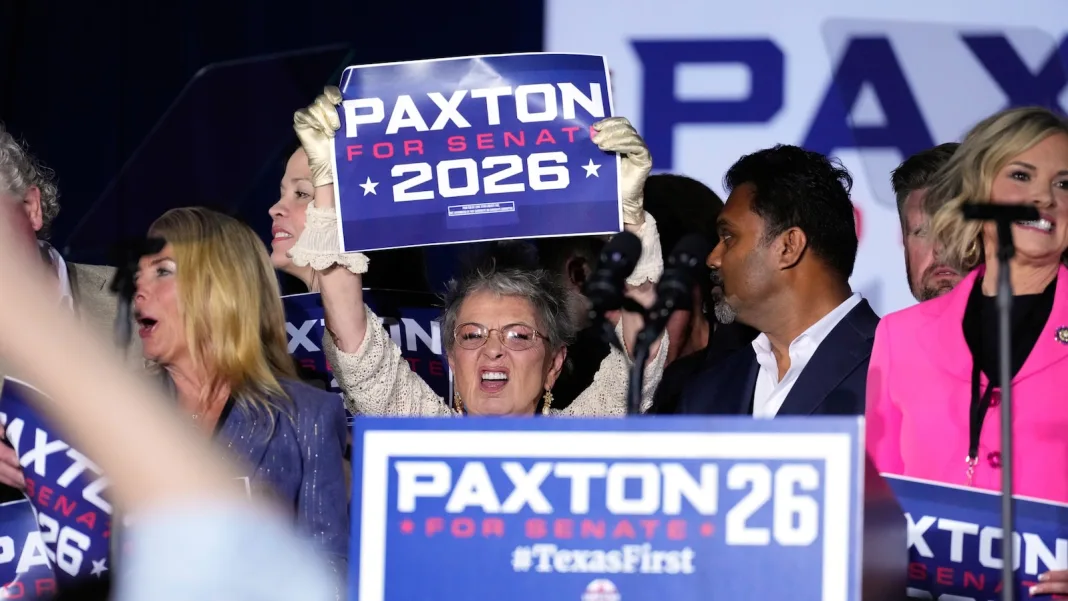

WASHINGTON — Controversial U.S. Senate hopefuls Ken Paxton, a Republican from Texas, and Graham Platner, a Democrat from Maine, are in the nation’s capital Tuesday to shore up support within their respective parties, with Paxton’s itinerary including a White House huddle with President Donald Trump.
The campaign pilgrimage by the two candidates, one from each end of the political spectrum, comes with both men facing concerns that they could cost their parties winnable races in the November midterms, with control of the Senate at stake for the final two years of Trump’s second presidency.
Paxton’s planned meeting with Trump comes after he won the president’s coveted endorsement ahead of trouncing Sen. John Cornyn in the Texas runoff last month. The scheduled meeting was confirmed by a person with knowledge of the president’s plans but who was not authorized to discuss them publicly.
Senate Republicans feared that Paxton, the Texas attorney general, would be a weaker candidate against James Talarico, the Democratic nominee, in the fall. Paxton has endured an indictment, an impeachment and public disclosure of martial infidelity.
He also is expected to meet with Senate Majority Leader John Thune, who backed Cornyn. Senate Republicans’ campaign arm excoriated Paxton during the primary campaign, accusing him of “repulsive and disgusting” behavior and quoting his estranged wife saying she filed for divorce “on biblical grounds.”
Platner, meanwhile, will meet with several Democratic senators days after disclosure that he and his wife have had marital difficulties and sought counseling after he reportedly sent sexually explicit text messages to other women.
Sen. Martin Heinrich, who is set to meet with Platner today, said he doesn’t believe Maine voters are focused on Platner’s marriage. Asked if Platner still has a shot in the race, Heinrich said “we’ll have to see” and “I suspect so.”
The latest personal issues added fuel to some Democrats’ skittishness about Platner, who already has faced scrutiny over Reddit posts that were dismissive of sexual assault and a tattoo that is recognized as a Nazi symbol. Platner has apologized for the posts and covered up the tattoo.
Like Paxton in Texas, Platner was not his party’s establishment favorite, with Senate Minority Leader Chuck Schumer backing Maine Gov. Janet Mills. But Platner effectively became the presumptive nominee after Mills suspended her campaign weeks ago because of fundraising difficulties.
Maine’s primary is June 9, and Platner would face Sen. Susan Collins, a Republican who is running for a sixth term. Defeating Collins is crucial to Democrats’ attempts to regain control of the Senate.
Democrats have repeatedly tried to unseat Collins, but she has repeatedly survived. In 2020, Collins won reelection even though Democrat Joe Biden carried the state over Trump by nearly nine points.
In Texas, some Republicans fear they will need to divert critical resources to boost Paxton over Talarico, who has become a national fundraising phenomenon.
Although Republicans have dominated Texas for decades, prominent party leaders have said the race could be genuinely competitive this time.
Eight years ago, during the midterm election of Trump’s first presidency, Texas Sen. Ted Cruz won reelection over another Democratic fundraising juggernaut, Beto O’Rourke, by less than 3 percentage points.
Republicans hold a 53-47 advantage and earlier in the campaign cycle were heavily favored to maintain their majority. But as Trump’s popularity fades and primary fights yield nominees, Democrats have become more confident in their prospects.
With control of the Senate on the line, partisans have generally lined up behind Platner and Paxton, even if begrudgingly because of their political baggage.
“My priority is to make sure that Republicans control the majority so we can continue the agenda that we’re on,” said Sen. Roger Marshall, R-Kansas, on Tuesday. “Ken Paxton is absolutely necessary as far as keeping that majority. I have faith that the people of Texas will support him, and he’ll get across the finish line.”
Sen. Bernie Sanders, a Vermont independent who caucuses with Democrats, made clear Monday that he still supports Platner. “Of course,” he said. “Why would I not?”
The independent senator, who will meet with Platner, added that the nation should “focus on issues more important than the Platner marriage.” _____
Beaumont reported from Des Moines, Iowa, and Barrow reported from Atlanta.