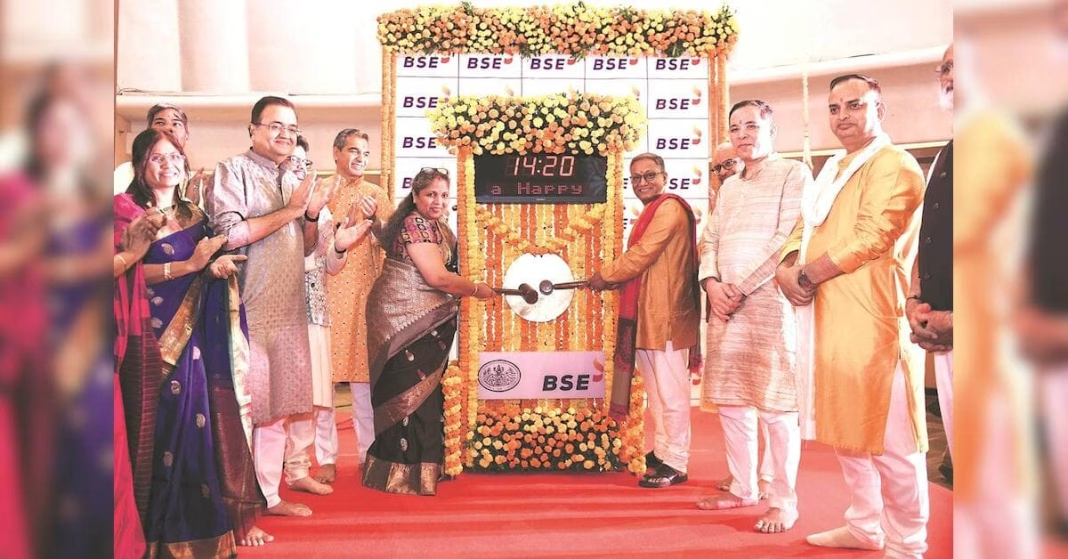

Domestic equity benchmarks ended marginally in the red in the hour-long ceremonial muhurat trading session on Sunday, marking the start of Samvat 2083, the new Hindu calendar year, snapping an eight-year green streak for the Sensex and Nifty at the end of the special session.
Traders attributed the market ending flat on Sunday to profit booking and the Diwali holidays, where trader participation is more ritualistic, as well as a truncated trading week with Tuesday being a market holiday. The banking and real estate sectors, which were the biggest gainers over the last five sessions, turned laggards on muhurat day.
Broader indices diverged from the trend, with the Nifty Midcap 100 rising 0.1 per cent and the Nifty Smallcap 100 advancing one per cent. Market breadth stood at 2,716 stocks advancing against 736 declines on the NSE and 3,253 advances and 937 declines on the BSE. Sectoral indices were mixed, with the Nifty Pharma, Nifty Media and Nifty Healthcare indices ending higher.
“We’ve seen corrections and major movements in the last two years, particularly in major sectors such as IT and pharma. However, the last Samvat was very difficult for the markets and we’re expecting very good market movement in Samvat 2083,” said Somil Mehta, head of retail research, Mirae Asset Sharekhan.
The recent cooling of crude prices will improve inflation numbers, corporate earnings, and market performances this Samvat, he added.
Stock exchanges conduct the one-hour muhurat trading session every year to mark the beginning of a new Hindu calendar year on Diwali. The muhurat trading session was held in the afternoon for the first time this year, instead of a traditional evening slot.
On the Multi Commodity Exchange (MCX), gold and silver were marginally lower, while crude oil gained over 1 per cent. Gold futures for December delivery slipped 0.02 per cent to ₹1.42 lakh per 10 gm, while silver futures for the same month eased 0.05 per cent to ₹1.85 lakh per kg. Crude oil futures for November delivery, in contrast, rose 1.13 per cent to ₹8,555 per barrel.
The market capitalisation (mcap) of all BSE-listed companies stood at ₹505.7 trillion as of Sunday session’s close, while that of NSE-listed companies stood at ₹499.2 trillion as of session closing on Friday.
The key indices remain elevated in the short run while broader indices lagged, after FIIs bought a record ₹45,960 crore and DIIs sold a record ₹24,197 crore last week.
These indices had corrected about 15 per cent from their peaks in April amid concerns over slowing corporate earnings and US trade policies. India underperformed most global peers as investors rotated funds to other attractive markets and in favour of the artificial intelligence (AI) trade.
“Today’s muhurat trading session has remained relatively muted, despite the strong rally in the preceding week. However, as we enter Samvat 2083, the key takeaway is that the market is increasingly rewarding selectivity over broad-based exposure,” said Kresha Gupta, director and fund manager, Steptrade Capital.
She expects a broader-based earnings recovery and sustained economic growth in Samvat 2083, adding that the market will need several more positive triggers before investor sentiment turns overwhelmingly bullish, and that the next phase of wealth creation could come from under-researched businesses with strong fundamentals rather than the top largecaps.