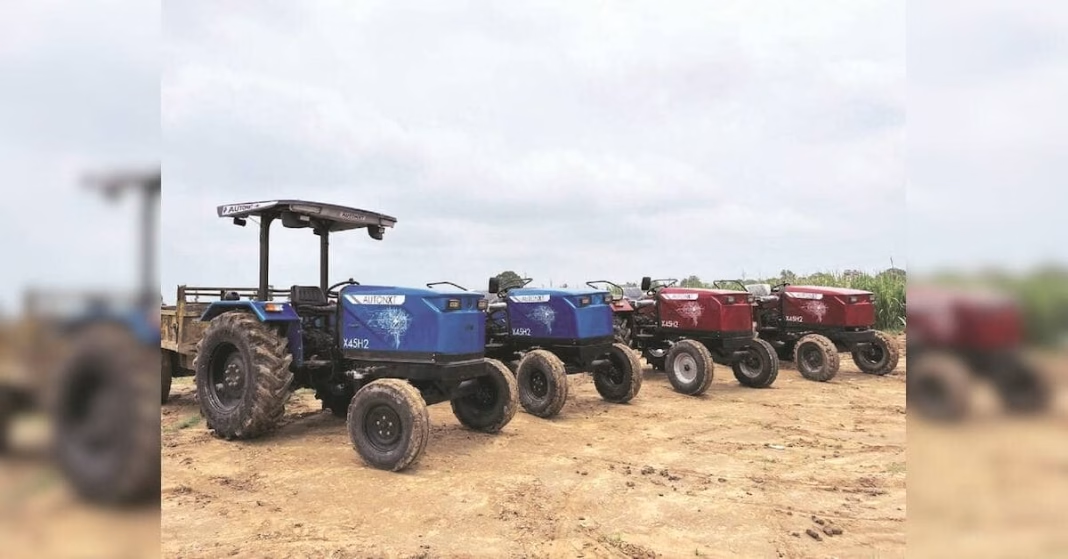

The Centre’s inclusion of electric tractors (etractors) under the Sub-Mission on Agricultural Mechanisation (SMAM), alongside diesel tractors for subsidies, and incentives introduced by states including Haryana, Maharashtra and Andhra Pradesh could accelerate adoption.
Manufacturers are seeking permission for etractors to operate under commercial registration on highways, potentially expanding demand from cement, sugar, paper, tile manufacturing, and firms in fast-moving consumer goods.
Annual sales of etractors could reach around 12,000 units in the next couple of years and 50,000 by 2030, according to tractor maker AutoNxt Automation, against just 219 registrations in 2025.
Despite recording only 248 registrations between January 1 and October 31 this year, according to the VAHAN data, the industry, with fewer than 10 licensed manufacturers, has created a combined annual capacity of 35,000-40,000 units.
The emerging market is led by Thane-based AutoNxt, the Murugappa group’s Montra Electric, and Moonrider Electric Tractors, operating from Bengaluru.
AutoNxt accounted for around 145 registrations, or 58 per cent of the total, during the period. It is targeting nearly tenfold revenue growth in FY27, at ₹80 crore, against ₹8.3 crore in 2025-26 (FY26).
AutoNxt said it had order books of around ₹60 crore, backed by advance payments from customers, and expects another ₹20 crore to ₹30 crore in business from other industrial sectors.
Electric units accounted for just 0.03 per cent of India’s tractor registrations in the first 10 months this calendar year, as against the electric-vehicle penetration of 64.9 per cent in three-wheelers, 11.6 per cent in two-wheelers, 8.5 per cent in PVs, and around 4 per cent in commercial vehicles in September.
Etractors had recorded barely 20 registrations in 2024.
However, compressed biogas (CBG) plants, sugar mills, paper mills and other industrial users are emerging as early adopters, attracted by lower operating costs and the ability to use equipment across extended shifts.
“The tipping point is going to arrive in four to five years. And there will be a movement towards electric tractors from diesel in five years,” said Pankaj Goyal, cofounder and chief operating officer, AutoNxt.
Montra Electric, operating under the brand TI Clean Mobility, has an annual manufacturing capacity of around 25,000 tractors in Chembarambakkam, Tamil Nadu. This accounts for the bulk of the industry’s installed capacity.
Its E27 was India’s first electric agricultural tractor to receive homologation and Central Motor Vehicle Rules compliance certification from the Automotive Research Association of India (ARAI).
“We have sold over 300 units so far (around 250 units of the E27 and 50 units of the recently launched 45 HP model). Currently, our order pipeline is over 1,000. The Centre’s policy is helping to bring the costs down by 10-15 per cent. In Haryana, the government is giving a flat ₹5 lakh subsidy for etractors valued at over ₹10 lakh. These moves are going to help the industry boom,” said a source from TI Clean Mobility.
Government incentives could narrow the upfront price gap, while lower operating costs strengthen the case for electrification. According to AutoNxt, a diesel tractor undertaking rotavation (breaking up soil) across 3 acres consumes 15-20 litres of diesel, costing ₹1,500-2,000. Its electric tractor can perform the same operation using electricity worth approximately ₹300-400 at a tariff of ₹10 per unit.
However, AutoNxt’s 45 HP electric tractor costs ₹15.5 lakh-16 lakh upfront, compared to ₹7 lakh-8 lakh for a comparable diesel model. The company estimates that the additional investment can be recovered within 12 months in high-utilisation industrial applications by saving fuel and operating costs.
AutoNxt has an installed capacity of around 3,000 tractors annually on a single-shift basis, expandable to 4,500 through additional shifts. It plans to increase its capacity to 12,000 tractors annually over the next couple of years.
Other manufacturers include Shree Marut E-Agrotech, Powerland Agro Tractor Vehicles, Vyomev Motors, Cygnus Motors, Royce EV, EVBharat Range and Thukral Electric.
Apart from AutoNxt, TI Clean Mobility, with 59 registrations, and Moonrider, with 27, the remaining manufacturers recorded single-digit figures individually during January-October.
Moonrider has also attracted investor interest, reportedly raising $8.38 million across its funding rounds.
AutoNxt has raised $5.4 million and is in discussion with global venture-capital investors to raise another $15 million.
Conventional tractor manufacturers including the Mahindra group, Sonalika, TAFE and Escorts Kubota have so far taken a cautious approach to electric models.
- Etractor registrations: 248 in Jan-Oct 2026, against 219 in 2025
- Industry capacity: 35,000-40,000 units annually
- Price: ₹15.5-16 lakh, against ₹7-8 lakh for diesel models
- A diesel tractor uses ₹1,500-2,000 fuel to rotavate 3 acres; etractors can do this consuming electricity worth ₹300-400
- Govt policies are helping bring etractor costs down by 10-15%