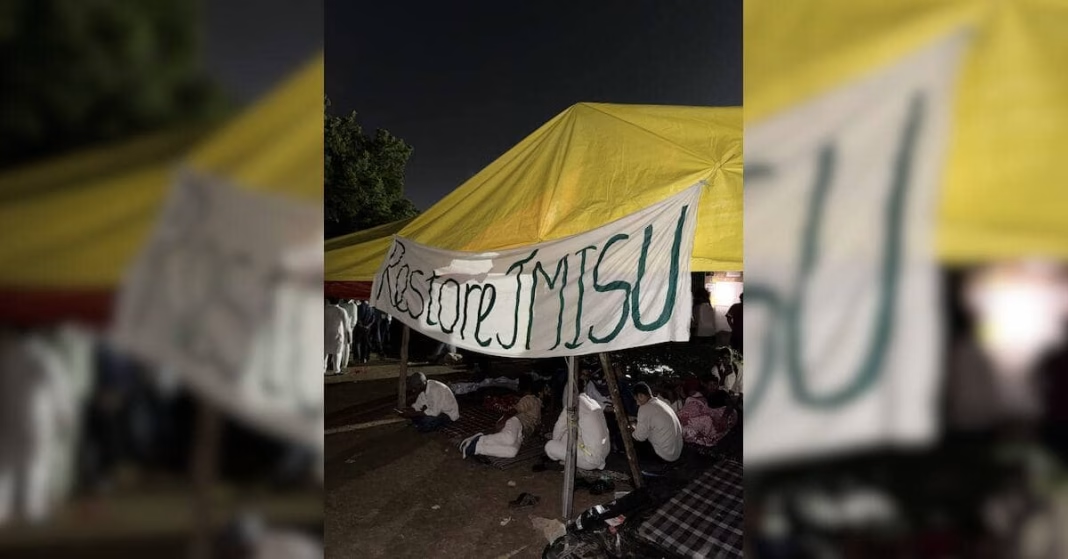

The agitation for the Jamia Millia Islamia Students’ Union (JMISU) saw five students go on an indefinite hunger strike. Classes were suspended or shifted online, while the presence of police and security personnel increased. Protesters and some faculty members described the campus as an “open-air prison”, a characterisation that reflected their frustration with the restrictions imposed during the agitation.
JMISU was dissolved in 2006, with the administration citing campus violence and disruptions in academic activities. With the issue going to court, successive administrations had cited judicial proceedings as a reason to not hold students’ union elections. In 2022, the Supreme Court while disposing a public interest litigation demanding that elections be held in accordance with the J M Lyngdoh Committee, had neither barred future elections nor mandated them.
The protest ended with the university administration agreeing to hold elections “approximately within six weeks of 16 July, 2027”, following the implementation of a new students’ union constitution by May 15 that year.
The administration also revoked earlier orders closing hostels and withdrew disciplinary proceedings, including suspension and expulsion proceedings, against protesting students. Offline classes resumed.
The development offered a way out of the immediate standoff, but it left larger questions about the place of student politics at Jamia, the university’s institutional autonomy and the political significance attached to the emergence of Muslim leadership.
The ‘Muslim leader’
On the face of it, the demand for a students’ union is about campus representation, not religious identity. At Jamia, however, the two have become difficult to separate, given the university’s status as a minority institution and its place in India’s political history.
According to a faculty member who spoke on condition of anonymity, the issue acquires a wider significance because of the limited avenues available for the emergence of Muslim political leadership. “A lot of politicians were exposed to politics on the campus first. We don’t really have that kind of thing for the Muslim community. We’ve been demanding that for 70 years now,” she says. “If an institution like Jamia gets its leadership, there is a high chance it might translate into leadership on a larger scale in the country also. And with the Right wing, the agenda is very clear — they absolutely don’t want a Muslim leadership to emerge.”
Former Amroha MP and Congress leader Danish Ali shares this interpretation. He believes resistance to the emergence of Muslim leadership is among the reasons the restoration of JMISU has taken so long.
“Don’t elections happen in DU (Delhi University) and JNU (Jawaharlal Nehru University)? In fact, Jamia never had the kind of violence that happens in several other universities. Why is it then that Jamia is being singled out?” he questions. “When student leaders emerge, they will become community, country leaders… Jamia’s founders did not establish the varsity just to distribute degrees.”
For Sanam Husain, a PhD scholar and former Jamia unit president of the Students’ Federation of India (SFI), who was among the organisers of the protests, the university’s role in the 2019 protests against the Citizenship Amendment Act (CAA) and National Register of Citizens (NRC) remains central to understanding the current tensions.
“If we look back at 2019, the first time this government was challenged over the CAA-NRC, it was by the students of Jamia Millia Islamia. They fear the students here. We were the first ones to take out a protest march, which then spread across the city and country,” she says.
Founded in 1920 by Mohammad Ali Jauhar, Hakim Ajmal Khan, Mukhtar Ahmad Ansari and Abdul Majeed Khwaja, Jamia emerged from the nationalist movement, with Mahatma Gandhi also supporting its formation. Its history has long intersected with India’s political life. Hamid Ansari — grand-nephew of one of its founders, Mukhtar Ahmad Ansari — served as Vice-President of India from 2007 to 2017.
Its alumni include former Chief Election Commissioner S Y Quraishi; BJP spokesperson Shazia Ilmi; Akhlaqur Rahman Kidwai, former Governor of Bihar, Haryana and West Bengal; and Amanatullah Khan, the incumbent MLA from Okhla.
“Jamia’s Gen Z celebrated Foundation Day when the administration didn’t… I am proud to be a Jamia alumnus when I see that there are still students like them,” says Ali.
The protests also bring into focus a wider pattern of youth-led political mobilisation. Gen Z, loosely defined as those born between 1997 and 2012, has increasingly found a voice in movements across the world, including India. Yet the extent to which these disparate protests represent a coherent political shift, rather than issue-specific bursts of discontent, remains an open question.
Earlier this year, in July, prominent Bharatiya Janata Party (BJP) leader Dharmendra Pradhan had to resign as Union Education Minister following widespread protests over the National Eligibility cum Entrance Test (Undergraduate), or NEET-UG, paper leak. The agitation brought young Indians onto the streets in a major challenge to the Narendra Modi-led government, which has been in power since 2014.
Husain attributes the success of the Jamia protests partly to this wider mood of youth mobilisation and the growing willingness among students to question institutions.
“After Jantar Mantar (the site of the July protests), students realised that we have no option but to ask for what we want, otherwise the system will keep blaming us for whatever is going wrong,” she says. “The administration tried to dismantle the protest site, but the students resisted. That spirit kept us together, even when our university was converted into an open-air prison.”
But the restoration of a students’ union also raises questions about the nature of campus politics itself: How representative its leadership will be, whether it can accommodate competing views and how it will navigate the political divisions that have increasingly shaped university campuses.
For Husain, the immediate priority is to draft the new students’ union constitution and ensure that student representation goes beyond being a provision on paper.
The larger challenge, she says, is the climate of political apprehension on campus.
“For 20 years, students have been unable to come together to express their problems and other issues. There’s an all-pervasive fear now among even educated Muslims that they will become the next Umar Khalids and Sharjeel Imams, and be targeted by the government. That has to go. And it will go — it’s a slow process, but we will get there,” she says.
The students’ union is not the only representative body whose future remains uncertain. The Jamia Teachers Association (JTA) has been defunct since 2022, when the university administration dissolved it, cancelled its forthcoming elections and sealed its office over disciplinary issues.
The Delhi High Court quashed the administration’s order in October 2025. Yet the association remains dissolved, with no plans announced by the university to revive it.
A second faculty member, also speaking on condition of anonymity, says there is an undercurrent of support for bringing back the JTA. But organising has become increasingly difficult.
The agreement to restore JMISU may resolve one long-standing dispute, but it does not settle the larger questions surrounding campus life at Jamia. The university will now have to work out the terms of representation, the rules governing elections and the relationship between student bodies and its administration. Equally important will be whether the restored union can represent a diverse student body rather than become an extension of competing political interests.
For a university whose history is closely tied to India’s nationalist movement, the debate is also about the kind of political space Jamia wants to be. Whether the return of student elections will create room for a broader generation of leadership, as its supporters hope, or bring fresh tensions to an already contested campus will depend on what follows.