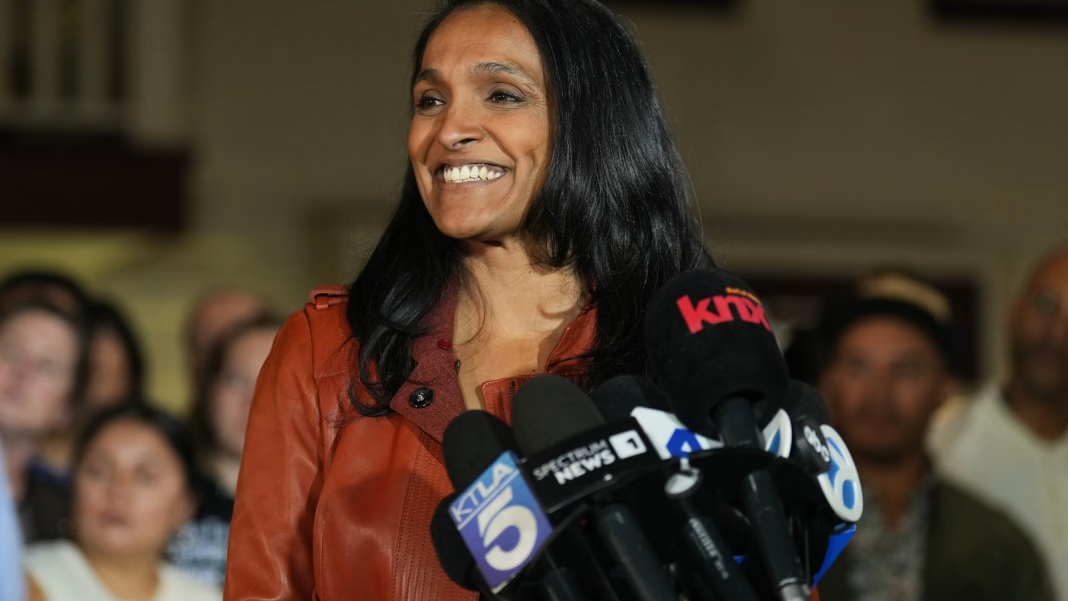

LOS ANGELES — In her bid for Los Angeles mayor, Nithya Raman ran as an outsider. The democratic socialist didn’t win a single endorsement from her 14 colleagues on the city council. The police union opposed her, she had friction with the Jewish community and the Democratic establishment lined up squarely behind the incumbent, Karen Bass.
She now has to show she can lead.
As mayor-elect following a stunning upset, Raman will need to navigate political rifts in balkanized City Hall while taking on an array of problems that have defied her predecessors, including a long-running homeless crisis, an exodus of Hollywood jobs and boundless miles of crumbling streets and sidewalks — all with a strained budget.
Appearing before reporters Thursday for the first time as mayor-elect, Raman was succinct about her agenda.
“Homelessness, housing costs and public safety,” she said. “These will have to be the priorities that I take on in the city.”
Even after the campaign, the millennial, India-born Raman will be a new face to many Angelenos in a city that tends to shrug at local politics. But how she governs the nation’s second most populous city will be closely watched nationally, especially as she prepares to welcome the world to LA for the 2028 Olympics.
When she takes office in mid-December, Raman will join the vanguard of democratic socialists in municipal government that includes Zohran Mamdani in New York and Katie Wilson in Seattle. Janeese Lewis George was elected Tuesday as mayor of Washington, D.C.
While she is expected to steer the city to the political left, she has been outspoken about her willingness to break from the Democratic Socialists of America when she believes their agenda conflicts with interests of the city. “My independence will always be paramount,” Raman said at a candidate forum in September.
At a time when the Democratic Party has been deeply divided over the war in Gaza and aid to Israel, Raman has faced questions about her interview with progressive commentator Hasan Piker last spring in which she responded “I do, yes,” when asked if she believed Israel had committed genocide. At a forum co-hosted by the Jewish Federation Los Angeles, she said she recognized genocide is “a deeply painful word” but said she was compelled to speak out after seeing images of “the targeting of hospitals, the deaths of children,” prompting murmurs in the audience.
At the same time, she faced pushback from within the DSA, where some believed her positions on Israel was not sufficiently tough.
After her surprise win, the federation called on Raman to “rebuild trust with Jewish Angelenos that was strained during the campaign.”
To Occidental College political scientist Caroline Heldman, Raman needs to propose concrete solutions to address the day-to-day headaches that frame life in LA, whether potholes or thousands of broken streetlights or clearing homeless encampments.
“She didn’t win the election by positioning herself as being really ideologically distinct from Karen Bass,” Heldman said. “She positioned herself as the pothole politician, very similar to Zohran Mamdani. I see her taking a page out of his playbook.”
Raman, however, never had the star power known as a Mamdani trademark. The contest in LA was relatively low key and overshadowed by turmoil in Washington and the fight for control of Congress.
Mike Bonin, a former LA city council member and executive director of the Pat Brown Institute for Public Affairs at California State University, Los Angeles, described Raman as philosophically progressive but temperamentally moderate.
“She got painted in this campaign as a crazy socialist idealogue or a flip-flopper with no core values,” said Bonin, who served with Raman from December 2020 to 2022. But, he said, “she wanted to work with people. She is very focused on results.”
She has not delivered a financially detailed plan on how she will take on some of the city’s persistent maladies.
There are few issues in LA — birthplace of the car culture, where driving is part of everyday life for most residents — that prompt more grumbling than traffic and potholes. In 2013, former Mayor Eric Garcetti, campaigned on a “back to basics” platform to deal with street paving, yet little happened.
Under Bass, the city began focusing on filling potholes rather than resurfacing streets. Raman has said she will recast that policy, but how much money will go toward streets — and how quickly they can be repaved — is not yet known.
In remarks on election night, before she was declared the winner, Raman depicted a city in statis and broadly sketched her vision for what Los Angeles could be.
“LA stopped being a place where we could build things, where we could open things, where we could film things, where we could create things,” she said. Raman added that she wanted to revive “that ambitious Los Angeles, that joyful Los Angeles, that creative Los Angeles, that entrepreneurial Los Angeles.”
On the city council, the reaction to her election was somewhat muted. Council member Traci Park, who voted for Bass and said she had “concerns about the leadership and effectiveness” of both candidates, said in a statement she looked forward to working with Raman in a city with “great challenges.”
Raising 10-year-old twins with her TV writer and producer husband in the Silver Lake neighborhood, her unlikely rise to the mayoralty came at least in part because she was running against a wounded incumbent at a time when voters nationwide were eager for change. Bass was undone by the deadly Palisades Fire, which ignited when she was out of the country and caught the fire department unprepared.
An urban planner, educated at Harvard University and the Massachusetts Institute of Technology, Raman’s background includes founding a homelessness outreach nonprofit in LA.
Mayors in LA don’t have the clout of their counterparts in New York and Chicago — power is shared with the city council. Bonin described it as an accordion, which can expand or contract depending on who holds the office.
He said former Mayor Antonio Villaraigosa, known for his chatty personality and charm, “swung for the fences.” Bass, by nature a compromiser, was different. Raman will set her own course.
“I can’t think of a mayor who had to take office with so many problems,” Bonin said. “Everybody leaves unpopular. … It’s not a job that makes you well loved.”