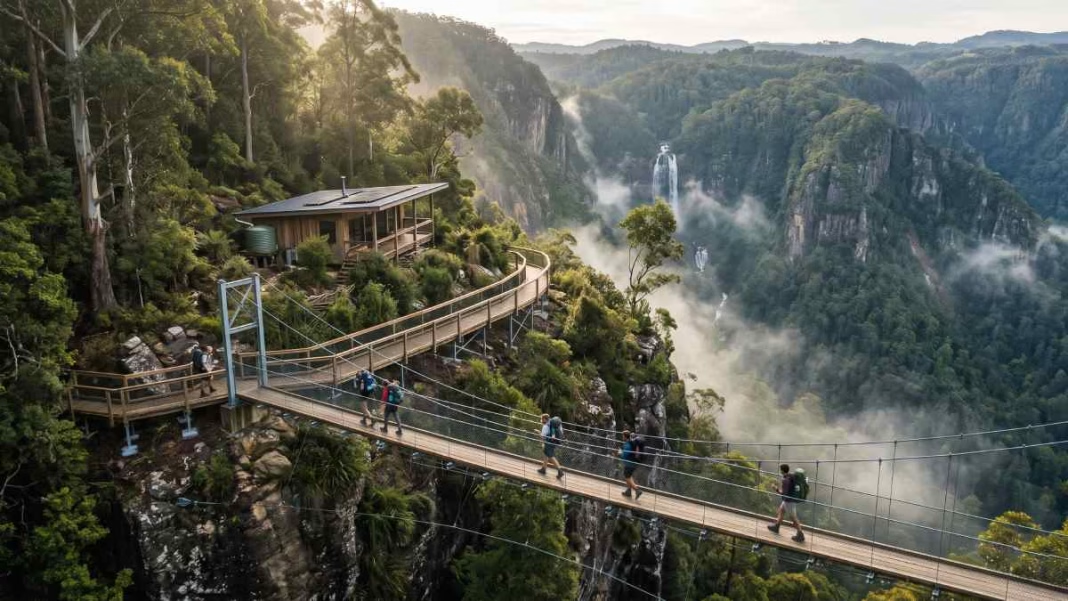


In Oceania, there is a fundamental modernizing shift happening in the field of protected wilderness governance, which is driven by both the governmental conservation authorities and the Indigenous custodians of the region. Using the innovative methods of precision aerial engineering, zero-ground-impact structural metallurgy, and biosecurity measures, vertical escarpments in remote areas are being made accessible without any damage to the environment. In this process, there is a fundamental shift from mere front-country day visits to high-value multi-day journeys, ensuring that endemic biomes are well protected against compaction and pathogen invasion. Under statutory co-design and carrying capacity quota systems, these trail assets serve as an international standard for backcountry conservation.
The Strategic Shift: High-Yield Backcountry Engineering in Oceania
The governance of protected wilderness across Oceania has been transitioned into an era defined by fiscal discipline, ecological preservation, and structural modernization. Historically, capital expenditures were directed by park agencies in Australia and New Zealand toward front-country day walks, centralized car parks, and short lookout platforms designed for rapid visitor turnover. While mass recreational arrivals were accommodated by this post-war model, mechanical wear was inadvertently concentrated in fragile ecological pockets, trailside vegetation damage was increased, soil compaction was accelerated, and minimal financial returns were delivered to adjacent rural communities.
An institutional pivot toward sustainable, high-yield multi-day escarpment trails has been initiated by national policy instruments, led by Australia’s THRIVE 2030 strategy and New Zealand’s Department of Conservation (DOC) Heritage and Visitor Strategy. It is recognized by these frameworks that higher dwell times and greater spending propensities are demonstrated by active outdoor recreationists compared to vehicle-dependent day sightseers. The relocation of visitor distribution from high-density urban belts to remote regional corridors requires high-standard walking infrastructure capable of traversing vertical escarpment geography without environmental degradation being caused.
The prioritization of long-distance trail infrastructure as core economic assets is reflected in public capital allocations. In New South Wales, $56.4 million was allocated by the Department of Climate Change, Energy, the Environment and Water (DCCEEW) through the National Parks and Wildlife Service (NPWS) for the construction of the Dorrigo Escarpment Great Walk and the development of the accompanying Dorrigo Arc Rainforest Centre. Across New South Wales, roughly 65.5 million visits are recorded annually across protected parklands, generating an estimated $19.5 billion in total economic value and underpinning 62,000 regional jobs. Through the construction of Grade 4 multi-day walking networks, transient tourists are successfully converted by conservation ministries into multi-night commercial patrons whose spending bolsters regional economic resilience.
Advertisement
Advertisement
Escarpment Topography and the Vulnerability of Fragile Biomes
Some of the most ecologically valuable yet physically unstable landforms in Oceania are represented by escarpments. Distinct ecological zones, ancient microclimates, and endemic flora are supported by formations along the Great Dividing Range in eastern Australia and the fault-ruptured Southern Alps in New Zealand. However, susceptibility to ground collapse, human disturbance, and systemic erosion is caused by their sheer angles of repose, thin topsoils, and proximity to high-energy river systems.
Extensive ground scarring was historically created when infrastructure was built in these steep areas using conventional civil methods. Root platforms were compromised, subsurface water channels were disrupted, and light corridors that foster weed invasion were introduced by excavator tracks, access logging roads, and earthwork benching. New low-impact construction standards were consequently formulated by engineering authorities. Specialized aerial assembly methods are currently deployed by destination developers and park management authorities across Oceania to construct resilient infrastructure in remote, high-rainfall, and rugged topographies without fragile biomes being scarred.
Advertisement
Advertisement
Precision Sky-Engineering and Low-Impact Aerial Logistics
Aerial delivery methods have been rendered essential by the logistical complexities of developing multi-day walking tracks through remote rainforests, coastal dolerite columns, and subalpine cliffs. Conventional mechanical ground transport is deemed entirely unfeasible in roadless wilderness zones. To ensure delicate understories remain protected, helicopter flight operations and modular structural designs are coordinated by engineers so that bridges, boardwalks, and huts are positioned with minimal surface disturbance.
Heavy-Lift Rotorcraft Assembly and Drop-Zone Precision
High-precision commercial rotorcraft operations are required for backcountry structural delivery. Intermediate utility helicopters, such as the Eurocopter AS350 B3 (Écureuil)—valued for maneuverability in turbulent gorges—are deployed by contractors alongside heavy-lift platforms such as the Sikorsky S-64 Aircrane for larger payloads. Pre-assembled track segments, composite structural components, tensioning hardware, and timber packs are delivered by these aircraft directly into tight drop zones.
Strict environmental safety protocols are adhered to during flight operations. Micro-climatic wind shear, thermal drafts across vertical escarpments, and canopy clearance margins are evaluated by aviation managers before sling paths are cleared. Staging yards are established at highway access points, where materials are weighed, sorted into balanced loads, and tagged with GPS destination markers.
On site, incoming suspended components are guided into place using high-tensile guide lines by specialized ground riggers who often work suspended on technical rope systems along cliff faces. The clearing of canopy trees is avoided, heavy machinery is prevented from touching the ground, and ancient rainforest root networks are preserved through this aerial assembly process.
Resilient Metallurgy and Zero-Concrete Footings in High-Rainfall Belts
High precipitation, often exceeding 2,500 to 4,000 millimetres of annual rainfall, accompanied by frequent flash flooding and acidic organic soils, is experienced along escarpment corridors on the eastern seaboard of Australia and throughout the South Island of New Zealand. Standard carbon steel and conventional wet-mix concrete footings are ill-suited to these environments. High-volume helicopter transit flights are required when liquid concrete is transported into isolated catchments, while alkaline runoff can be leaked into pristine aquatic habitats during concrete curing.
High-grade metallurgy and prefabricated foundation assemblies are utilized by structural engineers to address these challenges. Components are constructed from Grade 316 marine stainless steel or heavy hot-dip galvanized steel, which resist continuous moisture and acidic leaf-litter degradation. On the 46-kilometre Dorrigo Escarpment Great Walk, five major suspension bridges over river gorges and gullies were engineered by civil contractor Forge and alpine suspension specialist Abseil Access. Prefabricated steel footings and rock-anchored deadman cable systems that eliminate on-site concrete mixing are featured in these structures, ensuring headwater quality is protected. A five-metre flood clearance is incorporated into the suspension bridges, ensuring mountain storm runoff is withstood.
Advertisement
Advertisement
Elevated platform decking surfaces are constructed using pultruded Fibre-Reinforced Polymer (FRP) open mesh alongside sustainably harvested, recycled hardwoods. Dense, decay-resistant walking surfaces are provided by historic bridge timbers and selectively cleared local blackbutt (Eucalyptus pilularis) logs. Rain and sunlight are permitted by the FRP micro-grating to filter through to the ground, allowing vegetative growth beneath the boardwalks to be preserved and soil drying and erosion to be prevented.
Biosecurity Governance: Shielding Old-Growth Biomes from Pathogen Infiltration
Comprehensive biological defense strategies are required when untracked wilderness is opened to multi-day hiking. Recreational tracks can become vectors for invasive plant pathogens that decimate old-growth ecosystems if strict interventions are not applied. Across Oceania, containment efforts by conservation agencies are focused on two high-consequence soil pathogens: Phytophthora cinnamomi (a root-rot water mould causing broad dieback across Australian woodlands and heathlands) and Phytophthora agathidicida (the microscopic plant pathogen responsible for kauri dieback disease in New Zealand).
Aviation Helipad Quarantine and Anti-Pathogen Washdown Regimes
The first line of biosecurity containment is provided by helicopter landing zones and logistics pads. Because rotorcraft and cargo gear frequently travel between disturbed urban bases and pristine park perimeters, strict washdown procedures are enforced by national park services. Helicopter skids, cargo baskets, transport nets, and high-tensile lifting ropes must be treated at certified decontamination pads prior to operational clearance being granted.
Mechanical scrubbing followed by chemical sterilization is required under standard decontamination protocols. Broad-spectrum veterinary disinfectants, such as benzalkonium chloride, F10SC compound solutions, or Phytoclean, diluted to verified lethal concentrations for water-mould spores, are applied by technicians. Identical sterilization procedures are undergone by footwear, tools, and construction materials destined for remote drop sites. It is ensured by these strict washdown regimes that pathogens are not inadvertently introduced into isolated mountain drainages by aerial delivery operations.
Raised Infrastructure and Trackside Decontamination Architecture
Biosecurity measures are incorporated directly into trail entry architecture and track design for backcountry hikers. Specialized hygiene stations were deployed across trail portals in sensitive indigenous forests by New Zealand’s Tiakina Kauri biosecurity programme. Raised drainage grates are stepped onto by walkers, heavy-bristle brushes are used to clear caked mud from tread lugs, and mechanical sprays of Trigene disinfectant are applied to kill remaining soil microbes.
Physical separation between walking traffic and vulnerable root systems is mandated by park engineering standards beyond trailhead washing stations. Trails passing near ancient kauri (Agathis australis) or old-growth Antarctic beech (Lophozonia moorei) are constructed on elevated timber and composite boardwalks positioned 300 to 500 millimetres above the forest floor. Footwear is kept completely away from sensitive surface roots and natural ground hydrology is preserved by this elevated design, preventing mud and fungal spores from being spread along the track network by walkers.
Advertisement
Advertisement
First Nations Co-Design: Integrating Indigenous Custodianship on Country
Wilderness recreation management across Oceania has progressed from simple public consultation toward joint management and Indigenous co-design. First Nations peoples were historically excluded from ancestral estates by colonial park models, wild landscapes having been treated as uninhabited territory.
It is recognized by contemporary trail projects that these escarpment environments are living cultural landscapes that have been shaped by millennia of Indigenous custodianship. Governance authority over track alignments, cultural interpretation, and resource management is retained by Traditional Owners and tribal authorities under modern planning models.
Cultural Heritage Impact Assessments and Trail Alignment Sovereignty
In Australia, comprehensive Cultural Heritage Impact Assessments (CHIA) must be completed for long-distance trail projects under statutory instruments such as the NSW Environmental Planning and Assessment Act 1979 and the Commonwealth Environment Protection and Biodiversity Conservation Act 1999. On-ground field evaluations are conducted collaboratively with Local Aboriginal Land Councils, Registered Aboriginal Parties (RAPs), and community Elders.
On the Dorrigo Escarpment Great Walk project, direct collaboration was undertaken between archaeologists from EcoLogical Australia and 15 Aboriginal sites officers representing five regional organizations. Over 300 hours of field surveys were completed across 40 kilometres of the proposed trail route. Culturally modified scar trees, ancient stone artifacts, and significant ceremonial vantage points along the escarpment edge, including Mount Wondurrigah, were identified by surveyors under the guidance of Gumbaynggirr Elders. When it was revealed that an initial trail route encroached on a culturally significant blackbutt tree, the engineering alignment was modified so that an appropriate protective buffer was maintained.
This collaborative approach is extended to permanent track infrastructure, wherein dual-language Gumbaynggirr signage, audio narratives recorded by Traditional Owners, and enterprise pathways supporting Indigenous-led interpretive walking tours are incorporated.
Kaitiakitanga and Treaty Partnerships Across Aotearoa New Zealand
In Aotearoa New Zealand, public conservation lands are operated under the statutory mandates of Te Tiriti o Waitangi (the Treaty of Waitangi) through Section 4 of the Conservation Act 1987. Practical effect is legally required to be given to Treaty principles by the Department of Conservation, with Kaitiakitanga (tribal guardianship) and Tikanga Māori (customary protocols) being embedded into public lands management.
Advertisement
Advertisement
The development of the Tuatapere Hump Ridge Track, which officially joined the national network as New Zealand’s 11th Great Walk, was shaped by this statutory partnership. Passing through ancestral lands of the Ngāi Tahu iwi, the 61-kilometre track was developed in partnership with local rūnanga. Sacred coastal middens and sensitive food-gathering waterways were protected through the route design, while rich cultural histories detailing customary seasonal migrations were provided to visitors.
These governance partnerships were further institutionalized through legislative frameworks, including the Landmark Conservation Reform Bill. Commercial concession processes are streamlined by the reforms while it is ensured that visitor experiences are co-designed, commercial equity is held, and direct revenue shares from wilderness tourism concessions on public conservation land are received by Treaty partners.
| Project / Setting | Indigenous Traditional Owners | Statutory Governance Framework | Cultural Heritage Interventions | Economic & Custodial Beneficiary Systems |
|---|---|---|---|---|
| Dorrigo Escarpment Great Walk (NSW, Australia) | Gumbaynggirr Community | CHIA protocols; NSW Environmental Planning and Assessment Act 1979 | Route adjustments around scarred trees and Mount Wondurrigah; Gumbaynggirr place naming | Aboriginal ranger pathways; reserved commercial concessions for Indigenous guiding enterprises |
| Tuatapere Hump Ridge Track (Southland, New Zealand) | Ngāi Tahu / Local Rūnanga | Treaty of Waitangi principles; NZ Conservation Act 1987 | Direct narrative curation; preservation of coastal middens and native food gathering tracks | Direct concession equity; joint governance on Hump Track Charitable Trust; regional employment |
| wukalina Walk (Tasmania, Australia) | Palawa / Tasmanian Aboriginal Community | Palawa-owned enterprise operating under Tasmanian Parks lease | Authentic storytelling, traditional gathering, and krakani lumi domed timber huts | 100% community equity retention; cultural revival and long-term youth leadership training |
| Kokoda Track Corridor (Owen Stanley Range, PNG) | Mountain Koiari and Orokaiva Landowners | Kokoda Initiative Partnership (KIP); DFAT bilateral agreement | Protection of wartime heritage, sacred village areas, and traditional clan lands | Direct trekker permit distribution; local community funds; regulated porter welfare standards |
In Papua New Guinea, it is ensured through the Kokoda Initiative Partnership—supported by the Australian Department of Foreign Affairs and Trade (DFAT) and PNG conservation agencies—that the historic 96-kilometre Owen Stanley trek is co-managed with customary Mountain Koiari and Orokaiva landowners. Village education and health clinics are funded directly by trekker permit fees.
Similarly, in Fiji, traditional village agreements (sevusevu) with local clans (yavusa) are relied upon by interior trekking programs operated by Talanoa Treks in the Koroyanitu National Heritage Park, with visitor fees being channelled directly into community infrastructure and rural schools.
Destination Economics: Transforming Gateway Towns Through Capital Dispersal
Substantial economic benefits for rural gateway communities are generated by the construction of high-grade multi-day trail infrastructure. Low economic returns were frequently produced by conventional nature tourism: lookout points were visited for brief periods by self-drive day visitors arriving from major cities, municipal waste was generated, and departures occurred without local businesses being significantly patronized.
The visitor profile is shifted by converting day-use parks into connected multi-day hiking networks. Several nights are spent by hikers in surrounding towns preparing for expeditions, purchasing provisions, hiring equipment, and securing transfers, whereby sustained capital is directed into local economies.
Advertisement
Advertisement
The Yield Versus Volume Strategic Imperative
The economic value of overnight active travellers compared to transit sightseers is underscored by data published by Tourism Research Australia (TRA). An average of $801 per trip ($224 per night across an average 3.6-night itinerary) is spent in regional Australia by domestic overnight visitors, generating over five times the spend of single-day visitors, by whom an average of $150 per excursion is spent. Furthermore, approximately 44 cents of every Australian tourist dollar is captured by regional communities, supporting more than 100,000 regional small businesses.
It is indicated by DOC visitor research in New Zealand that an average of NZ3,600perjourneyisspentbyinternationaltouristsundertakingmulti−daytramps,comparedtotheoverallholidaymakeraverageofNZ2,800. In the Fiordland region—supported by the Milford, Routeburn, and Kepler Great Walks—NZ249millioninannualregionalvisitorspendingwasreached,with77percent(NZ191 million) being generated by visitors touring the national park system.
Environmental wear is reduced while sustained spending on local gear rental, food services, and accommodation is stimulated by park agencies through the limiting of daily numbers and the prioritization of high-standard infrastructure.
Case Analysis: Long-Distance Hiking Networks as Regional Economic Anchors
The economic influence of high-standard walking infrastructure is well demonstrated by Tasmania’s Three Capes Track. It is shown by comprehensive economic monitoring conducted by the Tasmania Parks and Wildlife Service and Tourism Tasmania that an average of 10.6 nights in the state is spent by hikers completing the 48-kilometre trail, generating 56,483 extra commercial bed-nights annually.
The route has been completed by more than 106,000 walkers since opening. Commercial regional partnerships are intentionally supported by the walk’s structure: journeys are commenced by hikers at the World Heritage-listed Port Arthur Historic Site before a coastal catamaran operated by Pennicott Wilderness Journeys is boarded to reach the trailhead at Denmans Cove.
Consistent booking demand is maintained, environmental impacts are minimized, and a stable, predictable customer base is provided to local accommodation providers, shuttle services, and food businesses across the Tasman Peninsula by capping daily departures at 48 walkers. Trail fees are channelled back into conservation, ensuring that trail maintenance and ecological protection across Tasman National Park are directly supported by visitor spending.
Advertisement
Advertisement
Architecture of the Unplugged: Off-Grid Micro-Lodging and Closed-Loop Utilities
Modern off-grid micro-accommodations have been engineered by park agencies to make remote multi-day routes accessible to higher-spending travellers without ecological damage being caused. A balance between basic tent camping and high-end private lodges is struck by these semi-serviced structures, weather protection being provided in extreme environments while zero-discharge environmental standards are upheld.
Weather-Resilient Communal Shelters and Modular Bunk Pods
Sustained rain, gale-force winds, and bushfire threats must be withstood by remote trail cabins—such as the Surveyor, Munro, and Retakunna huts on the Three Capes Track, and the planned shelters on the Dorrigo Escarpment designed by Bligh Tanner and Gall Architects. Low-profile timber framing, structural insulated panels (SIPs), and non-reflective Colorbond cladding are utilized by architects so that visual impact against scenic ridges is minimized.
Active communal spaces are separated from quiet sleeping areas within hut complexes. Stainless steel food preparation areas, commercial-grade LPG cooking stoves, clean rainwater taps, and broad outdoor viewing platforms that shelter hikers during severe weather are featured in communal hubs.
Shared bunkrooms accommodating four to eight people on high-density foam mattresses are provided in sleeping quarters. Because a comfortable base is supplied by the cabins, lighter packs without tents, sleep mats, or cooking stoves can be carried by walkers, rendering multi-day backcountry trails accessible to older hikers and families.
Zero-Discharge Blackwater Treatment and Microgrid Electrification
Because critical water catchment areas for downstream townships are situated along mountain ridgelines, the discharge of wastewater into adjacent soils from backcountry shelters is prohibited. Sensitive stream habitats risk being polluted and algal blooms risk being generated in pristine ecosystems by untreated effluent. Self-contained, closed-loop waste systems are therefore operated by trail shelters.
- Rainwater Harvesting and Filtration: Rainfall is collected by broad corrugated metal roofs and routed into bank-mounted stainless steel and polymer storage tanks. Multi-stage mechanical sedimentation, particulate filtration, and ultraviolet (UV) treatment are undergone by rainwater to produce potable drinking water without chlorine additives being introduced.
- Closed-Loop Waste and Blackwater Treatment: Dry-composting batch toilets or sealed pod tanks are relied upon across high-rainfall escarpments. Urine is mechanically separated from solid waste by waste systems to prevent anaerobic decomposition and eliminate odors. Waste is aerobically decomposed on site or stored in sealed transport containers that are airlifted out by helicopter for processing at municipal wastewater plants.
- Solar-Electric Microgrids and Environmental Telemetry: Power is supplied to huts by standalone 24-volt or 48-volt DC solar arrays coupled with lithium iron phosphate (LiFePO4) storage batteries. Low-voltage LED lighting, emergency satellite communication links, and automatic weather stations are supported by these silent systems without noisy diesel generators being operated. Dark-Sky compliance standards are followed by lighting fixtures, downward-directed, warm-spectrum lighting (under 3000 Kelvin) being utilized to avoid disrupting nocturnal marsupials and birds.
Enforcing Carrying Capacity Through Capped Digital Booking Engines
Physical cabins are integrated with digital booking systems by park authorities to preserve backcountry tranquility and prevent campsite overcrowding. Unregulated camping is strictly prohibited along these managed multi-day routes. Registration through government booking platforms modelled on New Zealand’s DOC Great Walks engine and the Tasmania Parks and Wildlife Service platform is required of all walkers.
Advertisement
Advertisement
Strict daily quotas are enforced by these platforms. Departures are capped at 48 walkers per day on the Three Capes Track, while entries on the Overland Track are limited to 34 independent hikers daily during peak periods, departure times being staggered to keep the track uncrowded. Upfront registration fees covering hut reservations, park passes, and connecting transfers are paid by walkers.
Trail overcrowding is prevented, an assigned bed is guaranteed to registered hikers, illegal backcountry camping is eliminated, and the uncrowded wilderness character that underpins high-yield ecotourism is preserved through the enforcement of firm daily caps.
Institutional Policy, Climate Resilience, and the Trans-Tasman Outlook
A broader evolution in protected area management across the Asia-Pacific region is reflected in the construction of high-precision, Indigenous-partnered walking tracks. As heavier storms, extended heatwaves, and elevated bushfire risks are generated by climate volatility, trail engineering designs are required to become increasingly durable.
Traditional ground-level dirt tracks are rendered impractical on steep grades as topsoils are washed away, bank slips are caused, and low-water river crossings are destroyed by intense storms. Elevated, aerially installed infrastructure engineered to clear 100-year flood levels, resist corrosion, and integrate unobtrusively into fragile environments is being prioritized by conservation agencies.
From an institutional standpoint, the balance between natural resource conservation and commercial recreation will be maintained as an active public priority. How legal frameworks are being adapted to reconcile regional economic growth, Treaty of Waitangi co-governance, and environmental protection is highlighted by New Zealand’s Landmark Conservation Reform Bill. It is ensured by agencies that environmental preservation is financially supported by outdoor recreation through the redirection of commercial concession revenues directly back into park maintenance and conservation funds.
Simultaneously, future wilderness developments will continue to be guided by First Nations self-determination. Indigenous groups are no longer treated merely as external parties consulted during track planning; sovereign co-designers, project partners, and equity owners of tourism enterprises are embodied by these groups. It is demonstrated by projects such as the Dorrigo Escarpment Great Walk, the Palawa-owned wukalina Walk in Tasmania, and the Tuatapere Hump Ridge Track partnership that visitor experiences are enhanced rather than restricted when traditional cultural authority is respected. A sustainable, highly resilient model for ecotourism across Oceania is offered toward 2030 through the integration of precision heli-engineering, strict biosecurity protocols, closed-loop off-grid design, and Indigenous leadership.
Advertisement
Advertisement
Conclusion
A defining threshold in the development of backcountry management in Oceania is reached via multi-day escarpment trails. Conservation of vulnerable ecosystems and living landscapes occurs through the application of precise aerial engineering, zero waste modular structures, and indigenous management governance systems. At the same time, economic resilience is provided for regional gateway communities.