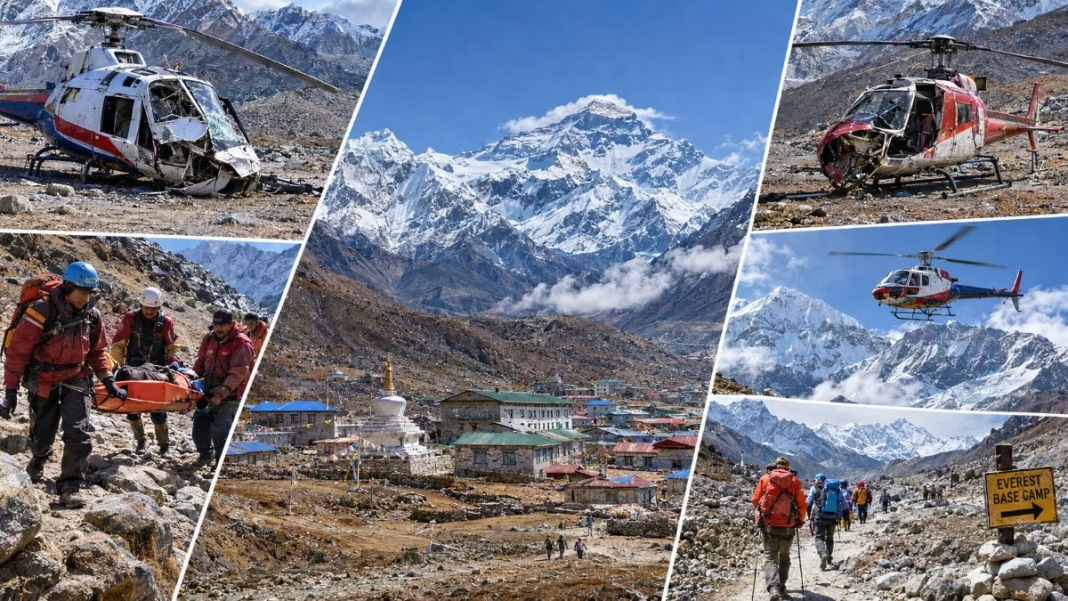


A deadly Everest helicopter collision at Pheriche in Nepal’s Solukhumbu district killed an Indian tourist on Tuesday, 3 November 2026. Two helicopters operated by Fishtail Air and Air Dynasty collided while attempting to land near the Mount Everest Base Camp trekking route. The accident occurred at approximately 8.11–8.12am local time, raising serious concerns about aviation safety in one of the world’s busiest high-altitude adventure tourism destinations. The deceased was identified in subsequent reports as 47-year-old Vasanth Kumar Balaramudu, an Indian national from Chennai. Updated reports also identified three injured people, including two pilots and a New Zealand passenger.
Updated Casualty Details and Aircraft Identification
The initial reports surrounding the accident contained differing casualty figures. However, subsequent reporting from Nepal identified three injured people, including both pilots and a passenger.
Advertisement
Advertisement
The aircraft involved were Airbus Helicopters AS350 models. The Civil Aviation Authority of Nepal identified their registrations as 9N-AOD and 9N-AJR. Air Dynasty operated the cargo aircraft, while Fishtail Air operated the passenger helicopter.
The aircraft approached the Pheriche helipad from different locations. Air Dynasty’s helicopter had departed from Lukla, while Fishtail Air’s aircraft had travelled from Gorakshep. Their simultaneous landing approaches ended in a collision involving their rotor blades.
Advertisement
Advertisement
The accident occurred outside the coverage of Lukla Airport’s air traffic control tower. Nepal’s aviation authorities are investigating the circumstances, including possible communication failures between the pilots. Civil Aviation Authority of Nepal Director General Mukesh Dangol indicated that preliminary information pointed towards possible miscommunication. Investigators were recording the injured pilot’s statement.
| Incident detail | Reported information |
|---|---|
| Date | 3 November 2026 |
| Time | Approximately 8.11–8.12am Nepal time |
| Location | Pheriche, Solukhumbu district |
| Operating companies | Fishtail Air and Air Dynasty |
| Aircraft type | Airbus Helicopters AS350 |
| Air Dynasty registration | 9N-AOD |
| Fishtail Air registration | 9N-AJR |
| Deceased | Vasanth Kumar Balaramudu, 47 |
| Injured | Two pilots and one passenger in subsequent local reports |
| Passenger nationality | Indian and New Zealand nationals |
| Investigation | Civil Aviation Authority of Nepal |
The difference between early reports and subsequent casualty updates makes it important to distinguish initial information from later identification. The precise sequence of events and the final accident findings remain subject to investigation.
Advertisement
Advertisement
Why Pheriche Matters to Everest Trekkers
Pheriche occupies a strategically important position along the Everest Base Camp trekking corridor. The settlement sits approximately 4,200–4,370 metres above sea level, depending on the reference point used. It provides accommodation, medical assistance and an important stopping point for trekkers ascending towards Everest Base Camp.
Its importance extends beyond conventional trekking services. The Himalayan Rescue Association operates a seasonal medical aid post in Pheriche. The facility helps identify and manage altitude-related illnesses among international visitors and mountain workers.
Advertisement
Advertisement
The settlement also lies within a demanding section of the Khumbu trekking network. Travellers approaching from Namche Bazaar and Tengboche typically pass through Pheriche or neighbouring Dingboche. They then continue towards Lobuche, Gorakshep and Everest Base Camp.
This geography explains why helicopter operations frequently converge around Pheriche. Operators transport passengers, supplies and emergency personnel across settlements separated by difficult terrain. Moreover, helicopters provide an important evacuation option when trekkers cannot safely descend on foot.
However, the same operational necessity creates additional aviation challenges. Narrow landing areas, changing mountain weather, limited infrastructure and simultaneous aircraft movements require particularly disciplined coordination.
The accident therefore raises questions about helipad management, pilot communication and operational separation in remote mountain settlements. These considerations matter to trekking companies, aviation operators and destination authorities alike.
Advertisement
Advertisement
Nepal’s Trekking Industry Faces New Scrutiny
The accident arrives during one of Nepal’s most commercially important trekking periods. Autumn, particularly October and November, attracts international visitors seeking clearer mountain views and favourable trekking conditions.
Nepal’s tourism industry has substantial exposure to adventure travel. According to the government’s Nepal Tourism Statistics 2025, the country received 1,162,365 international tourists during 2025. Of these, 165,056 visitors participated in trekking activities.
That represents approximately 14.2 per cent of international arrivals. The figures demonstrate how strongly Nepal’s tourism economy depends on trekking, mountaineering and associated services.
The same government publication recorded 334 expedition teams receiving permission during 2025. Their combined membership reached 2,766, reflecting growing international interest in Himalayan mountaineering.
Helicopters Remain Essential for Mountain Rescue
The Everest region presents logistical difficulties that conventional tourism destinations rarely experience. Roads do not connect the principal high-altitude trekking settlements. Consequently, helicopter services support medical evacuations, rescue missions and essential cargo transportation.
Trekkers can experience altitude sickness, exhaustion, dehydration and other medical emergencies. In severe cases, rapid descent becomes essential. Helicopters can shorten evacuation journeys that would otherwise require extensive walking across difficult terrain.
Advertisement
Advertisement
However, these services operate under demanding physical conditions. High altitude reduces engine and rotor performance, while mountainous terrain restricts approach and departure options. Wind, cloud, snowfall and visibility can change rapidly.
Passenger and cargo weight also influence helicopter performance. Operators must account for aircraft limitations, altitude, temperature, fuel requirements and landing conditions. These calculations become particularly important when operating above 4,000 metres.
The latest accident also illustrates the difference between rescue aviation and sightseeing operations. Both involve demanding mountain flying, but their operational objectives differ. Rescue flights prioritise urgent medical requirements, while sightseeing and passenger transfers follow different commercial schedules.
Consequently, aviation regulators must ensure that operational pressure never compromises flight separation or landing coordination.
Aviation Safety Questions Return to Focus
Nepal has a challenging aviation environment because its geography combines remote airstrips, steep valleys and high-altitude settlements. The Civil Aviation Authority of Nepal (CAAN) recognises these operational complexities in its aviation safety publications.
Its 2024 Aviation Safety Report identified 12 helicopter operators alongside domestic and international aeroplane operators. The report also highlighted the importance of helicopter services for remote-sector rescue and relief operations.
Advertisement
Advertisement
More significantly, CAAN’s historical safety analysis identified controlled flight into terrain (CFIT) as a major accident category. CFIT accounted for 58.5 per cent of fatalities in the preceding decade examined by the report. The approach phase also emerged as a particularly hazardous stage of flight.
These findings provide important context for the Pheriche accident. However, they do not establish its cause. Investigators must determine whether communication failures, landing procedures, visibility or other operational factors contributed to the collision.
| Previous aviation development | Safety significance |
|---|---|
| July 2023 Manang Air accident | Six people died after a helicopter crashed in the Everest region |
| CAAN Aviation Safety Report 2024 | Identified operational complexity across Nepal’s aviation network |
| December 2025 local restrictions | Sagarmatha authorities restricted sightseeing helicopter flights within the national park, while exempting rescue operations |
| November 2026 Pheriche collision | Raised fresh concerns about aircraft coordination during simultaneous landing approaches |
The December 2025 restrictions also deserve attention. Local authorities and Sagarmatha National Park sought to limit sightseeing helicopter activity while retaining rescue operations. This distinction reflects growing concern about balancing environmental protection, community interests and commercial aviation.
The latest accident could intensify discussions about how authorities supervise helicopter movements around sensitive mountain settlements. Nevertheless, any regulatory response should follow the investigation rather than assume a particular cause.
What Travellers Should Know Before Booking
The accident does not automatically mean that trekkers must cancel their Everest Base Camp holidays. However, prospective visitors should pay closer attention to operational arrangements, emergency procedures and travel insurance.
The Nepal Tourism Board describes the Everest Base Camp journey as an approximately two-week trekking experience beginning and ending at Lukla. Namche Bazaar, Tengboche, Pheriche, Lobuche and Gorakshep form important sections of the traditional route.
Advertisement
Advertisement
Travellers should understand that helicopter evacuation is not a guaranteed alternative to trekking. Availability depends on weather, aircraft access, operational permissions and the nature of the emergency.
Insurance arrangements deserve particular scrutiny. Standard travel insurance may exclude high-altitude trekking, mountaineering or helicopter rescue unless travellers purchase appropriate additional coverage.
| Travel consideration | Practical advice |
|---|---|
| Trekking season | Autumn and spring offer popular trekking windows |
| Everest Base Camp altitude | Approximately 5,364–5,380 metres |
| Pheriche altitude | Approximately 4,200–4,370 metres |
| Trek duration | Around two weeks from Lukla |
| Acclimatisation | Follow a gradual ascent and planned rest days |
| Medical preparation | Understand altitude sickness symptoms before departure |
| Insurance | Confirm high-altitude trekking and helicopter evacuation coverage |
| Helicopter bookings | Check operator credentials and emergency arrangements |
| Weather | Allow flexibility for cancellations and delays |
Altitude management remains particularly important. Nepal Tourism Board guidance recommends limiting sleeping-altitude increases to approximately 300–500 metres daily above 2,500 metres. It also recommends a rest day after every 1,000 metres of altitude gain.
Travellers should never treat helicopter evacuation as a substitute for proper acclimatisation. Anyone experiencing serious altitude-related symptoms should seek immediate medical assessment.
Additionally, trekkers should maintain communication with licensed guides and follow official instructions when authorities restrict access to particular routes.
How the Accident Could Affect Tourism
The immediate consequences concern the victims, their families and the investigation. However, the longer-term implications extend across Nepal’s adventure tourism industry.
Advertisement
Advertisement
Helicopter companies support several interconnected businesses. These include trekking agencies, mountain lodges, expedition organisers, rescue providers and specialist travel insurers.
Any additional safety requirements could increase operational costs. Operators might need to invest in communication equipment, revised landing procedures, pilot training and stronger coordination systems. Such improvements could affect commercial flight schedules and pricing.
Meanwhile, international tour operators may review their supplier arrangements. Insurance companies could also examine how helicopter evacuation risks feature in policies covering Himalayan trekking.
However, Nepal’s competitive position remains supported by its extraordinary mountain landscapes and established trekking infrastructure. The Everest Base Camp route continues to attract visitors seeking an experience that few destinations can replicate.
The challenge is ensuring that tourism growth does not outpace safety oversight. Reliable rescue services and disciplined aviation operations remain essential to sustaining international confidence.
Authorities Face Pressure to Strengthen Oversight
The immediate priority is establishing exactly how two aircraft reached the same landing area without adequate separation. Investigators will need to examine pilot communications, flight records, aircraft condition and helipad operating procedures.
Advertisement
Advertisement
The Everest helicopter collision also highlights the importance of reviewing traffic coordination beyond major airports. Remote settlements need procedures suited to their operating conditions, particularly when rescue flights and cargo movements overlap.
For international travellers, transparent investigation findings will matter considerably. Clear safety improvements can help restore confidence among trekking agencies, tour operators and visitors planning Himalayan holidays.
Nepal’s mountain tourism industry has considerable economic and cultural value. Protecting that reputation requires strong aviation oversight alongside responsible trekking and rescue operations.