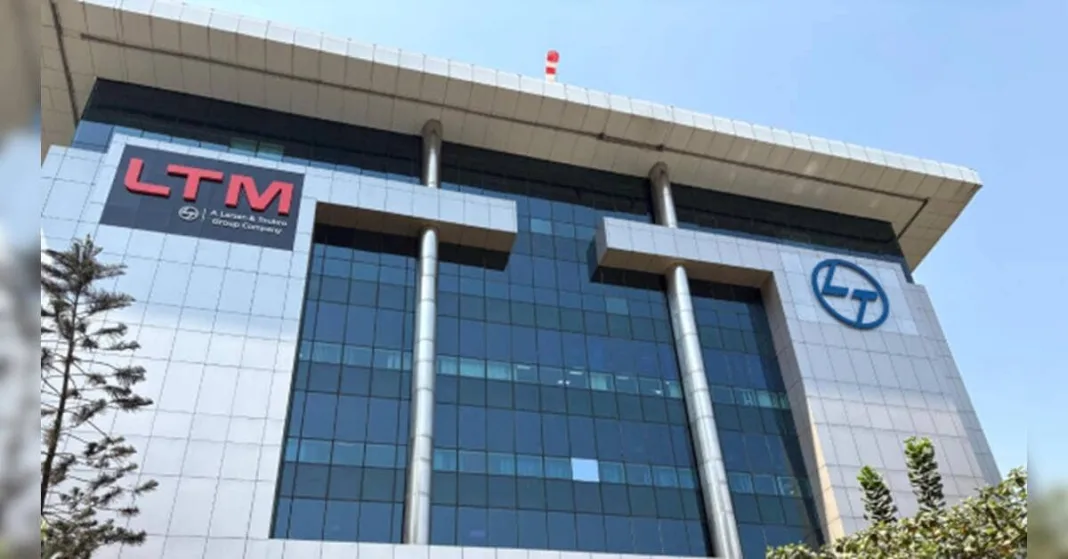

Information technology (IT) major LTM reported soft revenue, which was expected, given its exposure to the West-Asian market. The management commentary was positive. Analysts expect growth and margins to improve in 2027-28 (FY28) as artificial intelligence (AI)-led deals dominate and convert into revenue faster with higher margins. But attitudes towards valuation are mixed, with some earnings downgrades and expectations that forex losses will continue in the second half (H2) of FY27.
The revenue of $1.2 billion in the second quarter (Q2) of FY27 was up 1.1 per cent quarter-on-quarter (Q-o-Q) in constant currency (CC). The earnings before interest and taxes (Ebit) margin was 15.6 per cent. Adjusted net profit was ~1,400 crore, flat year-on-year (Y-o-Y), and down 6 per cent Q-o-Q. In current rupee terms, revenue was up 15.7 per cent Y-o-Y, Ebit was up 19.1 per cent, and adjusted net profit was up 8.1 per cent in H1FY27.
The banking, financial services, and insurance (BFSI) as well as production verticals grew 3.1 per cent and 3.7 per cent Q-o-Q in constant currency (CC), respectively. Technology declined 4 per cent Q-o-Q (CC), and the travel segment was also down. Headcount for software rose by 947 (1.1 per cent Q-o-Q). Utilisation was flat Q-o-Q at 86.4 per cent, and attrition was flat Q-o-Q at 13.3 per cent. LTM declared an interim dividend of ~25/share for Q2FY27.
West Asia exposures (especially Saudi Arabia exposures) pulled down Q2FY27 Q-o-Q revenue growth in CC by 60-70 basis points (bps). In the Q2FY27 guidance, FY27 margins are targeted to stay close to the FY26 level (15.4 per cent), including the Randstad acquisition-related amortisation. Approvals for the acquisition of Randstad’s businesses in Europe and Australia are expected by the end of Q3FY27.
The market is pivoting to AI-led deals, which are short-tenure, with faster revenue conversion. AI deals typically run 6-12 months, with iterative follow-ons. The gross margin profile of AI projects is higher. LTM expanded its AI platform BlueVerse, launching BlueVerse One Token, BlueVerse RightLogic, and BlueVerse Sovereign models.
Overall order inflows were $1.26 bn, declining 25 per cent Q-o-Q. Wins included a strategic technology partnership with a global bank, AI-led infrastructure management for a North American construction firm, and IT consolidation for a US insurer.
The management says macro conditions are broadly unchanged over the last two-three quarters. There were no deal deferrals, and the softer TCV is due to deliberate shift in deal mix towards AI in response to client spend shifting towards AI deployment.
Excluding Saudi Arabia, demand is healthy, with BFSI growth recovering. Three of four verticals exceeded 7 per cent growth Y-o-Y. The H1FY27 growth was 5.4 per cent Y-o-Y, with the management guiding for higher Q-o-Q growth in Q3 and Q4. Sales KPIs (key performance indicators) and incentives are being recalibrated, with different commissions and rate cards for AI-native deals.
In the BFSI vertical, revenue grew 3.1 per cent Q-o-Q and returned to Y-o-Y growth at 0.4 per cent in CC. This is the second consecutive quarter of sequential growth. Given the top client’s consolidation from 50-plus vendors to 5 vendors, LTM expects to benefit as a retained vendor. In the technology vertical, revenue declined 4 per cent Q-o-Q but grew 7 per cent Y-o-Y in CC. The decline reflects the top client’s seasonal renewal cycle from July, and the Saudi joint venture (JV) is also in this vertical. Growth is expected to normalise from Q3. In the consumer vertical, revenue grew 0.3 per cent Q-o-Q and 8.6 per cent Y-o-Y in CC. Travel and hospitality was in decline.
A new business unit is being set up to help clients build and scale global capability centres (GCCs) in India. Partnerships include Anthropic (Claude embedded in Blueworks Delivery Fabric), Glean, Cognition, IBM-Red Hat, and Chainguard.
The net profit margin declined to 11.7 per cent from 12.7 per cent in Q1, which included a one-time gain on the invoicing.ai investment. Forex losses may continue for the next two quarters, with rupee depreciation being a key factor, against layered hedges of $4.5 billion. After assessing H1 performance and factoring for guidance on continuing forex losses, analysts might cut FY27 earnings expectations while holding FY28 and FY29 earnings estimates largely unchanged. There are wide variations on recommendations and valuations.
The writer is a New Delhi-based independent journalist