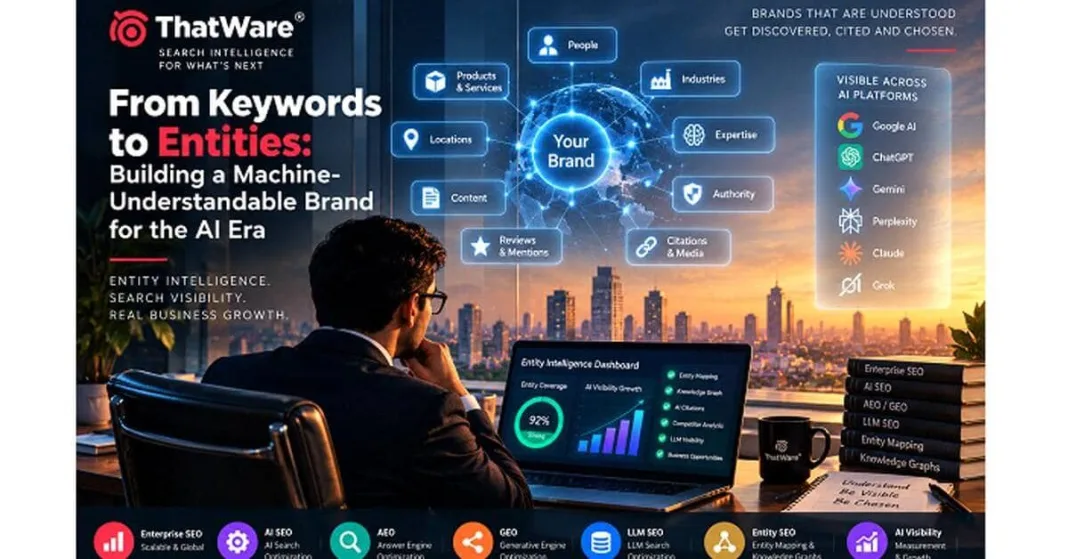

Search marketing has spent years helping businesses become easier to find. The next challenge may be more fundamental: making sure machines understand what they find.
A company can rank highly on Google, attract organic traffic, and maintain thousands of indexed pages, yet still leave Google and AI systems with an incomplete understanding of its business.
What does the company specialize in? Which products and services belong to it? Who are its key people? Which markets does it serve? And what reliable sources support those relationships?
As discovery expandsinto Google AI Overviews, ChatGPT, Gemini, Perplexity and other AI environments, those questions are becoming commercially important.
From Keywords to Entities
An entity-led strategy connects a company with its products, services, technologies, locations, leadership, industries and expertise, creating a clearer digital identity.
The company combines enterprise SEO with AI SEO, Answer Engine Optimization (AEO), Generative Engine Optimization (GEO), LLM SEO, structured data and knowledge-graph engineering.
Why Knowledge Graphs Matter
“Search is moving from matching words toward understanding organizations, expertise and relationships,” said Dr. Tuhin Banik, Founder and CEO of ThatWare.
A knowledge graph connects entities through defined relationships. For a business, these can include the organization, founders, services, products, technologies, locations and authoritative references.
When those relationships are fragmented or contradictory, machines have to determine which information to trust.
That becomes commercially relevant when a prospective customer asks an AI assistant to identify providers, compare companies or recommend businesses with particular capabilities.
Entity Mapping Meets AI Search
ThatWare uses entity mapping to examine relationships surrounding a business and how consistently they appear across websites, structured data, business profiles, executive information, reviews and authoritative publications.
The company extends this through VEM, or Vector Entity Modelling, a framework focused on relationships among brands, services, people, topics and other entities in ways that support machine understanding.
A business seeking visibility across AI-generated answers cannot rely simply on repeating commercial keywords. Its information needs to be clear enough to retrieve, structured enough to interpret and supported strongly enough to trust.
SEO and AI Search Are Converging
Conventional SEO is not disappearing. Technical accessibility, website architecture, content quality, linksand organic rankings remain fundamental.
What is changing is the number of discovery environments businesses must consider.
For large organizations, this becomes a governance issue. Multiple websites, markets, products and content teams can create conflicting signals around the same brand.
ThatWare’s broader Intelligence approach combines semantic SEO, knowledge graphs and entity engineering readiness to address these challenges.
Its AVM examines how brands appear across AI-led discovery environments, while VEM addresses the underlying entity and relationship layer.
In simple terms, one examines whether a brand is being seen; the other focuses on whether it is being understood.
For businesses, that distinction could become increasingly important.
Customers are increasingly using digital platforms to research and shortlist companies before making contact. Brands therefore need more than visibility.
They need a digital identity that machines can understand with confidence.
Disclaimer: No Business Standard Journalist was involved in creation of this content
First Published: Oct 02 2026 | 1:08 PM IST