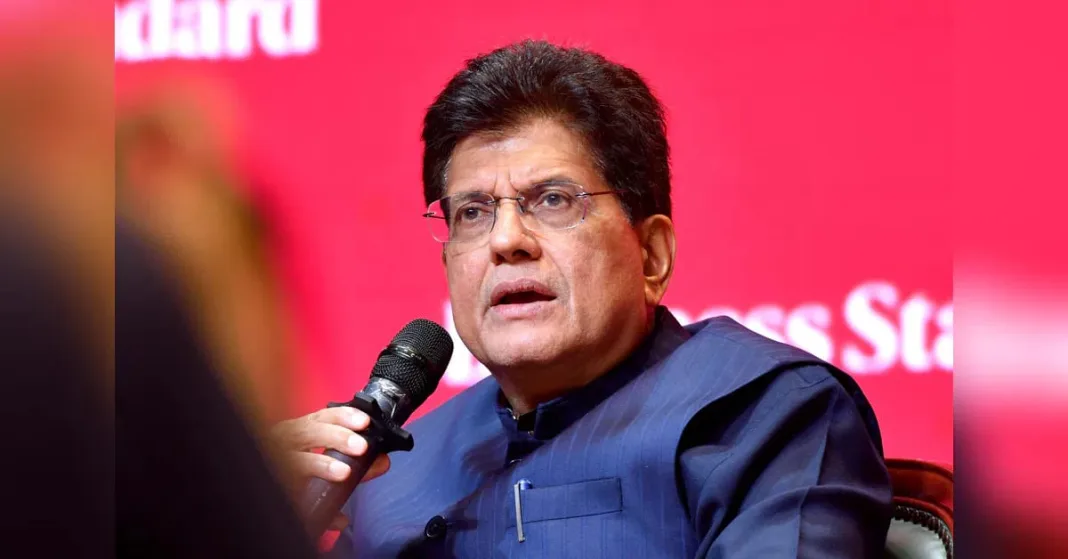

Commerce Minister Piyush Goyal has asserted the need to clearly distinguish between the weaponisation of food supply chains and legitimate measures adopted by countries to address food security requirements.
Addressing the G20 Trade Ministers’ meeting in Milwaukee, about 1,200 kms from here, Goyal said the shared objective must be to ensure that food remains a source of security, stability and cooperation.
“Also, underlined that we must clearly distinguish between the weaponisation of food supply chains and legitimate measures adopted by countries to pursue domestic policy objectives and address food-security needs,” Goyal said in a post on X.
The minister was speaking at a session on ‘Weaponisation of Food through Coercive Trade Action’ at the G20 Trade Ministers’ Meet on Wednesday.
Earlier, US Trade Representative (USTR) Jamieson Greer said the US, during its G20 Presidency, has focused over the course of the year on four work streams — the weaponisation of food, structural excess capacity and production, the Most-Favoured-Nation (MFN) principle, and forced labour in global supply chains.
“First, the weaponisation of food. Coercive trade actions involving food, agricultural products, and agricultural inputs pose serious consequences for economies and the people in them,” Greer said.
On structural excess capacity and production, he said that when non-market policies and practices allow production to expand far beyond domestic demand, the consequences spill across borders.
“Excess production flows into global markets, putting pressure on producers and workers elsewhere,” Greer said.
The USTR said many consider MFN to be the cornerstone of the global trading system.
“But even a cornerstone should be examined from time to time to ensure it is still supporting the structure we need. The MFN principle, particularly when applied unconditionally, constrains economies’ ability to effectively respond to distortive policies and adapt to changing market conditions,” Greer said.
The USTR said forced labour was not just a humanitarian issue, but also a trade issue.
“Goods made with forced labour enter markets with an artificial price advantage, creating unfair competitive conditions for workers and businesses, while eroding trust in the fairness of the global trading system,” Greer said.