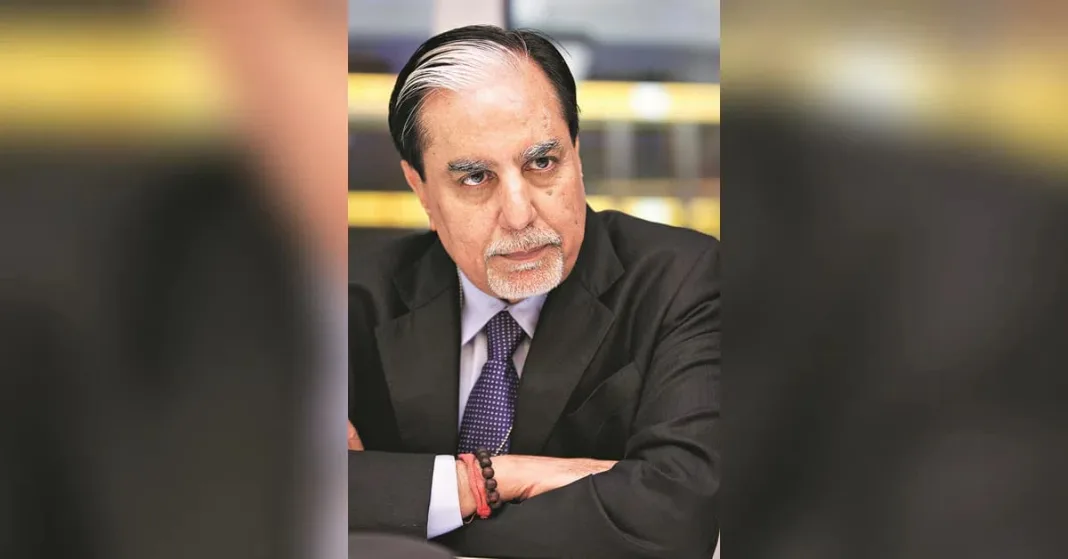

The National Company Law Appellate Tribunal (NCLAT) on Tuesday sought responses from creditors to a petition filed by Essel Group Chairman Subhash Chandra challenging an order in his personal insolvency proceedings. The appellate tribunal is likely to hear the matter on October 29 and 30. A three-member Bench comprising Officiating Chairperson Justice (Retd.) Yogesh Khanna and Technical Members Barun Mitra and Ajai Das Mehrotra directed the creditors opposing Chandra’s plea to file their replies within a week. Chandra has been granted another week to file his rejoinder.
The Zee Group founder is challenging a September 1 order of a five-member Bench of the National Company Law Tribunal (NCLT), which stayed the order of a third member in his personal insolvency proceedings and restrained him from disposing of his assets.
The appellate proceedings also include a separate challenge by creditors to the NCLT’s approval of a settlement under which Chandra proposed to repay about ₹6.5 crore against admitted claims of approximately ₹22,006.57 crore. The plea was clubbed with Chandra’s appeal at the request of Solicitor General Tushar Mehta, who appeared for some of the creditors.
The NCLAT has earmarked October 29 and 30 for arguments on Chandra’s applications seeking interim relief. The tribunal indicated that one day would be devoted to Chandra’s submissions and the other to the creditors’ arguments.
During Tuesday’s hearing, the Solicitor General suggested that the appellate tribunal await the outcome of proceedings before a five-member NCLT Bench scheduled for November 19. Advocate Dhruv Mehta, appearing for Chandra, opposed the suggestion.
The dispute stems from a split decision by a two-member NCLT Bench on Chandra’s personal insolvency resolution process. Member (Judicial) Ashok Kumar Bhardwaj had approved Chandra’s repayment proposal and held that he could seek relief under the insolvency framework applicable to personal guarantors.
Member (Technical) Reeta Kohli disagreed with the proposal. The difference of opinion resulted in a reference under Section 419(5) of the Companies Act, 2013, which provides for points of difference between members to be placed before additional members for determination.
Nilesh Sharma, Member (Judicial), was subsequently appointed as the third member to decide the issues on which the original Bench had differed. Sharma concurred with Bhardwaj on the key questions and upheld Chandra’s repayment proposal, under which claims of around ₹22,006 crore arising from personal guarantees were proposed to be settled for approximately ₹6.5 crore.
The operation of Sharma’s order was subsequently stayed by a five-member NCLT Bench, which also restrained Chandra from alienating his assets pending further proceedings.
The personal insolvency proceedings are also linked to a complaint by Life Insurance Corporation Housing Finance Limited (LICHFL). The lender alleged that Chandra had submitted net-worth certificates containing inflated figures to obtain approval and disbursal of two loans aggregating ₹980 crore.
The Central Bureau of Investigation (CBI) has registered an FIR against Chandra over the allegations. According to the complaint, the alleged conduct resulted in a loss of more than ₹1,322 crore to the public-sector lender.
At the NCLAT, Chandra has also questioned the statutory authority of the NCLT to pass its September 1 order and challenged the constitution of the five-member Bench that stayed the third member’s decision.
The appellate tribunal has now sought the creditors’ responses before taking up Chandra’s challenge and his plea for interim relief.