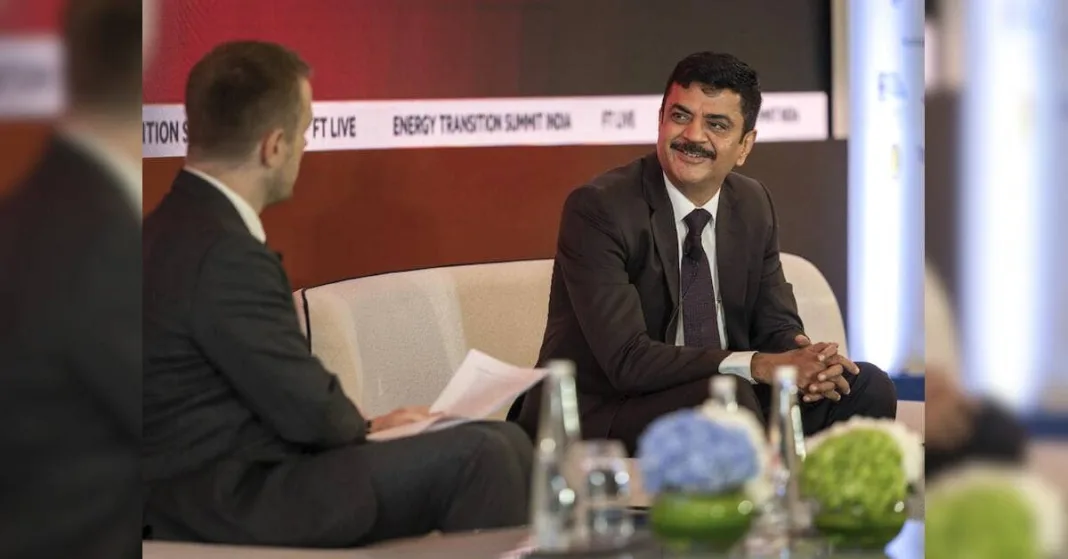

The government will put its draft National Steel Policy in the public domain in about a week for stakeholder consultation, with the policy targeting more than 600 million tonnes (MT) of steelmaking capacity and over 500 MT of consumption by 2047, Steel Secretary Sandeep Poundrik said on Tuesday.
The policy will also propose a ₹5,000 crore scheme for small steel producers to incentivise production linked to reduction in carbon emissions, while the Carbon Credit Trading Scheme (CCTS) for larger steel producers is expected to be notified “very soon”, Poundrik said on the sidelines of an industry event organised by the Confederation of Indian Industry (CII) in New Delhi.
“In about a week, we will put this policy into the public domain for consultation and for comments from stakeholders,” he said. He added that it could be released as early as Monday next week.
The proposed policy will provide a roadmap for the steel sector up to 2047 and replace the National Steel Policy, 2017, which has a horizon up to 2030.
Poundrik said the new policy takes into account issues that were not as prominent when the 2017 policy was formulated, including artificial intelligence, machine learning, technology upgradation, decarbonisation and sustainability.
Under the proposed policy, India is expected to have more than 600 MT of steel capacity by 2047, while consumption is estimated at more than 500 MT.
About 45 MT of this is expected to be accounted for by exports, either directly or through steel embedded in manufactured products.
“These are conservative numbers,” Poundrik said.
The government also plans to increase speciality steel production, particularly grades used in automobiles, defence and aerospace.
Poundrik said 175 speciality-steel projects involving investments of ₹55,000 crore are currently underway.
The policy will also include measures to discourage cheap and substandard steel imports to make the Indian steel industry, including small steel players, competitive.
“As far as imports are concerned, the policy also gives measures to discourage cheap substandard imports, including safeguard measures like safeguard duty, anti-dumping duty, etc. as well as to make Indian steel industry and especially the small steel players competitive in terms of technology and price,” he said.
Poundrik, however, said the government is not currently considering a higher safeguard duty, saying the existing three-year safeguard duty appeared to be working.
“As you know, there is already a safeguard duty for a period of three years, and presently I don’t see the Indian steel industry facing any price differential based on the prices going on in domestic prices. So presently that seems to be working,” he said.
For small steel producers, the government is proposing the ₹5,000 crore Viksit Bharat Ispat scheme, under which incentives would be linked to production and reduction in carbon emissions.
“We are proposing a scheme which is called Viksit Bharat Ispat, which is only targeted at small steel producers where they will be given incentives linked to their production, which will be dependent on reduction of carbon emission,” Poundrik said.
He said emission reductions could be achieved through better technology, better raw materials and greater use of renewable energy.
The scheme is likely to be approved by the competent authority in the near future, he said.
For larger steel producers, the government is moving towards mandatory emissions reduction through the CCTS.
“For bigger steel producers, the CCTS is already going to be notified very soon, which will ensure that they reduce their carbon emissions under the CCTS scheme,” Poundrik said.
The government has also approved the carbon capture, utilisation and storage (CCUS) mission, with the steel sector expected to be an important part of it because of its contribution to emissions.
Poundrik said India’s steel consumption has grown faster than capacity over the past four years, with consumption growing at 11 per cent compared with capacity growth of more than 9 per cent.
The projected expansion of steel capacity by 2047 will also increase pressure on raw materials.
India will require more than 700 MT of iron ore, Poundrik said.
“Raw material availability will become a major challenge. We will have to work on that,” he said.
He also said India remained dependent on foreign countries for critical steelmaking technologies despite having around 120 years of steelmaking history.
The government is, therefore, seeking to incentivise the development of domestic technologies, he said.
Separately, the government has notified the constitution of a Steel Industry Safety Council following accidents at steel plants, including RINL and SAIL, Poundrik said.
The council will be chaired by the Steel Secretary and include chairmen and managing directors of integrated steel plants and representatives of associations of small steel producers.
Its mandate will include ensuring that standard operating procedures are in place and implemented, as well as third-party investigations following accidents.
The Steel Ministry is also studying the impact of the European Union’s 1.6 MT steel quota for India before taking up the issue with the concerned governments, Poundrik said.
He said some grades could not currently be exported in sufficient quantities, while India could export more than the quota in certain other grades.
“There are certain grades under which we are not able to export. And there are certain grades where we can export more,” he said.
“So we are studying that, and then we will again take it up with the concerned governments,” he added.