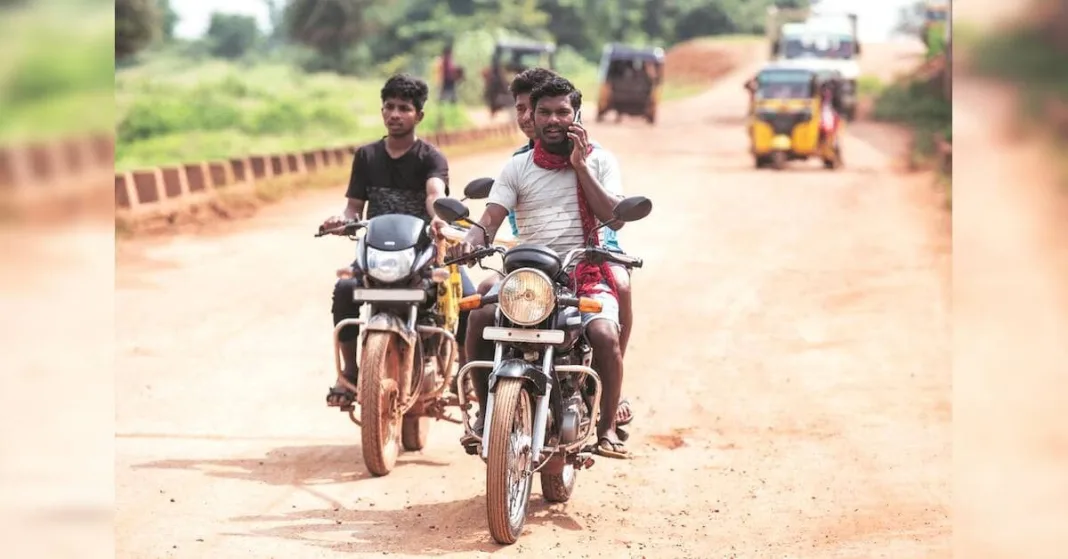

Rural demand for passenger vehicles (PVs), commercial vehicles (CVs) and three-wheelers is comfortably outpacing that in urban markets, even as deficient rain in several parts of the country has sharply pulled down tractor sales.
The retail data from the Federation of Automobile Dealers Associations (Fada) shows rural sales of PVs grew 24.9 per cent year-on-year in August against 10.9 per cent in urban markets, those of CVs rose 16.3 per cent against urban’s 12.7 per cent, and rural three-wheelers grew 23.9 per cent even as urban three-wheeler sales fell.
Tractors moved in the opposite direction, down 25 per cent month-on-month and effectively flat year-on-year.
Fada President Sai Giridhar has described this as rural demand “decoupling” from the monsoon, with non-farm activities, movements of goods, construction and livelihood mobility apparently holding up even as the farm-linked segment softens.
The divergence matters because rural automobile demand has traditionally been read partly through the agricultural cycle: The rains influence sowing, farm incomes and eventually discretionary purchases.
There are a few obvious historical parallels. In 2023-24, during an El Nino-affected monsoon, tractor sales fell countrywide, but Fada’s numbers for the year show those of PVs and CVs too declining alongside tractors, rather than taking a different path. Only two- and three-wheelers grew.
When asked if the year’s pattern had a precedent, Anurag Singh, managing director at Primus Partners, said: “It’s relatively new.”
The production data from the Society of Indian Automobile Manufacturers (Siam), which gives figures for sales to dealers, shows strong activity in several vehicle categories.
The output of utility vehicles rose 28.3 per cent year-on-year in August, while the production of three-wheeler passenger-carriers grew 22.6 per cent.
Two-wheeler production grew 15.2 per cent. Scooters, typically more urban-weighted, grew faster at 26.7 per cent than motorcycles at 9.1 per cent, even as motorcycle exports rose 33.4 per cent.
Siam’s data for domestic sales also points to a strong August: PV sales rose 36.5 per cent year-on-year, three-wheelers 22.8 per cent and two-wheelers 10.5 per cent. Siam attributed the performance partly to the lower base of the previous year, while describing rural markets as resilient.
Taken together, however, it is Fada’s rural-urban retail split — rather than the production data — that provides the clearest evidence of the geographic divergence. It raises a larger question: Is the current pattern transient, driven by the timing and base effects, or is rural vehicle demand becoming less dependent on the traditional farm cycle?
Singh cautioned against taking the rain deficit as any guide. “Less than half of India is in deficit,” he said. “A large part of the country including Uttar Pradesh and Maharashtra is in a reasonable position. Only pockets, such as parts of the Northeast, are running excessively or significantly short.”
The India Meteorological Department (IMD) data shows considerable variation in rain across states and districts, making the geographical distribution of the monsoon important alongside the all-India number. The IMD’s rainfall-monitoring data is updated daily and provides cumulative rainfall from June 1 as well as district- and state-level distribution.
The bigger open question is whether rain deficits translate into weaker Kharif output or farm incomes later in the year once farm incomes are measured rather than merely anticipated.
Singh said the two were linked but not simply.
Non-farm rural spending, he said, depends on the crop cycle. But a smaller harvest does not necessarily mean less money in farmers’ hands because falling yields can, depending on the crop and market conditions, push up prices and partly offset the loss, according to him.
He also pointed to a structural shift that complicated the old assumption that sowing-season sentiment tracked actual farm income. With greater access to savings and credit, farmers today will often go ahead with big-ticket purchases even if the season disappoints. That decouples near-term buying behaviour from realised farm income more than it used to, he argued, which could make tractor demand — traditionally read as immediate proxy for rural sentiment — a noisier signal than in the past.
Partho Banerjee, head of sales and marketing, Maruti Suzuki, in an earlier media roundtable, offered a separate, more company-specific data point in support of the broader rural trend. Rural markets now account for 53 per cent of the company’s sales while first-time buyers account for 54 per cent of its sales mix, up roughly 10 percentage points since the cut in goods and services last year. He attributed that shift to the rate cut itself, last year’s income-tax relief and cumulative repo-rate reductions.