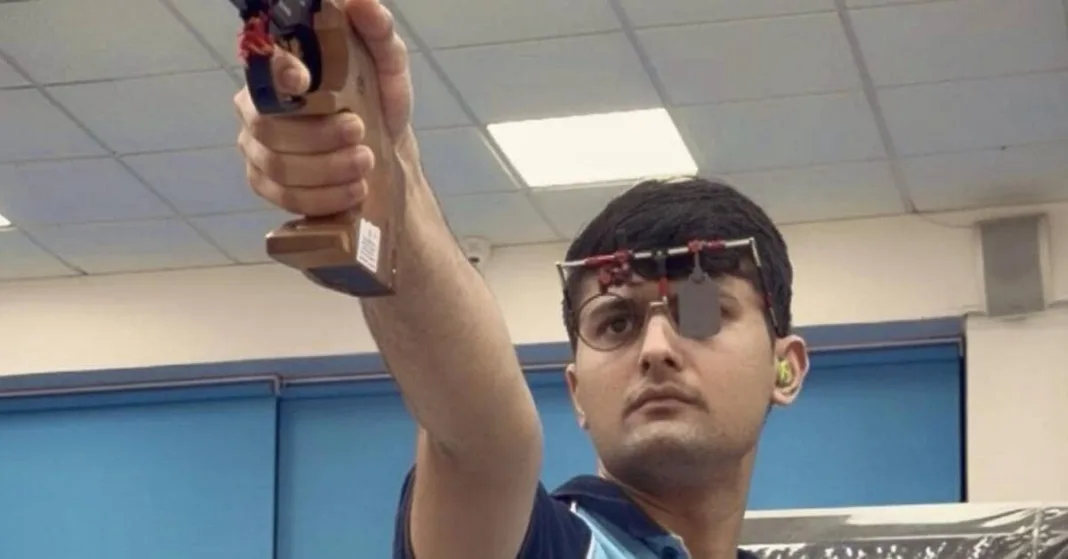

With the 2026 Asian Games under way in Aichi-Nagoya, Akash Bharadwaj is entering the shooting range with a story that began much later than those of most of his rivals. The Jaipur shooter was already 21 when he first held a pistol — an age by which many elite shooters have spent years competing at junior and senior levels.
Bhardwaj, however, has made up for lost time. His introduction to shooting came through a chance advertisement for an academy in Jaipur in late 2021. What followed was a period of relentless self-training, long journeys to the range and sacrifices from a family that could not afford to make the sport an easy pursuit.
His father, a commercial driver, bought his first pistol on a credit card, while his elder brother Subham took responsibility for his academy fees. Bhardwaj himself often travelled 14 kilometres to training by walking, cycling or taking lifts, while setting aside small amounts from his daily allowance to buy pellets and meet his nutritional needs.
There was no established roadmap to follow either. Without a personal coach during his formative years, he spent hours studying his technique, conditioning his body and correcting his own mistakes.
That unconventional route has now taken him to the Indian team. After appearances at four ISSF World Cups and a rise to 44th in the world rankings, Bhardwaj is preparing for his first Asian Games — less than five years after discovering the sport.
Who is Aakash Bhardwaj?
Born on August 13, 2001, Aakash hails from Niwaru Road on the outskirts of Jaipur, Rajasthan.
He grew up in a modest household, with his father working as a commercial driver and earning around Rs 10,000 a month. Before discovering shooting, Aakash was involved in athletics and rugby and even won a national bronze medal in rugby.
It was concerns over injuries in contact sports that eventually pushed him towards an individual discipline, where performance would depend largely on his own preparation and execution.
Aakash was introduced to shooting in late 2021 after coming across an advertisement for a shooting academy. Despite having no previous experience with a pistol, he immediately caught the attention of coaches with his natural accuracy.
The late start meant that he had to make up for years of experience that many of his competitors already possessed. Rather than allowing that gap to discourage him, he immersed himself in training.
His journey has since taken him from an academy in Jaipur to the national selection process and, now, his first Asian Games.
A family that backed the dream
For Aakash, taking up shooting was not an easy financial decision. Coming from a family where money was limited, the cost of equipment, academy fees and training could have ended his sporting ambitions before they had properly begun.
His father, however, bought him his first pistol on a credit card after recognising his potential, while his elder brother Subham took responsibility for his monthly academy fees.
“Coming from a background where every rupee counted, shooting felt out of reach at first. My father worked relentlessly as a driver to provide for us. When I showed genuine promise, he bought my first pistol on a credit card,” Aakash said.
“My elder brother Subham covered my monthly academy fees from his own earnings. My father and brother made countless sacrifices so I could pursue this dream without carrying the financial burden.”
Those sacrifices gave Aakash the opportunity to continue training during the period when he was still trying to establish himself.
The long road to the shooting range
The distance between Aakash’s home and the Marudhara Sports Shooting Academy on Kalwar Road was another challenge.
Without the financial means for regular transport, he often walked, cycled or relied on lifts from passers-by to reach the range. He would cycle as much as 14 kilometres for training.
Even his daily allowance had to be carefully managed. Aakash saved small amounts from his travel money to buy basic nutrition and training pellets.
The limitations of his circumstances also meant that he had to become unusually self-reliant during his formative years.
Without a personal coach guiding him through every stage, he developed his own conditioning and practice routines.
“In the beginning, I had to figure out many things on my own. I would spend six to seven hours every single day doing dumbbell conditioning and dry-fire drills,” he said.
“I used to analyse my errors closely, noting down how my shots shifted whenever my neck tilted. That solitary grind taught me how to stay calm and trust my own hard work.”
That period of self-analysis became an important part of his development, helping him understand his technique and identify small errors that could affect his shooting.
From self-training to national selection
Aakash’s progress began to show through his performances on the domestic circuit.
Steady scores eventually earned him an opportunity to compete in the national selection trials, where he had to compete against shooters with considerably more experience.
His breakthrough into the national set-up was based on his ranking points accumulated through the selection events, something Aakash sees as particularly important given his background.
“When you come from a humble background, you need a system where only your performance matters. The best part of NRAI’s selection process is its complete transparency. My selection for the Asian Games was earned strictly through the ranking points accumulated across the trials.”
For Aakash, that performance-based pathway removed another potential barrier. Instead of having to rely on connections or reputation, his scores determined his progress.
The National Rifle Association of India also provided institutional support once he entered the national system.
“The administrative team at NRAI has backed me at every turn. Whenever I needed logistical help, equipment clearance or administrative support, the federation sorted it out immediately. That reassurance lets athletes like me focus entirely on hitting the target.”
Testing himself on the World Cup circuit
Aakash’s transition to the international circuit has been another stage of his development.
His World Cup results in 2025 and 2026 have included a 10th-place finish in Lima in 2025, where he qualified with 583, followed by another 10th-place finish in Granada in 2026 with a qualification score of 580.
He also finished 19th in Buenos Aires in 2025 and 24th in Hangzhou in 2026.
While he is yet to reach a World Cup podium, those appearances have given him valuable experience against the world’s leading 10m air pistol shooters.
At the 2026 Asian Championships in New Delhi, Aakash finished 10th in the individual event with a qualification score of 584. The results have been part of a learning process rather than a final measure of his potential.
Learning to perform under pressure
For Aakash, one of the biggest changes since he first entered shooting has been his ability to reproduce his practice form when the pressure of competition arrives.
That is particularly important for a shooter who had to build much of his technical understanding independently.
“Earlier, I used to shoot good scores only in practice, but now I have the belief that I can deliver the same performance under match pressure.”
That confidence will be tested at the Asian Games, where he will compete at the Aichi Prefectural General Shooting Gallery against some of the continent’s best shooters.
The Asian Games will also represent a significant step up in terms of the scale of the occasion. For a shooter who only discovered the sport in his early twenties, it is another indication of how quickly his career has developed.
A first Asian Games
Aakash’s maiden Asian Games appearance marks the latest chapter in a journey that began far later than the conventional pathway into elite shooting.
He will compete in the men’s 10m air pistol, having earned his place through the ranking and selection system.
His preparation has been shaped by years of doing more with less — travelling long distances to train, saving money for pellets and nutrition, developing his own conditioning routine and relying on his family when professional shooting seemed financially out of reach.
Those experiences have also shaped his outlook ahead of Aichi-Nagoya.
“If my journey has taught me one lesson, it is that no hardship can hold you back if you remain dedicated. When you believe in your preparation and stay disciplined, results will follow. I am looking forward to giving my absolute best for India in Japan.”