

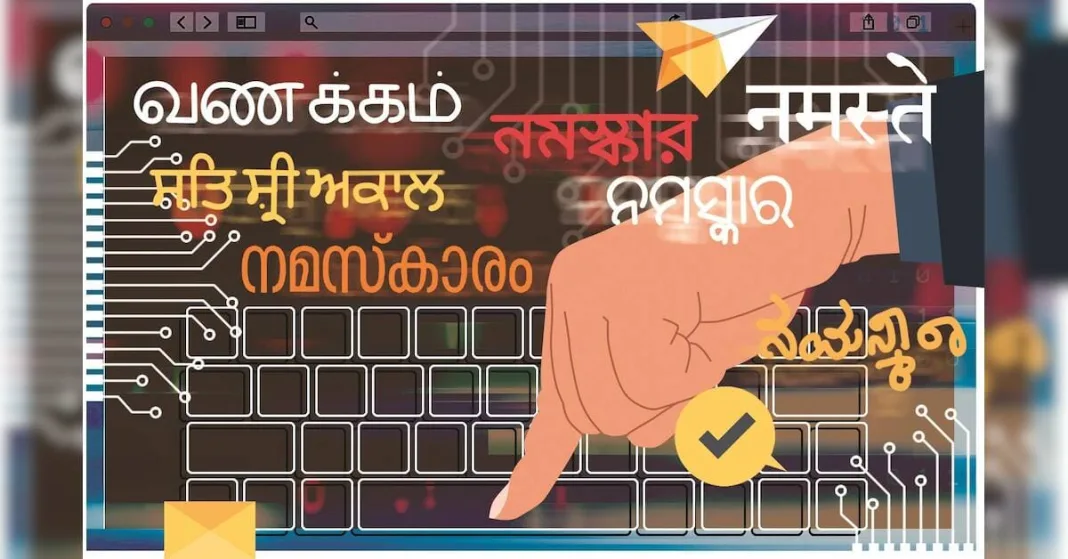

Here’s how it could work: An electronics retailer stocks goods after quickly checking on ChatGPT, Gemini, CoPilot or Anthropic as to what’s selling. They reorder goods by speaking rather than typing. A borrower in rural India, puzzled by an English text message from her bank, discusses the repayment schedule in her local language. A senior citizen asks a government chatbot about a welfare benefit in the familiar language spoken at home.
For India’s AI industry, these seemingly mundane conversations represent one of its biggest opportunities — and one of its hardest technical problems.
Rajiv Kumar, managing director and president, Microsoft India Development Centre said, “India’s AI opportunity will be fully realised only when AI speaks the languages people talk in. In a country as linguistically diverse as India, AI that is intuitive, conversational and grounded in local context isn’t a feature — it is the precondition for reach.”
Hinglish, Tanglish, Kanglish
India has 22 scheduled languages, multiple scripts and hundreds of dialects. Conversations routinely slip between Hindi and English, Tamil and English, Kannada and English — sometimes within the same sentence. Sanjeeth R, chief product officer of Bengaluru-based Exotel, said, “Nobody speaks clean Hindi or clean English on a phone call. It’s Hinglish, Tanglish, and Kanglish.” That is forcing AI companies to rethink AI models that by default put English first and other languages second. Bangalore based Exotel is an AI-powered customer engagement platform. Its clients include Swiggy, Uber, Flipkart, HDFC Bank, JW MG Motors among others.
Ganesh Gopalan, co-founder and CEO, Gnani.ai, a voice AI company, said, “The single biggest hurdle to scale vernacular AI is the Indian language tax — models that work well in English but degrade sharply (in both latency and accuracy) the moment you move to a regional language.” Translating an Indian-language conversation into English, processing it and translating the response back can introduce more errors and delay.
Gnani.ai’s Prisma v2.5 speech engine handles 22 languages at the voice layer, including accents, dialects and mixed-language speech, while its Evon v3.3 large language model is trained natively across 11 Indian languages. The Bengaluru-based company, which is also developing sovereign AI models, says the latest version of Evon cuts the Indian-language tax by
38.6 per cent compared with earlier-generation models.
Besides getting the right language models, companies have to also overcome technical and real-life challenges. Real-life conversations are not recordings made in a quiet studio. Conversations have to account for background traffic noise, multiple people talking, interruptions, and varying accents.
For vernacular AI to become “invisible” enough to be useful, Sanjeeth said, “the whole conversation has to be natural — not simply improving transcription accuracy. That means low latency, natural turn-taking (knowing when to speak and when to listen) and an ability to switch languages without disrupting the interaction. If a caller speaks Tamil, the system should understand Tamil, reason in that context and respond in Tamil.”
Voice AI company Krisp is also tackling language barriers to help users. Vimal Nair, chief growth officer at Krisp, said, “Our Accent Conversion Technology supports about 95 per cent of Indian English speakers across major dialects, while the
Voice Translation technology covers 61 languages globally, including Hindi, Bengali, Marathi, Telugu, Tamil and Kannada.”
Google is also channeling its efforts to build inclusive AI. Partha Talukdar, principal scientist and director Indic language research, Google DeepMind, said, “The goal is to enable Indians to access the information they need in a language of their choice.” One of Google’s initiatives, Project Vaani, in collaboration with the Indian Institute of Science (IISc), is building an open source speech dataset with the goal of representing language and speech diversity across India. Startups like Shillong- based mWire Labs used Project Vaani’s natural conversational speech dataset to train a voice recognition system for Garo, a local language that is traditionally excluded from major AI models.
Another startup, Bengaluru-based SandLogic, used Project Vaani dataset to teach its speech recognition AI model to improve accuracy of transcriptions of spoken Hindi in call centres. “Recently, we expanded the capabilities of Gemini Live (Google’s real-time conversation feature) as well. It now has the ability to converse naturally in over 25 Indian languages and dialects, in voice and text, including Sanskrit, Bhojpuri, Maithili and others,” added Talukdar.
Apart from improving access, integrating vernacular AI can make a lot of difference in daily transactions. According to Gnani.ai, a bank that deployed vernacular voice AI for authentication and collections saw its call handling time come down by roughly 50 seconds per call and customer satisfaction scores increase by 24 per cent. A rural microfinance lender using its technology for collection calls recorded an 82 per cent engagement rate, while another microfinance NBFC generated an 8.8-times return and 48 per cent higher engagement compared with text-based borrower outreach.
The bigger transformation could happen among people who have been only partially served by India’s digital revolution. Smartphones brought the internet to millions of users, but much of the digital economy still assumes that users can read menus, type queries and navigate apps. Voice AI can remove those requirements.
Sanjeeth said, “If you can’t read, an app can be a wall. A kirana-store owner, for instance, could use a voice prompt and ask about inventory or place an order in the language he knows. A farmer or borrower could respond verbally to a loan reminder. A patient could make an appointment without working through a text-heavy interface.”
Gopalan called voice’s ability to eliminate the literacy requirement one of its fundamental advantages over text-based AI: No script to read, keyboard to use or menu to navigate. The ability to ask a price, obtain information or do market research simply by speaking expands the use of AI.
ChatGPT owner OpenAI has developed IndQA, an evaluation comprising 2,278 culturally grounded questions across 12 Indian languages and 10 domains, created with 261 experts. “We specifically included Hinglish because code-switching (alternating between two languages) is so common in conversations including Hinglish,” said an OpenAI spokesperson. Early in July, OpenAI launched GPT-Live, a new generation of voice models, which it claims makes talking with AI feel like a natural conversation.
Better vernacular platforms will improve access to government services as well. Microsoft-backed Jugalbandi, a multi-lingual chatbox, uses generative AI to allow people to find information about government programmes through spoken or typed conversations in local languages. Instead of knowing which website, department or scheme to search, a citizen can ask a question conversationally.
Other applications are emerging in healthcare and education. AI-powered WhatsApp chatbot, ASHAbot, is designed to provide localised information to Accredited Social Health Activists (ASHA), frontline workers who connect rural households with the healthcare system. Such tools could reduce the expertise required to navigate complex systems, like filling government forms, insurance claim documents or banking processes.
Microsoft’s Kumar said, “the goal is simple. No Indian should have to change the language they think in to benefit from AI.”
Solving India’s language problem could also create an export industry. India’s complexity makes it an unusually demanding lab for multilingual AI: 22 scheduled languages, multiple dialects, scripts, accents and relentless code-switching. Gopalan said, “India isn’t just a market for multilingual AI, it’s the hardest possible proving ground for it. Once you solve that, it transfers well to other linguistically fragmented markets, like Southeast Asia, Japan and West Asia.”
Sanjeeth added, “India isn’t the testbed. It’s the real playing field. If you can make voice AI work here, it can travel well to multilingual markets with similar characteristics — like Africa and West Asia.”
For decades, India’s technology services industry exported engineering talent and software expertise. Vernacular AI raises another possibility: Build systems at home to solve one of the world’s most complicated language environments, then export the technology to other multilingual markets.
In fact, AI creates limited economic value if it remains primarily a productivity tool for English-speaking professionals who are already comfortable with digital technology. The best return on the billions now being invested in AI will come from mass adoption. And in India, mass adoption will depend on whether AI models can crack the vernacular code.
- Expand AI use beyond the 100 million early adopters
- Build inclusive AI in languages that people know
- Remove the “India language tax” or models that work well in English but degrade in local languages
- Make government and private services across healthcare, banking, insurance more AI-accessible
- Advantages
- Local voice interfaces for AI reduce the “literacy barriers”
- Solving for Indian languages will help crack problems for the other countries grappling with language barriers
Sources: Gnani.ai, Krisp, Exotel