
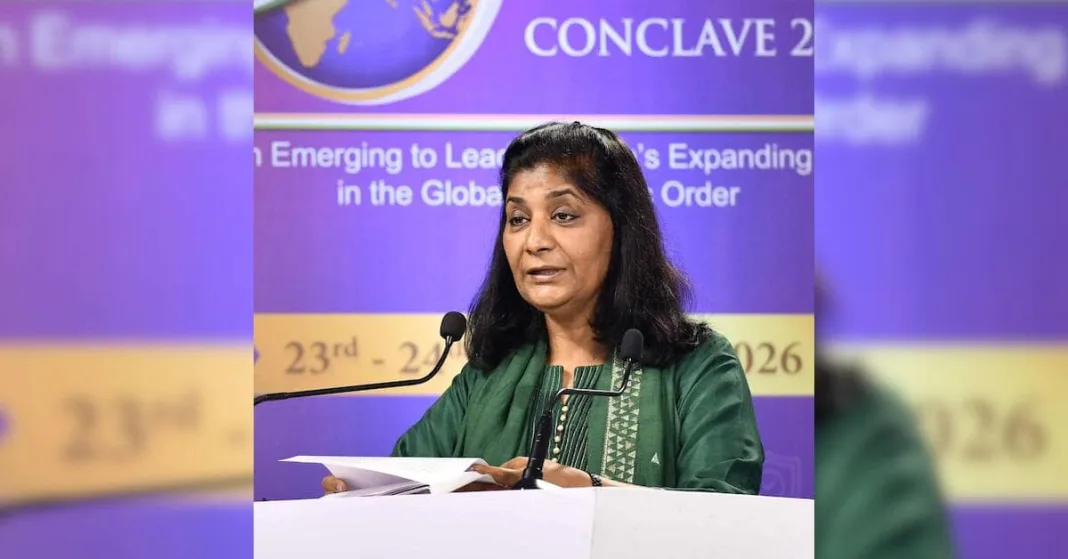

The rupee’s 13 per cent depreciation in the last one year and a half can be seen as a temporary phenomenon and there is a fair case for the Indian currency to not only stabilise but also appreciate from current levels, Reserve Bank of India (RBI) Deputy Governor Poonam Gupta said on Wednesday.
She expects the current account deficit (CAD) to shrink further, helped by stabilisation in oil prices once the West Asia conflict resolves. Gupta also expects the capital account to turn more favourable later this financial year.
“With the RBI remaining committed to ensuring orderly conditions in the foreign exchange market, and having the wherewithal to meet decades worth of CAD, or the net balance of payment (BOP) deficit, the current market dynamics do not appear especially well-founded,” Gupta said at the SBI Banking and Economics Conclave 2026.
On Wednesday, the rupee reversed its five-day gaining streak to close at 95.75 per dollar, down 0.16 per cent from previous close. It has depreciated 0.6 per cent in September.
“If anything, there seems to be a fair case for the rupee to not just stabilise but perhaps even appreciate from the current levels, as was being anticipated by the market analysts when the capital flow measures were first announced,” she said.
The rupee came under pressure after the West Asia war, falling over 4 per cent in March against the dollar. Following several steps in the next few months, its depreciation has been contained to less than 1 per cent between April and now, despite spike in oil prices.
She said the recent oil price and gold price shocks have pushed CAD temporarily higher.
Noting that India has traditionally run a small current account deficit and a larger capital account surplus, resulting in a net positive balance of payment, she said that in the last two years, capital account surplus has fallen short of CAD, resulting in a negative BOP of about $ 5.0 billion in 2024-25 and $ 23.6 billion in 2025-26.
Commenting on the direction of BoP and exchange rate, especially for an economy positioned to grow at 7-8 percent in real terms, and 11-12 percent in nominal terms, she said, “One plausible assessment is as follows: First, the CAD should shrink further in coming years, with the traditional strengths persisting and the new ones emerging, including the growing success in merchandise exports.”
This is because India’s dependence on imported oil is set to decline, through alternative sources of energy and the quest to find its own oil reserves, both of which will further bolster the trend reduction in the demand for oil as percent of GDP. Also, oil prices would stabilize as soon as the [West Asia] conflict resolves, she said.
“Meanwhile, the rest of the trade basket is responding well to the new trade opportunities that are being leveraged, a strength that will continue with the positive impact of recent FTAs materializing, and a conducive exchange rate,” she said.
Second, she said, capital account too should turn more favourable from later this financial year and then remain so.
She cited several factors for this, which include stretched valuations elsewhere, the AI-mania saturating, strong domestic macroeconomic fundamentals, a high real and nominal GDP growth helping improve the earnings guidance. Also, the domestic investment cycle is gathering pace along with healthy balance sheets of banks and corporate houses.
She said India’s inclusion in global bond indices is inevitable which will also attract capital flows.
“The AI story is, in effect, an “unspent force” for us. Just as India has leveraged the potential of digital innovation thus far, it will leverage the potential of AI equally well going forward, while avoiding the risks,” she said.
Further, Gupta said she saw no reason India would not keep growing at 7 per cent or more, pointing to the breadth of the economy. Unlike countries that depend on one or two sectors, India has several doing well at once, serving both domestic and external demand, she said. The same diversity shows up across states, with some specialising in high-tech manufacturing and others still catching up, and every state investing in skills, infrastructure and ease of doing business.
She said that growth would already be at 8 per cent if external conditions were more conducive. A simple regression of India’s growth on global growth shows a positive relationship, she said, but India is currently not getting an “extra kick” from the global economy. That lift would come if conditions improve, she added, noting that artificial intelligence remains an untapped growth driver and that India has not reached saturation, either across regions or sectors.