

The company’s board has also sought a ₹3,508 crore financial incentive under the Ministry of Coal’s newly launched surface coal gasification scheme, sources said.
The financial incentive has been sought as part of the viability gap funding (VGF). According to official sources, the overall progress of the project stood at 72.97 per cent as of August 31, an incremental improvement of 0.21 percentage points.
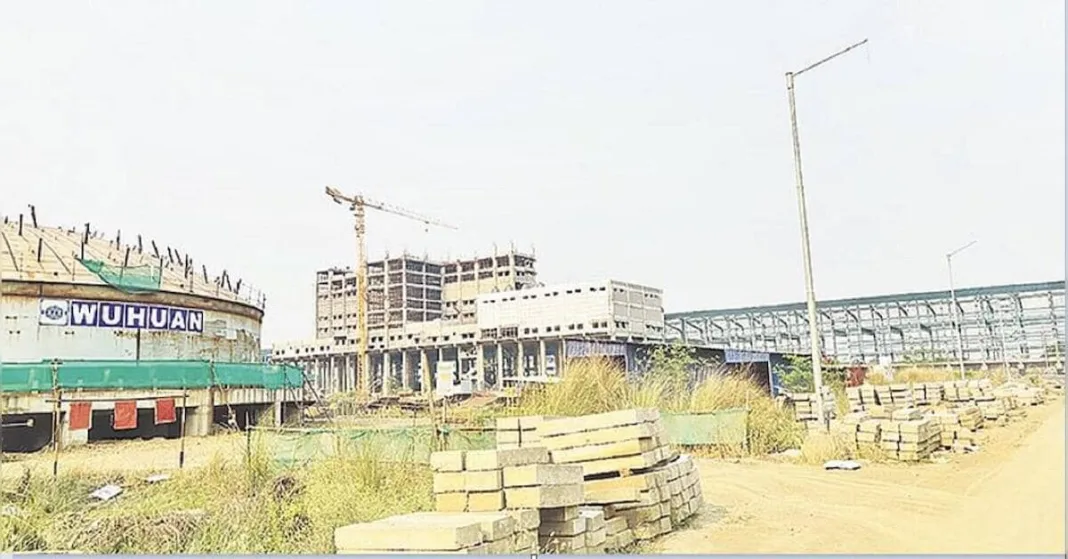
Meanwhile, infrastructure work has also advanced in the past few months, sources said.
Both compartments of the raw water reservoirs are complete, and the intake water pipeline to the reservoirs has been installed. Work has also started to mobilise a 2,000-tonne mega crane, with the final notice issued a few months ago.
Billed as India’s first coal gasification-based urea plant, the nearly ₹19,000 crore TFL project in the Angul district of Odisha has been battling execution delays for years, with the fresh completion target now revised to December 2027 — more than three years after the deadline set when the project was formally approved.
Prime Minister Narendra Modi laid the foundation stone for the revival of the TFL plant on September 22, 2018, and it was originally expected to begin production in October 2024.
The ambitious project is being implemented by TFL, a joint venture (JV) of Gail (India), Coal India (CIL), Rashtriya Chemicals and Fertilizers (RCF), and Fertilizer Corporation of India (FCIL), to revive the Talcher unit. According to the company’s website, Gail, RCF, and CIL each currently hold 31.85 per cent in the JV, while FCIL holds 4.45 per cent.
The TFL facility, which comprises a 2,200-tonne-per-day ammonia plant and a 3,850-tonne-per-day urea plant, along with a coal gasification unit and associated utilities, has been designed to produce about 1.27 million tonnes (mt) of urea annually using domestic coal as feedstock.
The Ministry of Coal currently lists TFL’s coal gasification capacity at about 2.6 million tonnes per annum as part of the country’s coal gasification capacity under implementation. The ministry has argued that coal gasification would provide an alternative to natural gas as feedstock and reduce exposure to imported gas.
The revival initiative dates back to 2013, when FCIL signed a memorandum of understanding with CIL, Gail, and RCF to revive the TFL unit. The proposed project was initially estimated at around ₹8,000 crore and was expected to be commissioned by 2017.
The structure and scope subsequently changed, with TFL being incorporated as the implementing JV and the project eventually taking the form of a new greenfield 1.27 mt urea plant based on coal gasification.
The cost of the project has also risen sharply.
According to TFL’s 2025-26 annual report, the total revised project cost approved for implementation of the coal gasification-based ammonia-urea fertiliser project stood at ₹19,062.22 crore.
The approved project cost is proposed to be financed through a combination of debt of ₹12,250.06 crore and equity contribution of ₹6,812.16 crore.
The turnkey contracts for the coal gasification and ammonia-urea packages of TFL were awarded to China Wuhuan in September 2019.
According to the ministry, procurement, construction, and equipment erection by China Wuhuan were delayed due to the Covid-19 pandemic, ultimately leading to a delay in completion.
Some insiders said the delay in execution, however, was not solely due to the pandemic. TFL and China Wuhuan subsequently went through a prolonged period of problems over project execution, further pushing back completion of the project.
The Ministry of Chemicals and Fertilizers informed Parliament some time ago that TFL was deducting mutually agreed damages from China Wuhuan’s bills under the contract provisions because of slow progress and delays. Meanwhile, regular reviews were held with the contractor and its Chinese engineering team to resolve pending engineering issues.
Perturbed by the delays, the Odisha government has also come forward to expedite the project and achieve the December 2027 commissioning target. According to officials, the Odisha Power Generation Corporation has assured completion of the 220-kilovolt power line connectivity by December this year.
The original FCIL unit was set up in Angul district in 1971 and began production in 1980. It subsequently became financially and technologically unviable and was eventually closed in 2002.