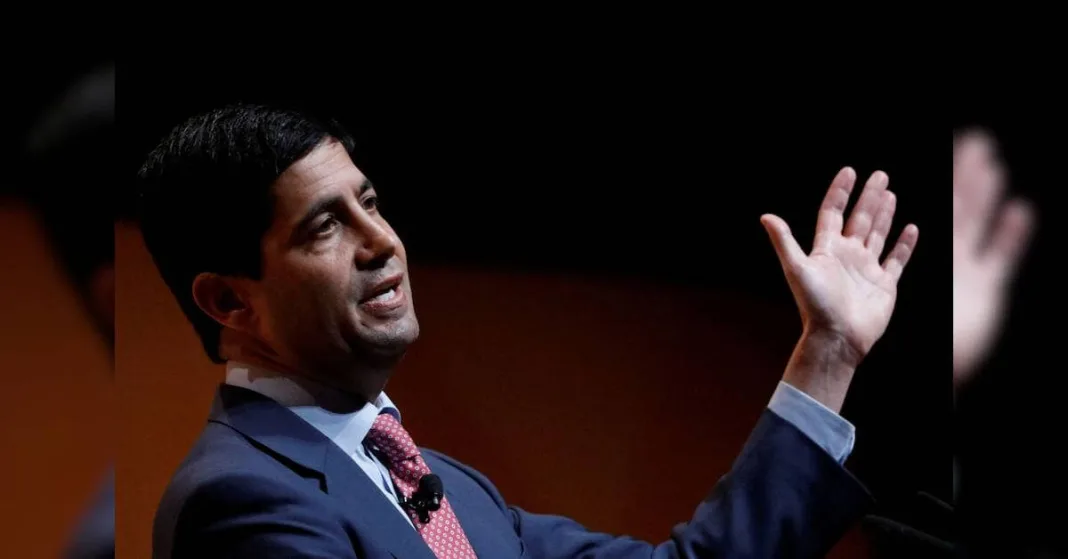

After a span of nearly three years, the needle on interest rate hikes has finally moved in the US as Kevin Warsh delivered his first increase since assuming the role of Fed chief amid persistent inflation worries.
In line with expectations, the Fed raised rates by 25 bps, with policy signalling that this cycle will continue.
Two other elements of the decision tilted the outcome hawkish. First, the vote was unanimous – a signal that bolsters institutional independence and the new Chair’s leadership, said Emkay Global. Secondly, there was broad support for further hikes: the median dots project one more 25 bps hike this year.
Fed’s renewed focus on taming inflation drove front-end US yields and the dollar higher, while US shares retreated by up to 1 per cent. However, most Asian markets, including India, gained. Generally, a US Fed rate hike is considered negative for emerging markets as it raises the risk of foreign outflows.
However, this time around the reaction has been muted, largely as the Fed hike was priced in. The BSE barometer Sensex was trading nearly 0.40 per cent or 285 points higher at 74,620 levels around 12.30 PM following a range-bound move in early trade.
Dr VK Vijaykumar, chief investment strategist at Geojit Investments, said that the market had already discounted this move as there was no other choice for the Fed Chief.
What Fed hike means for Indian markets
Surprised by the market’s muted reaction, G Chokkalingam, founder of Equinomics Research, said he isn’t confident that there will not be further correction. “It is very difficult to sustain the market sideways. Unfortunately, we might see a 2–3 per cent fall in the Nifty in the short term because of the Fed hike and other factors like the weak monsoon, strengthening bond yields and rising inflation,” he added.
For the Fed not to raise rates further, or to maintain the current rate, everything depends on oil prices. Unless the conflict in West Asia subsides and oil prices start correcting, analysts believe there is no resolution to the current trend of rising inflation, interest rates and bond yields.
This means “the Indian market is likely to remain weak”, according to Chokkalingam. He does not expect this situation to extend beyond 3-6 months as valuations remain lucrative.
However, Nachiketa Sawrikar, fund manager at Artha Bharat Global Multiplier Fund, finds stabilisation in longer-term rates constructive for the equity markets.
Currently, yield on the two-year US note fell by 2 basis points to 4.71 per cent after climbing to the highest since 2024 in the prior session following the Fed move. Yields on the 10-year and 30-year bonds both dropped by two basis points, according to a Bloomberg report.
“Sometimes raising short-term interest rates is precisely what is needed to bring long-term interest rates down. A credible commitment from the Federal Reserve to control inflation should help stabilise, and potentially lower, longer-term Treasury yields,” she said, adding that this would allow attention to shift increasingly toward corporate fundamentals and the upcoming earnings season.
Impact on FII flows
The Fed rate hike has further opened the scope for selling by foreign investors, especially as Indian markets reel from the worst FPI outflows in history.
NSDL data shows that ₹2.41 trillion of selloff by FPIs so far this year. In September, they have offloaded shares worth ₹17,222 crore after two months of buying. Vijaykumar believes that this trend is likely to continue.
“Another concern is the news of the US House of Representatives passing a bill to impose 100 per cent tariff on countries like India which import oil from Russia. The geopolitical scene and Trump’s policies are getting murkier,” the expert added.
The rupee weakness adds to FPI pain. In trade today, the domestic unit crossed the 96 per dollar mark after a two-month gap. When rupee weakness continues, foreign institutional investors’ money cannot come into the secondary market because their dollar returns will be dented, explained Chokkalingam.
Disclaimer: Views and outlook shared belong to the respective brokerages/analysts and are not endorsed by Business Standard. Readers’ discretion is advised.