
De-dollarisation was among the key economic themes at the 18th Brics Summit in New Delhi, but the grouping stopped short of backing a common Brics currency.
Instead, Brics grouping encouraged the New Development Bank (NDB) to expand its local-currency financing and strengthen its ability to mobilise resources. The grouping described the NDB as a crucial BRICS institution for promoting sustainable development, reducing inequalities and supporting resilience in emerging economies. The focus puts the spotlight on the institution often described as the “Brics bank”. So, what exactly is the NDB, how does it raise money, and what does it finance?
What is the New Development Bank?
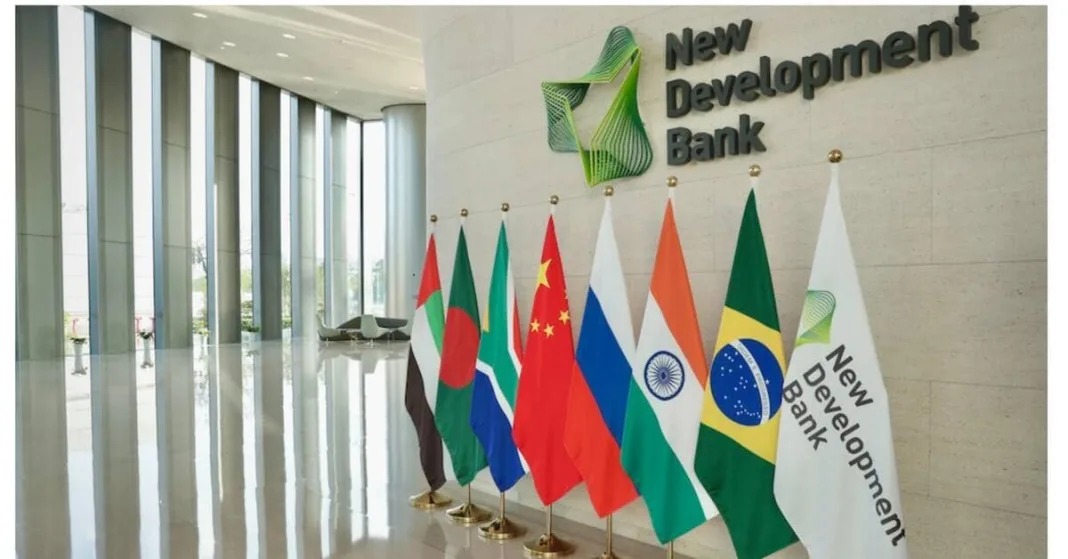
The New Development Bank is a multilateral development bank established in 2015 by the orginial Brics countries: Brazil, Russia, India, China and South Africa. The bank is headquartered in Shanghai and has established an on-the-ground presence in all five founding members.
The NDB was established with an authorised capital of $100 billion. Its mandate is to mobilise resources for infrastructure and sustainable development projects in Brics countries and other emerging-market and developing economies. The NDB is no longer restricted to the original five countries. The bank began expanding its membership in 2021. Bangladesh, the United Arab Emirates (UAE), Egypt, Algeria and Uzbekistan have subsequently joined. Uzbekistan became a member in June 2026. Uruguay, Colombia, Ethiopia, Angola and Zimbabwe are listed as prospective members.
What is the shareholding structure of the NDB?
The NDB was initially structured around equal shareholdings among its five founding members. Brazil, Russia, India, China and South Africa each subscribed $10 billion of the bank’s initial $50 billion subscribed capital.
Following the expansion of membership, the five founding members continue to have equal stakes. According to the NDB’s current shareholding structure, Brazil, Russia, India, China and South Africa each hold 18.72 per cent of the total subscribed capital. Egypt holds 2.24 per cent, Bangladesh 1.76 per cent, Algeria 1.15 per cent, the UAE 1.04 per cent, and Uzbekistan 0.23 per cent. The NDB’s governance structure also provides that no single member has veto power.
How does the NDB raise money?
The NDB raises money through capital provided by its members as well as borrowing in domestic and international capital markets. It issues different types of bonds, including benchmark bonds, thematic bonds and bonds denominated in the currencies of its member countries. This diversification allows the NDB to mobilise resources for its project portfolio while managing its borrowing costs and liquidity needs.
How does the NDB promote local-currency financing?
At the 18th Brics Summit in New Delhi, member countries encouraged the NDB to expand local-currency financing. This is one of the NDB’s key strategic priorities.
The NDB promotes local-currency financing by raising funds directly in domestic capital markets and lending those same national currencies to borrowers, thereby avoiding US dollar conversion. To do this, the NDB registers bond programmes with national regulators in member countries and issues local bonds to domestic institutional investors such as pension funds, insurance companies and commercial banks. It then provides the funds raised in local currency directly to sovereign or sub-sovereign borrowers for infrastructure and sustainable-development projects.
This approach means that the NDB’s funding and lending are in the same domestic currency. As a result, neither the bank nor the borrower faces foreign exchange volatility or currency mismatch risks. Under its general strategy, the NDB aims to increase local-currency financing to 30 per cent of its overall lending portfolio.
How big is the NDB today?
The NDB has expanded substantially since it approved its first projects in 2016. The NDB said in August 2026 that, as of June 30, it had approved 141 projects with cumulative financing of about $44 billion, while disbursements had reached $25 billion.
Its portfolio spans areas including roads and bridges, metro systems, water supply and sanitation, renewable energy, environmental protection, housing and digital infrastructure. The bank’s current project portfolio also includes clean energy and energy efficiency, transport infrastructure, social infrastructure and digital infrastructure.
What has the NDB financed in India?
Since 2016, the NDB has approved $9.5 billion for 32 initiatives across India, covering sectors such as clean energy, transport infrastructure, water and sanitation, and social development.
Its investments span transformative urban transit networks, including the Delhi-Ghaziabad-Meerut Regional Rapid Transit System and metro expansions in Chennai, Mumbai and Indore, as well as crucial water supply projects in Manipur and Himachal Pradesh. The NDB has also supported national highway upgrades, state roads in Bihar and Gujarat, and the $500 million Gujarat Rural Road Programme to build 13,500 kilometres of rural roads.
The bank’s support extends to water and sanitation projects, including integrated sewerage systems and the Lamphelpat Waterbody Rejuvenation Project in Imphal, Manipur. It has also provided support through Piramal Finance for housing loans to economically weaker sections and through Shriram Finance for low-carbon commercial vehicles.
What does the NDB’s next phase look like?
The NDB is now moving into what it describes as its second golden decade, with local-currency financing expected to remain a major part of this expansion. In August 2026, the NDB said it was advancing its first onshore Indian rupee-denominated “Maharaja Bond”, with support from the Indian government and the Reserve Bank of India (RBI). The proposed bond is intended to strengthen the bank’s local-currency financing operations in India.