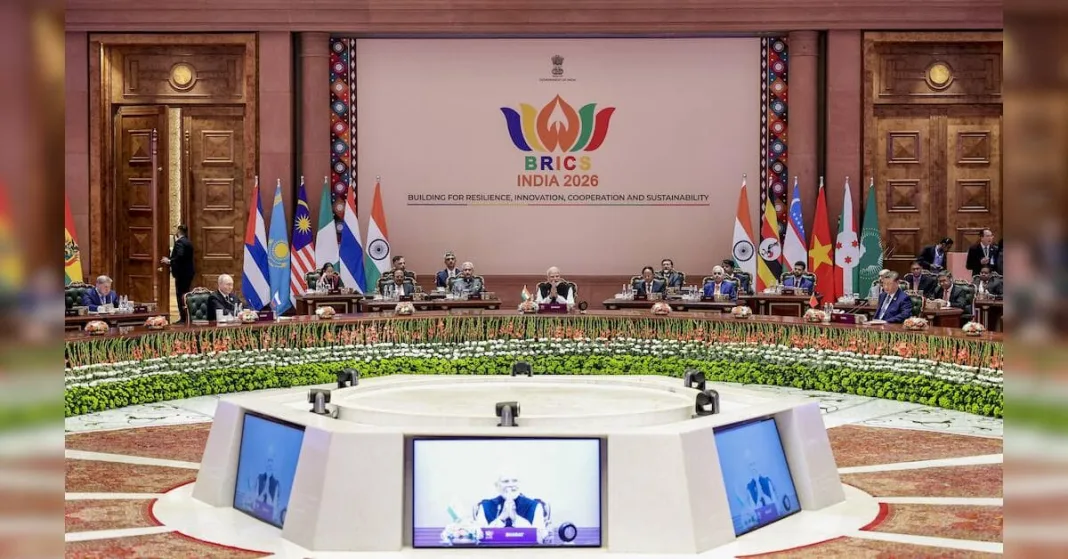

Brics countries on Saturday backed the safe, ethical, and human-centred use of emerging technologies, including artificial intelligence, in education, alongside greater cooperation on mutual recognition of qualifications as well as academic and professional mobility.
The commitments were outlined in the New Delhi Declaration adopted at the Brics Summit 2026 being held in Delhi on September 12 and 13. The grouping supported continued cooperation through existing education mechanisms, including the Brics Network University, and called for stronger institutional partnerships among Brics countries.
The Declaration also called for greater sharing of best practices in education, including cooperation in early childhood care and education (ECCE), and foundational literacy and numeracy (FLN). It backed mutual recognition of qualifications, academic and professional mobility, and digital literacy, alongside the use of emerging technologies, including AI, in education.
On higher education, Brics countries called for collaborative efforts to improve institutional governance and enhance the quality and accessibility of education. The Declaration also supported exchange and scholarship programmes at undergraduate and postgraduate levels, including in science, technology, engineering, and mathematics (Stem).
The grouping also backed stronger institutional partnerships and innovation and knowledge exchange to equip learners and institutions to address future opportunities and challenges. It said stronger links between technical and vocational education and training (TVET) institutions and industry could foster innovation and expand job opportunities.
On traditional and indigenous knowledge, the declaration noted India’s initiative on guiding principles for strengthening academic collaboration in traditional and indigenous knowledge systems. It encouraged the Brics Network University to consider including traditional, indigenous and local knowledge systems as an additional International Thematic Group, subject to its existing governance procedures and the national laws and policies of Brics countries.
The Brics Network University was established in 2015 as a consortium of higher-education institutions from Brics countries to promote joint research, academic mobility and educational programmes in common areas of interest.
It currently has 178 participating universities across 11 thematic groups, including IIT Bombay, IIT Kanpur, Banaras Hindu University, Moscow State University, Beijing Normal University, University of Cape Town and Federal University of Minas Gerais.
The declaration also called for continued organisation of the Brics Rectors’ Forum and discussions on a Brics Education Olympiad. It further supported exploring the development of a Brics University Global Ranking and Evaluation System.
The declaration separately highlighted cooperation among Brics youth in education, training and skills, youth entrepreneurship, science, technology and innovation, social and cultural participation, youth exchanges and inclusion. It also welcomed progress on the Brics Youth Cooperation Framework.