
POLICY AT A GLANCE
| Item | Position |
| Official title | Uttar Pradesh Green Hydrogen Policy, 2024 |
| Policy date | March 5, 2024 |
| Administrative department | Department of Additional Sources of Energy, Uttar Pradesh |
| Nodal agency | Uttar Pradesh New and Renewable Energy Development Agency |
| Policy validity | Five years |
| Production target | 1 million metric tonnes of green hydrogen and green ammonia capacity annually by 2028 |
| Employment projection | About 1.2 lakh jobs by 2028 |
| Principal beneficiaries | Green hydrogen and green ammonia producers, renewable-energy developers, hydrogen-based product manufacturers, storage and distribution projects, research institutions and eligible ancillary units |
| Major incentives | Capital subsidy, concessional government land, stamp-duty exemption, electricity-duty relief and transmission-related concessions |
| Research objective | Establishment of four Centres of Excellence |
| Current implementation status | Policy notified and implementation activity initiated; official project-level commissioning and disbursement data remain limited |
The production and employment figures are targets and government projections. They do not represent capacity already commissioned or jobs already created under the policy.
What is the Uttar Pradesh Green Hydrogen Policy?
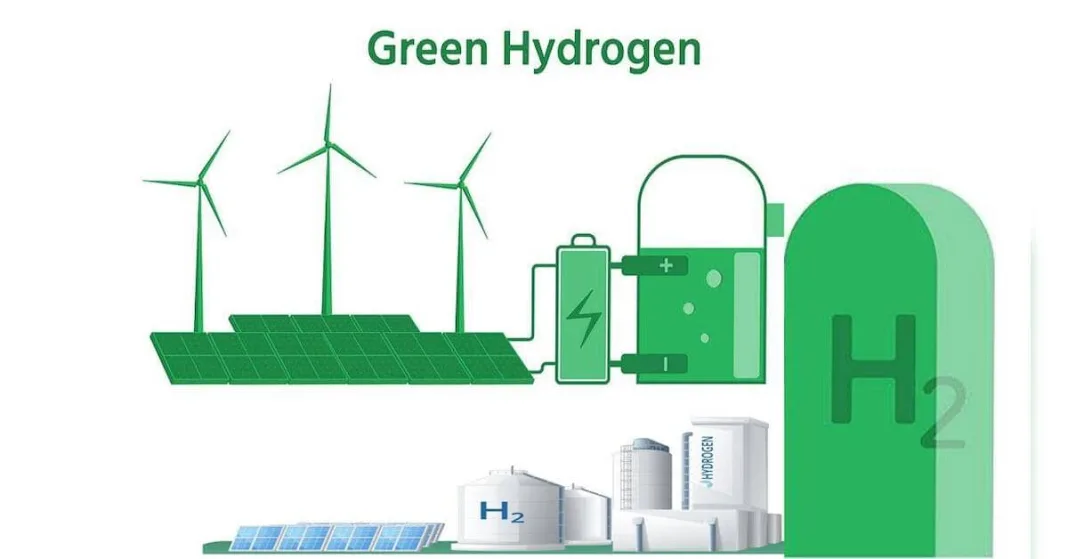
The policy is a state framework for promoting the production, storage, transport and use of green hydrogen and green ammonia.
The policy covers more than hydrogen-production plants. It is intended to support an ecosystem including:
- Renewable-energy projects supplying hydrogen units;
- Electrolysers and related equipment;
- Green ammonia production;
- Hydrogen storage and transportation;
- Hydrogen pipelines and distribution infrastructure;
- Hydrogen-based industrial products;
- Research, development and testing facilities;
- Skill-development and innovation programmes.
The policy operates alongside the National Green Hydrogen Mission and the Green Hydrogen Standard issued by the Ministry of New and Renewable Energy.
Why was the policy introduced?
Hydrogen is already used in industries such as fertilisers, refining and chemicals, but much of it is conventionally produced from fossil fuels. Green hydrogen offers a possible route for reducing emissions in sectors that are difficult to electrify directly.
Uttar Pradesh also has a large renewable-energy, sugar, agricultural and industrial base. The policy seeks to combine renewable power with demand from fertiliser, refining, transport, manufacturing and other industries.
Its principal rationale includes:
- Reducing dependence on fossil-fuel-based hydrogen;
- Supporting industrial decarbonisation;
- Encouraging investment in renewable energy;
- Developing domestic hydrogen-production capacity;
- Creating demand for equipment, storage and transport infrastructure;
- Supporting research and technical skills;
- Positioning the state within the National Green Hydrogen Mission.
The policy’s anticipated environmental and economic benefits remain dependent on actual project development, renewable-power availability and commercial demand.
What are the main objectives?
The policy seeks to:
- Develop annual green hydrogen and green ammonia capacity of 1 million metric tonnes by 2028;
- Promote consumption of green hydrogen in line with the Union government’s mission;
- Encourage green hydrogen and ammonia production projects;
- Support hydrogen-based manufacturing and industrial applications;
- Establish four Centres of Excellence for research, development and innovation;
- Develop storage, transport and distribution infrastructure;
- Promote renewable-energy projects linked to hydrogen production;
- Encourage employment and specialised skill development;
- Facilitate private investment through financial and administrative incentives.
The government projected that the framework could support around 1.2 lakh jobs by 2028. This is an expectation associated with the policy, not a verified employment outcome.
Who is eligible?
The policy may cover eligible projects involving:
- Production of green hydrogen;
- Production of green ammonia;
- Manufacturing of products based on green hydrogen;
- Renewable-energy generation for hydrogen production;
- Electrolyser and hydrogen-equipment manufacturing;
- Hydrogen storage and transportation;
- Research, development and innovation;
- Common infrastructure connected with approved hydrogen projects.
Eligibility depends on the project’s technology, investment, production route, renewable-energy source and compliance with the Union government’s definition of green hydrogen.
A company describing its product as low-carbon or renewable does not automatically qualify. The hydrogen produced must meet the applicable national standard, including the prescribed emissions threshold and verification requirements.
The exact minimum investment, production capacity and commercial-operation requirements vary by project category and should be verified through the policy document, implementation procedure and approval letter.
What financial incentives are available?
Capital subsidy
The official Invest UP policy summary states that eligible projects may receive a capital subsidy of up to 30 per cent.
The first five qualifying projects may receive an enhanced capital subsidy of up to 40 per cent, subject to the applicable project category, eligible investment, maximum ceiling and approval conditions.
The rate should not be applied mechanically to total project cost. The subsidy calculation depends on the definition of eligible capital investment, which may exclude items such as working capital, certain land costs, taxes, second-hand machinery or expenditure incurred outside the eligible period.
The official summary retrieved for this review did not provide sufficient detail to reproduce every category-specific ceiling reliably. Applicants should obtain a formal calculation from the nodal agency before incorporating the subsidy into project financing.
Concessional government land
Government or revenue land may be made available to eligible projects on lease at Re 1 per acre per year, subject to availability, project approval and the applicable land-allotment conditions.
This provision does not guarantee land for every applicant. The project must satisfy the policy conditions, and the responsible authority must determine whether suitable government land is available.
The developer may remain responsible for:
- Site development;
- Access roads;
- Water supply;
- power evacuation;
- environmental approvals;
- lease conditions;
- construction deadlines;
- restoration or transfer obligations.
Stamp-duty exemption
Eligible projects may receive a 100 per cent exemption from stamp duty, subject to the approved transaction and operative government order.
Applicants should secure the required eligibility or exemption certificate before executing a land or lease document. A general policy provision should not be treated as an automatic waiver without approval from the competent authority.
Electricity-duty exemption
The policy provides a 100 per cent exemption from electricity duty for the first ten years or for the policy-specified eligible period, depending on the project and electricity arrangement.
Electricity-duty exemption does not mean that electricity is supplied free of charge. The project must continue to pay the applicable energy tariff, demand charges and other charges not expressly exempted.
Transmission and wheeling concessions
The policy provides full exemption from specified intra-state transmission, wheeling and cross-subsidy charges for renewable power procured for eligible green hydrogen production.
Interstate transmission treatment remains governed substantially by Union government rules and orders. The state cannot independently guarantee an exemption from charges administered under a central framework.
The actual benefit depends on:
- Whether renewable energy is generated within or outside Uttar Pradesh;
- Whether the plant is captive or connected through open access;
- The applicable transmission network;
- Banking and scheduling rules;
- The commercial-operation date;
- Orders issued by the electricity regulator and relevant utilities.
Land for captive renewable-energy plants
The policy allows land facilitation for captive solar or other renewable-energy projects linked to approved green hydrogen units.
The renewable-energy project must separately comply with grid-connectivity, land-use, environmental and power-sector regulations.
What research and innovation support is available?
The policy proposes the establishment of four Centres of Excellence to support:
- Hydrogen-production technology;
- Electrolyser development;
- Storage and transport;
- Industrial applications;
- Safety and testing;
- Skills and training;
- Commercialisation of research.
In January 2026, the Uttar Pradesh government and Japan’s Yamanashi prefectural government announced cooperation to establish two Centres of Excellence under the policy. The official announcement described the centres as research and innovation initiatives; it did not establish that both were already fully operational.
The state has also issued government orders relating to financial approval for green hydrogen projects and research, development and innovation activity. The exact grant amount and beneficiary conditions should be taken from the relevant annual sanction and project order.
How can an applicant access the benefits?
The Uttar Pradesh New and Renewable Energy Development Agency is the principal state agency associated with the policy.
The broad process is expected to include:
- Submission of a detailed project proposal;
- Verification of the hydrogen-production route and renewable-energy source;
- Assessment of investment, capacity, land, water and power requirements;
- Confirmation of compliance with the national green hydrogen standard;
- Appraisal of the proposed incentive package;
- Approval by the competent state authority;
- Issue of an eligibility approval or Letter of Comfort;
- Completion of land, power and environmental approvals;
- Construction and commencement of commercial production;
- Submission of incentive claims with audited expenditure and operating evidence.
The official documents reviewed do not provide a single simplified application procedure applicable to every project category. Green hydrogen production, renewable-energy generation, electricity open access, land allotment and research grants may require separate applications.
Implementation and progress so far
At the time of approval, official government material referred to 19 potential green hydrogen projects and projected about 1.2 lakh jobs. These were described as projects in the pipeline or expected investments and should not be treated as operational projects.
Subsequent official initiatives include:
- Publication of the policy by the Uttar Pradesh New and Renewable Energy Development Agency;
- Government orders relating to implementation and financial approvals;
- Cooperation with Yamanashi for proposed Centres of Excellence;
- Research and institutional initiatives involving state and national organisations.
However, consolidated official data were not identified on:
- Projects formally approved;
- Capital subsidy sanctioned;
- Land allotted;
- Financial closure achieved;
- Electrolyser capacity installed;
- Green hydrogen production commissioned;
- Annual production achieved;
- Incentives disbursed;
- Employment generated specifically under the policy.
The 1 million metric tonne target should therefore continue to be described as a target for 2028.
How does the policy support Uttar Pradesh’s wider economic strategy?
The policy links renewable energy with industrial development. Green hydrogen could support fertilisers, chemicals, refining, heavy transport and other sectors where direct electrification may be difficult.
It also complements the state’s solar-energy, bioenergy, industrial-investment and manufacturing policies. Hydrogen projects may create demand for renewable power, electrolysers, storage tanks, control systems, engineering services and specialised skills.
However, eligibility under the Green Hydrogen Policy does not automatically confer benefits under another state policy. Duplicate assistance for the same expenditure must be avoided unless expressly permitted.
Key challenges and limitations
- High production cost: Green hydrogen remains dependent on the cost of renewable power, electrolysers, financing and water treatment.
- Water requirements: Electrolysis requires purified water, making source availability and local water impact important project considerations.
- Infrastructure gaps: Pipelines, storage, transport and refuelling systems are at an early stage of development.
- Demand uncertainty: Producers may require long-term purchase commitments from fertiliser, refining, transport or industrial users.
- Safety and regulation: Hydrogen requires specialised handling, storage, fire-safety and technical standards.
- Limited implementation disclosure: Official project-level data on approvals, commissioning and subsidy disbursement remain incomplete.
What businesses should keep in mind
A prospective applicant should verify:
- Whether the project meets the national green hydrogen standard;
- The correct project category;
- Eligible capital investment;
- The applicable subsidy rate and ceiling;
- Whether the project falls among the first five qualifying units;
- Land availability and lease conditions;
- Renewable-power sourcing;
- Transmission, wheeling and open-access charges;
- Water availability;
- Environmental and safety approvals;
- Commercial-production deadlines;
- Restrictions on overlapping incentives.
Eligibility and benefits remain subject to the notified policy, subsequent government orders, electricity regulations, implementation procedures and approval by the competent authority.
FAQs
What is the main target of the policy?
It aims to develop annual green hydrogen and green ammonia production capacity of 1 million metric tonnes by 2028.
What capital subsidy is available?
Eligible projects may receive up to 30 per cent capital subsidy. The first five qualifying projects may receive up to 40 per cent, subject to policy ceilings and approval.
Is government land available?
Eligible projects may be considered for government or revenue land on lease at Re 1 per acre per year, subject to availability and approval.
Is electricity free for green hydrogen projects?
No. The policy provides electricity-duty and specified transmission-related concessions, not free electricity.
Which agency implements the policy?
The Uttar Pradesh New and Renewable Energy Development Agency is the principal state agency associated with implementation.
Does the policy cover green ammonia?
Yes. It covers green hydrogen, green ammonia and eligible hydrogen-based products and infrastructure.
Are the targeted 1.2 lakh jobs already created?
No. The figure is a government employment projection associated with the policy.
Conclusion
The Uttar Pradesh Green Hydrogen Policy, 2024 seeks to establish a state-level hydrogen ecosystem through capital support, concessional land, duty exemptions, power-related concessions and research infrastructure.
Its 1 million metric tonne production target is substantial, but implementation depends on renewable-energy availability, project financing, long-term demand, water access and safe storage and transport. The most important indicators to monitor are projects formally approved, capacity commissioned, hydrogen actually produced, subsidies disbursed and employment generated.
Sources
- Uttar Pradesh Green Hydrogen Policy, 2024, Department of Additional Sources of Energy, Government of Uttar Pradesh; dated March 5, 2024.
- Uttar Pradesh Green Hydrogen Policy, 2024 — policy and incentive summary, Invest UP, Government of Uttar Pradesh.
- Green Hydrogen Policy, 2024, Uttar Pradesh New and Renewable Energy Development Agency, Government of Uttar Pradesh.
- National Green Hydrogen Mission, Ministry of New and Renewable Energy, Government of India.
- Green Hydrogen Standard for India, Ministry of New and Renewable Energy, Government of India; August 18, 2023.
- Government orders relating to Green Hydrogen Policy implementation and research funding, Uttar Pradesh New and Renewable Energy Development Agency.
- Uttar Pradesh–Yamanashi cooperation on Centres of Excellence, Invest UP, Government of Uttar Pradesh; official release issued in February 2026.